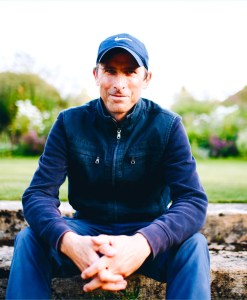
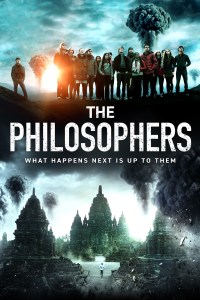
 John Huddles’ movie The Philosophers has been released on digital platforms this week. It’s a thought-provoking film that explores emotion versus reason and follows a controversial philosophy teacher at an international school who sets a final thought experiment for his class before they graduate. They are then pushed to their limits to determine which of them should be saved in the event of an atomic apocalypse and will be vaporised. Paul Simpson chatted with Huddles about both the themes and the challenges of making the movie…
It’s nearly a decade since you made The Philosophers?
I know. It’s insane, yes exactly.
It says in the press notes that this is a director’s cut; how much is it different from what was originally released?
It’s not significantly different, with the exception of one major element which is the title, the identity of the movie. In the English speaking territories of the world there was concern on the part of executives that the word “philosopher” or anything to do with philosophy would be off-putting to kids, which was tragic. Not tragic compared to life in the Sudan, but tragic in the world of independent filmmaking for me personally because the whole point of the exercise was to try to connect with kids without speaking down to them. That’s what the story is about. And at the very last minute snatching defeat from the jaws of reason.
The executives were terrified and switched it to After The Dark. So long story short, it was released as After The Dark in the US, Australia and the UK; everywhere else in the world as The Philosophers (sometimes in translation obviously). No one ever had a problem with it and the president of the distribution company had to try to make amends but there was nothing he could do at that point. So with the re-release on digital, starting in the UK and I guess expanding elsewhere, the new distribution company was really wholeheartedly endorsing what the film was meant to be and so it may seem just cosmetic to others but it’s very meaningful to me.
I think also, it gives different expectations. After The Dark feels like the title of a CW show, you expect to see bronzed Californians or David Boreanaz reprising his role as Angel which is not what this movie is.
 Who are The Philosophers of the title to your mind? Are they the kids? No, let’s call them students. Are they the students? Are they the ideas that they are debating effectively, in practice?
You put your finger on it, you said it exactly. For me, it’s the kids – and by the way that’s how I think of them too. The kids are The Philosophers. The kids are living up to their potential as human beings without being forced to dumb down their feelings, their beliefs, their reactions, their processes. That’s what I envisioned.
I envision philosophy as a tool as powerful as a physical weapon and in this particular story, without weapons on the part of the kids mostly, the tools they had at their disposal were ideas and their ability to articulate those ideas. A dialectic where one idea and another idea clash and then synthesize to something new, that was the aspiration, narratively.
We all know movies are made three times – in the script, in the shooting, and in the edit. With this one, did you end up in discussions with the actors playing the kids and did the movie alter as a result of that, or were they very much there as actors playing the roles of the kids?
 It was the latter and maybe that’s because the mechanics of the narrative are so specific and tightly organised. I’m not saying that as a qualitative term, just with respect to the structure for good or for ill. I think they could see there was never going to be a lot of room for negotiation on how it needed to unfold without pulling out a domino piece that would make the whole thing come undone, even with respect to who was in the bunker in the various scenarios.
I had a spreadsheet that almost drove me crazy to make sure of that. By the way note to self: think twice before writing another movie with twenty-one main characters who are essentially in every scene. It wasn’t high order math but it was still complicated arithmetic and so I think they could tell that there wasn’t [room to change]. Sure, there were occasionally some questions asked but I don’t think with the expectation of really changing the trajectory of story or character, more just to understand.
OK, let’s take that back a step to when you were writing it. Did you sit there arguing with yourself or how did you work out the arguments for and against?
 I think that’s a great question. For some reason I would like to say that I did sit there arguing both sides but the truthful answer is that I think I had a very internal position as to what would be [the outcome]. I’ll use this word again: I aspired to want to feel a certain way about the value of X over Y or A over B and so I tried to craft a character in the person of the leading girl Petra who would represent those positions which are more humanistic than mechanistic, which supersedes the logical with the emotional. So there wasn’t the kind of philosophising hardcore with myself.
The corollary of that then is, if you’re having to create a credible position for the person who’s arguing the other side, did you have issues getting yourself into that mindset?
It’s another great question and it is exactly, you’re right, the corollary. I don’t think I had trouble because I enjoy exploring mentally both sides of the issue. I didn’t have trouble knowing where I would end up but the implication that you make, I think, is that it’s important to authentically argue or at least explore both sides and I certainly tried to do that.
The thing about this is, there’s a degree of Socratic debate about it. If you put Einstein on one side of a debate and – let’s use a divisive person – Trump on the other, you’re not necessarily going to get the quality of debate from it, whereas if you have Einstein arguing against, again, I’ll use a deliberately explosive figure, Hitler, who made his own arguments in Mein Kampf and believed in his own arguments, then you’ve got a debate there where two people are arguing in the proper sense of the word.
 I think that’s a great point and of course it’s important to take seriously the process of dialectic in these debates. For me what’s interesting to think about with respect to these characters is the context in which they exist. So what happened before the story starts is that they’re mostly smart, motivated kids who like the ideas of the mind. My strong position is that almost all kids do and are never given credit for this, and so we enter the story with a bunch of kids who are used to this kind of authentic and serious, not necessarily always heavy but seriously intentioned debate.
Obviously that’s the story’s point of departure and it’s also a lot of the story’s arc; however it bumps up against the other side of human nature by the end, which is equally serious but not relying on Socratic methodology or reason to win the day. It’s not emotion in the worst sense of emotion, it’s emotion in the best sense of emotion as the counter methodology.
So the story goes in that direction and we have a conclusion largely based on where those two methodologies hit each other. It doesn’t then go on to explore the consequences of the one methodology in life vs. the other but I think we see, and per your really great examples of Einstein versus Trump or Einstein versus Hitler or you could also add to that Einstein versus Mahatma Gandhi, logic has its place but it’s not necessarily the ultimate virtue.
Would you put the teacher on the right side of the human ledger?
 My God, that’s such a good question…
I think that it’s easy to see him as… the villain is the wrong word, antagonist is certainly the right word.
I think I see him edging toward the right side, the good side, the correct side of the ledger. I think his intentions are good but I think he’s doing two things: he’s embodying both the rational and of course we then find out it was, at the very least, tinged with the emotional. I think he’s caught in that space between knowing and yearning, right? Understanding and feeling. He’s in a kind of nether region but I wouldn’t write him off, personally, as a bad guy. I think I like him.
He’s a catalyst to an extent. The interesting part is how they react to the circumstances.
Moving away from the philosophical side of The Philosophers to the more practical, was keeping an eye on where everybody was the biggest challenge you faced making it? Or were there other major challenges?
Really the major challenges were the physical ones because we shot entirely in Indonesia and it was an amazing, fantastic experience, one of the best ones of my life. Being in Indonesia posed really significant physical challenges. We shot all over the place.
Jakarta’s amazing but it’s chaotic. Our studio, as the crow flies, was fifteen minutes from our hotel but it was quite literally a two hour trip, each way. That had upsides too – it just so happened that the woodworkers who were building the interior sets lived right near to where the studio was, so we got extra time with them and that really paid off in production value. That beautiful classroom is a set that didn’t exist before or after.
We really were on a tropical island, called Belitung, off the coast of Sumatra, in the blazing heat with nothing on the island, just a bathroom boat, fifteen minutes out to sea. That was hard and we really were on the volcanic plane of Mount Bromo, which looked spectacular, felt spectacular but subjected us to sand storms, which knocked over everything and shut us down.
And there was an active volcano 100 yards away! When I asked one of our guides ‘When did it last erupt?’ I think it was only six months prior so I asked how long we would have if it started to erupt again, for our evacuation, and with no sarcasm in his voice he said, ‘Oh no, we die’. With the sandstorms and the cold, it was freezing there.
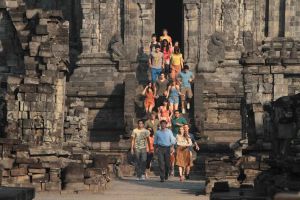
 Then thirdly those beautiful 9th century Hindu temples at Prambanan, just amazing but again boiling heat, well over 100 degrees Fahrenheit. It was a UNESCO World Heritage site. No one had ever been allowed to film there before, we were so lucky to be able to persuade them but there was a lot of wrangling. You get five minutes with this much weight on that portion of the pavilion and then get out and shift to somewhere else.
I would say the physicality, for an independent film with not even close to anything like what a studio production would have at its disposal in terms of resources, that was very challenging.
I want to quickly append – because I sounded like that might have been a complaint and it wasn’t – we were very fortunate to have the support of the Indonesian President and his cabinet. They made a lot of these things possible for us. Indonesians were just so generous and wonderful.
The flipside is that if you were a studio shoot there’s no way that they would have let you with 100 people, 400 runners and who knows what else anywhere near those things.
You’re right.
 It sounds like there’s a degree of guerrilla filmmaking in it.
Yes, it was a hybrid but it’s good to point that out. There was a lot of guerrilla in the mix.
So, what are you up to currently?
I have three films teed up, one was meant to go last June in Mauritius but like everybody else I got shut down. And navigating development pathology and finance is painful, I’m hoping to be behind the camera before the end of the year.
The Philosophers is out now on digital platforms




 Sci-Fi Bulletin: Exploring the Universes of SF, Fantasy, Horror and Spy-fi!