The Banishing: Interview: Christopher Smith
Christopher Smith’s latest movie The Banishing is out now from Vertigo, and chronicles events when a new vicar arrives in a rectory with his wife and her daughter. The house […]



Christopher Smith’s latest movie The Banishing is out now from Vertigo, and chronicles events when a new vicar arrives in a rectory with his wife and her daughter. The house […]
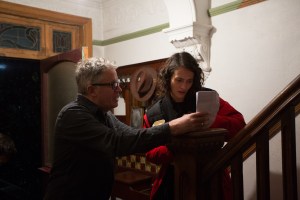 Christopher Smith’s latest movie The Banishing is out now from Vertigo, and chronicles events when a new vicar arrives in a rectory with his wife and her daughter. The house holds secrets – and shortly before release, Smith talked about the challenges involved with bringing the story to life.
Obviously The Banishing is based on the events at Borley Rectory, and there are hundreds of takes on that. What did you know about it before you got involved with this?
Well, someone said to me, “Oh it’s based on a true story” and I was like, “What?”
 When I looked into it I immediately went, “OK, I want to slightly pull away from making it exactly about that” only because I felt as though you find yourself falling into a trap creatively where the characters are real, of course, but the idea that something happened, to me, is not real. It may have happened to the people that were going through it in their psychology, in their brains, in their heads, but I’m very much a believer that ghosts are buried away within you and that houses can have a profound effect on you, and on a family for whatever reason. Chances are that’s the reason for what they’ve been through or what they are going through.
We’ve all heard as a kid, a tapping downstairs. My son said to me, ‘Daddy are you not scared when you go downstairs?’ and I said ‘No, not really’. If you’re on your own in a house and you think, “Christ, there might be some trouble, there might be someone breaking in” but you’re not thinking it’s a ghost (laughs) I’m not anyway. And I wouldn’t be, I would be trying to find who it was.
But then again you could find yourself in a house where there’s noises and it sends you into a massive spiral – it is haunted to you and you’re haunted already.
I guess I’m touching on all those things, those things interest me more I think.
There’s an element of that very much in the novel of The Shining…
Definitely yes.
The Overlook is a character in the same way that the Rectory is in this.
Yes. It definitely comes through that it’s either the house or it’s [Jack Torrance], it’s both. That’s definitely there.
That film had a huge effect on me, because when you first watch The Shining when you’re young it doesn’t scare you in quite the way it does as you get older. In a way you understand it’s about losing it, it’s about the walls closing in. Certainly if you write, like we do, you know those lonely moments of “God, I can’t do this anymore…” loathing.
What stage was the script for The Banishing at when you became involved?
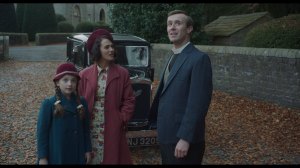 It was fully ready to go but very much as a Borley Rectory story. I said to the writers, “I want to push more some of the themes” I’ve just said to you. “I want to blur the distinction between them as characters, bring in this stuff with their own past vs the haunted house and also I want to make more of the themes of the period. Touch on the idea of things that can’t be spoken that can destroy, jealousy, and these little cancers that can happen in a relationship.”
It would be a massive scandal for a vicar to have a wife with a child out of wedlock, much more so than we make it in the film. There would be an absolute scandal but that wasn’t there.
I was pushing and leaning into those things. Does he hate his wife? Is he impotent? Is he scared of her sexually? Is he jealous of her? Is he gay? There are all these things that could easily be swept under the rug in that period.
I felt that all those things resonate now and I was leaning into them a bit.
The way you’re describing it, it’s a degree of loathing. Whether it’s self loathing or it’s a loathing of society or whatever.
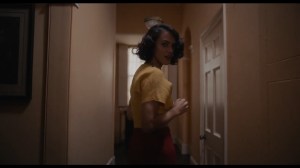 Yes. Adding to the fact that he’s boxing well above his weight with the absolutely beautiful Jessica Brown Findlay. I said to him at the time, ‘You’ve suffered taking this woman with a child who just happens to be drop dead beautiful… only in the movies.’
But you don’t really play on that aspect.
Not at all no.
It’s almost the idea of her that he’s more frightened of. I‘m thinking of that first scene in the bedroom.
Yes.
She’s basically saying ‘I want a shag’ and he’s going ‘Oh well, um maybe next week… third day after never’…
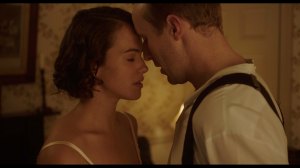 (Laughs) [John Heffernan] said to me in that scene ‘Why don’t I want to have sex with her?’ Jess is a mate – I’ve known her for a few years – and I just went ‘I don’t know?’ so she came and punched me (laughs).
He’s scared of her but the idea is that that big old house starts to push and get into the cracks, and so the things that are happening to her, it’s her distraction of the house, the fact that she’s alienated. It’s all these themes that are in the break up of a relationship. So the house is playing into that as well.
If there is a haunted house movie that’s my favourite it would be The Shining but I don’t see The Shining as a haunted house movie. A haunted house movie is Shutter Island for me. It’s a wormhole that you’re going in, of your own making if you like.
What was the biggest challenge for you in directing this?
 Without a shadow of a doubt, it was a smaller budget than I’d ever worked with. We had the money to make this the way we wanted to make it but for a set price, and I’d come off the back of doing some big TV like Alex Rider where it was like ‘Get the Steadicam out!’ Suddenly I had to choose Steadicam days and all that sort of stuff and I didn’t find that easy.
I think that that was probably the hardest part of it. We embarked on a style of using wide angle lenses and wanting to very much get into the head [of the characters]. Jess and Sean [Harris] especially are phenomenal and certainly Jess, you really do get into her head and you do start to buy into the chaos of what’s going on in her mind. Realising we had to not give up that elegance but knowing the schedule was a challenge.
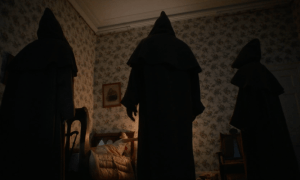 The schedules are always the hardest thing. You hear young kids – and I used to be one of them – going, ‘That film’s no good, I much prefer The Shining’. The Shining was a 300 day shoot, this was a 25 day shoot. That was an unlimited budget; they built cameras for that film and fortunately the director of that film is the greatest filmmaker in the world and that will ever live as well. One thing he did have an advantage on and he did deserve it: he had the time. It’s not an excuse. I actually like sometimes that you have this time issue.
It’s changed my filmmaking and TV generally is because in TV you want to put some style into it. You don’t want to shoot every single angle because if you shoot every single angle you become much less specific with the camera and then it ends up on everyone’s faces. I came to TV very much deliberately trying to make it more filmic and I think what low budget films have taught me is to be very specific with the camera. Shoot less but shoot right – I think it makes things more interesting when you do that.
When you do that though, do you sometimes find problems in the edit room that you might not have the coverage? Or do you know what you’re going to need?
I know what I need. A producer might want to see something else. You need something to cut to, so maybe you need three shots.
If you think about the opening of The Godfather it slowly creeps in onto Marlon Brando. That’s the scene and then there’s one cut to the two sons when Duvall lets him out of the room. They had seven people in that room and it didn’t cut to them.
You’ve just got to make choices and that’s where I feel like I’ve moved on in a way: I’m just bolder with the camera.
It sounds like that’s making much more of a subjective thing. If you’ve got basically wide shots and reverses, it becomes very objective.
It does yes.
You have an incredible performance out of young Anya Mckenna-Bruce as Adelaide.
Oh yes.
Where did you find her?
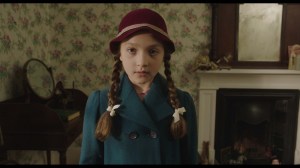 She just came in for an audition. It was funny; she was the first girl in. I went up to her Mum and Dad afterwards and said ‘Oh yes, she’s brilliant’.
She was 95% there: I could just say ‘Do it a bit slower when you wave’ and she’d say OK and then ‘Be a bit weirder with your head’ and she’d say ‘OK brilliant’. It was easy and we’d give it all to her, she was great.
She’s in some quite frightening scenes, was a lot of that not there when she was on set?
No, it was all there for her; she loves it. Her Mum was there but yes, some of the stuff, like a scene where all the tortures going on, she’s not there. We finished shooting that when she’d gone but she’s there with the woman with the eyes, the woman with the bandages, she’s in the scene with her but of course she’s been in the makeup truck with her. Anya spent all day waiting, talking to her, playing snap or whatever, and by the time they’re in the scene she was not remotely scared.
It’s normalised by then for her.
 Totally yes, absolutely. There’s no sound effects, no smoke, there’s a load of guys there and women there and Mum’s there and yes, it’s harder when you’re doing scenes that are intense but she was great.
She’s great with Jess and she’s just weird. And the thing is she’s not remotely weird. She is the most beautiful little girl, totally confident, just a nice grounded kid but she enjoys being freaky. She came in for ADR and she’s like, ‘Oh my God, I’m really weird! I look weird!’ and I was like ‘Yes, you look great’!
If you had to pick one scene from the movie that sums up the experience for you what would it be?
 I think the scene I’m most proud of and like the most, is one of the better scenes just because Jess is so brilliant. It’s where we push in behind her, she’s in black and she turns back and sees herself hung up on the wall.
That’s from an image I got from a sanatorium where genuinely people were having mental breakdowns. They weren’t floating up on the walls like that but were all stood in corners facing the wall – very similar imagery maybe to what they used in The Blair Witch Project at the end.
The reason I like that scene is because Jess could just be laughing and joking and showing us her holiday photos one moment and then snap into that. That was my favourite moment, definitely.
The Banishing is available now on digital platforms and will stream on Shudder beginning 15th April.
 Doctor Who News Star Trek News
 Sci-Fi Bulletin: Exploring the Universes of SF, Fantasy, Horror and Spy-fi!