School’s Out: Interview: Oliver Milburn and Oscar Kennedy
School’s Out Forever is available now to download (read our review here). Based on the first book of Rebellion’s Afterblight Chronicles – School’s Out, by Scott K. Andrews – it […]



School’s Out Forever is available now to download (read our review here). Based on the first book of Rebellion’s Afterblight Chronicles – School’s Out, by Scott K. Andrews – it […]
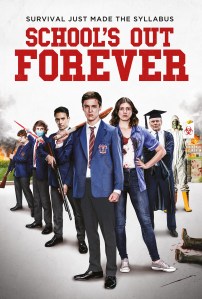 School’s Out Forever is available now to download (read our review here). Based on the first book of Rebellion’s Afterblight Chronicles – School’s Out, by Scott K. Andrews – it tells of the aftermath of a plague that wipes out much of humanity, and a group of survivors at a school. Paul Simpson chatted with director Oliver Milburn and star Oscar Kennedy about a world that’s rather less far away from our own than it was when they made it…
Was getting involved with the movie the first time you knew of the Afterblight Chronicles or were you aware of the books first?
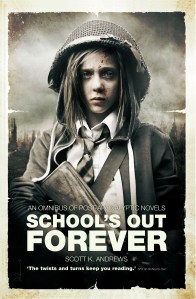 Oliver: I discovered School’s Out while working part time in a library over a decade ago. I think it was before the sequels had come out and I said to Emma Biggins, who’s the producer of the film, ‘One day, when people will listen to what we have to say, this would make a good film’. That was the start of it.
From there I went on and read more Afterblight stuff particularly the rest of the School’s Out series. Had you ever heard of it, Oscar?
Oscar: No I hadn’t, this is the first time I heard about any parts of the series. My introduction to the whole thing was Ollie’s screenplay and I think it probably did a very similar thing as to what the book does to readers. I was very intrigued.
What were your first thoughts about the end of the world scenarios that were presented? Did you think it was a believable end of the world?
 Oliver: I’ll let you go first, Oscar, because I’ll ruin it with my authorial eyes – what did you think reading the script?
Oscar: Definitely. Reading the synopsis, I half thought ‘Oh, is this someone saying, in a roundabout way, it’s a zombie film or something like that?’ but when reading it, you could imagine this to be a real life event. Yes, I think it is 100% a believable apocalyptic event.
Oliver: What I loved about the books and the School’s Out story, which I thought was particularly strong, is that it gives you a wild west in rural Britain. There’s less people, there’s no law; what happens then? We’ve seen that many times in other places, particularly in America, although usually accompanied by scorched earth or zombies or something like that. I just liked that it wasn’t that – it was this reset button almost and that you could play in that playground.
Obviously I was working off the strength of the books but when we were shopping the script around before Rebellion got involved in making it themselves, we would constantly be told that it should have zombies in it or something. People just didn’t get it, even though it was very much there on the page. There was this sense of “Is there not something else? Is there not some aspect of this world that is corrupt?” I always loved that there wasn’t, that it was this almost Eden of carnage – I don’t know what better term to use. It was all untouched; all the wildlife was still the same there was just this lawlessness basically.
What was the biggest challenge for you in turning a 300 page book into a 100 minute screenplay?
 Oliver: I mean certainly, you’ve hit on it there. Basically what to cut out and what to keep in and keeping those narrative threads present but reducing them to their most basic because the runtime is only ever two hours or less. Everything has to be the essence of itself. You can’t spend time exploring things, you have to make your points very quickly.
We changed a lot. I think the single biggest change is that Mac is Lee’s friend at the start, whereas in the books he’s very much this bully figure that Lee immediately knows is a psychopath. That was simply because it allowed us to experience Lee’s moral conundrums because Mac’s sort of goading him into them rather than he was immediately going, ‘I don’t like this guy, he’s bad news’. There was a road to be travelled there rather than it being explicit from the start. Then the addition of Lee being expelled at the start helped underline that moral conundrum.
There was some back and forth with Rebellion about what aspects we were losing and keeping. They were very free and easy with us actually and very supportive but there were certain things they wanted to keep because they felt they were part of the DNA of what School’s Out is. I think generally speaking we made the right decisions, so I’m very pleased, they’re a great company to work for in that way.
When you first read the script, what did you think of Lee? If you met him in real life, would you get on with him?
 Oscar: I think I would yes. I think that was one of the most striking things when I first read the script, was that I found there were quite a lot of similarities between me and Lee. Yes, I can imagine getting on with Lee in real life. I think he’s got a good moral compass, he’s quite silly at times a bit like me. So from the first time reading the script, that was something that was really very apparent.
Once you’d got the casting, Oliver, how much did the script alter or was it just a question of little tweaks while you were actually shooting?
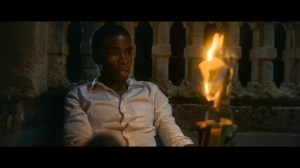 Oliver: It was mostly little tweaks and not generally cast related. I think we did make a few minor changes to some of the lines, based on specific people who were in the roles. Particularly Sebastian Croft, a brilliant actor who played Pugh, he has very small moments in the film but quite specific moments as a character. He took a few of those lines and really ran with them and did a bit of ad libbing. We used some of those, they were very good.
But beyond that, we did do some script changes while shooting but they were mostly to do with time and money. The library showdown was about three times more elaborate in the written script and then the week before we shot it, over the weekend I had to do a quick rewrite because the first AD said ‘We’re never going to get this shot, it’s just not going to happen’. We made some trimming and adjustment to our ambition at a few points but generally it’s all there. The shooting script is very similar to what’s on screen.
Let’s stick with that library sequence for the moment. The editing on the whole film is definitely one of its strengths but were you able to do those sorts of action sequences in order to give the actors a throughline or was it, “we’ve got to have this shot, this shot, this shot” and done that way?
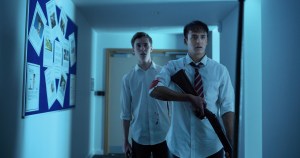 Oliver: I’ll let Oscar take that because I think we shot them largely in sequence but it’s an interesting question as to whether you, Oscar, really understood what was going on when we were doing it. It was very choppy, wasn’t it?
Oscar: I think it was pretty clear that you guys were trying to make it as easy as possible for us actors to go through the paces of it in as right an order as possible. I feel like, with the library stuff, I we did pretty much do the whole thing in order.
Oliver: We did. It was two nights but we went off and did different scenes during the days of those nights. It was two nights in a row in order.
I remember there were a couple of times when because we were losing shots and time was getting on top of us, I had to say – and it’s testament to Oscar as an actor and Liam too because I had to do it to him a few times as well – ‘Just do this, I know you don’t know what you’re doing but you’re frightened, just be there and I just need this one moment and then we get it.’ And you’d go ’So what was that about?’ and I’d say ‘Well, we just need an insert for this bit’.
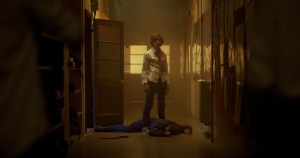 In the production notes you say you’d shot what you needed, you came in with the shot and went out with the shot. You were as tight as you could be – which has the corollary of lack of coverage if something happens.
Oliver: I’m glad you liked the edit because yes generally speaking as I said in those notes, there’s rarely ever anything else to cut to during the action. The moments you see on screen are what we shot and that was it.
What was the most challenging aspect of playing him for you, the stunt work? The emotional stuff?
Oscar: I don’t know, probably a mix of everything. I’d never done any stunt work before so that was definitely a new challenge for me. We had a great stunt team who were all a bunch of characters and they made sure that everyone felt safe in what they were doing so that wasn’t too much of a challenge. I think maybe the emotional stuff…
 It takes you to some quite dark places with the death of your father at the beginning and then what you see and go through.
Oscar: Exactly, and it was hard to try and remember as well that whilst they’re all going through this stuff there’s also quite a few moments where you see that they seem to have forgotten about everything that’s going on outside of the school and they’ve become kids again. It’s really nice to see the transition from a bunch of lads hanging out and even whilst it is them boarding up a window or something like that, they’re just a group of lads messing about… and then it gets to another serious moment.
For me from the moment where Alex Macqueen’s character interrupts the boys the shit hits the fan. There’s not really any let up apart from one beautiful moment from Samantha Bond where she’s in the car and you can actually see it, as if there’s a caption on her face going ‘What have I started?’
 Oliver: I’m really glad you say that about it not letting up because that’s very much the point. You could almost put a pin in that point in the script – our idea was that from then it goes completely ballistic for 30 solid minutes.
It’ll be interesting to see it on a bigger screen than a laptop.
Oliver: Well yes, that’s the deep shame about this current moment. It was shot for cinema. We did all the [quality control] in Molinare at the post house. They have a cinema screen so I’ve been lucky enough to watch it on the big screen three times. There’s nothing to be done but it is a different experience and it is such a shame that most people will never get to see it like that – but that’s where we are.
Oliver, what was the biggest challenge of the shoot?
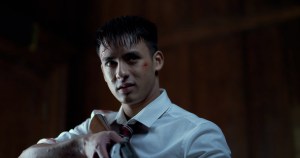 Oliver: It’s my own fault for writing it this way but the sheer amount we had to achieve on the money that we had. When we were scheduling about a week before the shoot the first AD who has a very sardonic manner said ‘Do you know what I really love about this, Ollie? There’s not a single easy day in this entire shoot.’ There was always a dog or a fight or a something.
There are two scenes in the film I think which have zero what you’d call abnormal challenges, which are just people talking. Everything else had something really complicated about it so just achieving that on that time and that money was tough but as Oscar says, we had an amazing stunt team. I come from VFX and I was very comfortable with any of that stuff.
The toughest thing with that time and money constraint was making sure that Oscar and all the actors and people who were actually on camera, knew where they were, what was going on and we weren’t running around so madly trying to get it shot that we forgot to tell the story. Making the time to make sure that was coming across was probably, amongst all the other stuff, the trickiest thing but I hope we achieved it.
For the action sequences, bearing in mind your VFX background, were you semi-animating it or storyboarding it or just knowing what you wanted to see?
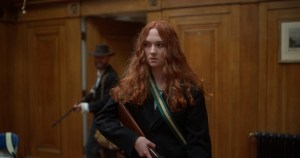 Oliver: More the latter. I did do some terrible stickman drawings and I’m not sure how much that helped anyone to be honest. Every time I showed them to people they went ‘Huh, so what do you want?’ and then I’d just describe it.
The action [in the script] is written mostly for me on set. It’s written as it’s shot and it’s very descriptive. It’s not just ‘Lee and Smith have a fight’ it’s ‘Smith picks up Lee, runs across the room landing on a table on top of some pencils’ It’s really beat by beat. And that really helps me.
Do you have the camera shots in there as well?
Oliver: A little bit. More just trying to get the vibe in the language and then working out a bit more on set. What we would do is a long walk through for everyone of each scene. In that concourse scene, that big fight scene with the chair stunt, even though we were on a very short time span we still spent a good hour of the first day in there, just walking it through with everyone, all the actors, all the crew so everyone knew at any given point [what was happening] because that sequence was a lot more cut up. We had stunts on certain days and not on others.
It was really important that everybody knew the overall movement of it, what the song should sound like at the end and then they could play their individual instrument when we needed it.
So not a lot of storyboarding but in the future I’d love to do more when time and money allows.
The music score works very effectively as well. What were your instructions to the composer for it? Or was it more visual, find the mood?
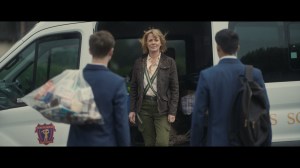 Oliver: The composer is a guy called Angus MacRae I’ve known for a while and he’s very talented so I was never worried about it.
I did a cut with temp music – a lot of stuff like John Murphy – and then for each scene I’d sit down with Angus and he would say ‘So how close to this?’ In some cases I wanted it to sound quite a lot like the temp track, not the exact chord structure but the instrumentation to be the same sort of thing. Then in other cases I’d use the track and it was nothing to do with the instrumentation, it was more about the feel and the emotional quality of it. Then he’d always come back with something absolutely brilliant and very in tune with what I wanted from a sequence.
I think one of his most impressive bits of score, it’s one of the least noticeable, is when it all kicks off – in fact, that very moment you were just talking about with Samantha where she goes “Jesus Christ, what’s going on here?” If you listen to the track on its own, it’s absolutely all over the pace, it makes no sense, but then neither does what’s going on. That’s the beauty of it. It’s this chaos of drums and weird guitar sounds. It works so well in the scene.
I think that’s a great example of where I’d given him a temp track that was a rhythmic actiony thing and he’d gone “No, I don’t think that’s going to work, let’s do this” and he was absolutely right.
What bit of the film are you proudest of?
Oliver: Oscar, you can tackle that first.
He’ll cover his ears and not listen if you want (laughs).
 Oscar: (laughs) Because I’m not like Ollie, I don’t quite understand everything that goes on behind the scenes and what’s going on behind the camera, I can appreciate that everything that was done was brilliant. Tom, the DOP and you obviously worked together and did some amazing stuff because the films looks great, as well as the VFX.
But I think for me, the thing I can be most proud of probably because it relates to me, is everyone’s performances. I don’t think there’s one weak performance in the film, I think everyone’s really strong and everyone gels so well together
Oliver: It’s a really tricky one because this is where I want to go on that insufferable roll call of just praising everyone who worked on the film.
Take that as read, maybe then a moment in the film where everybody’s contributions come together.
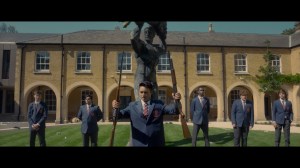
 Oliver: I think the concourse sequence when Lee arrives at the school and Bates is doing his lecture. Not just because I think it’s good and it works well, but mostly because even at script stage there was always this feeling I wanted of the film really kicking off now, which might seem odd because it’s 20 minutes in or something.
When I watch it with people, I get that feeling. Somehow, you can read people’s body language when they watch a film, and you get this feel, particularly around all the banter and the cricket ball being thrown up, that people sink in and go ‘Right, I’m on board now’. Generally I think, especially people who don’t necessarily watch films like School’s Out seem to very gripped from that point on and the story seems to carry.
I can’t quite tell you why but around the bit where Mac says ‘Get on the team, man’ and Bates says ‘Exactly’, there’s something about that where you suddenly sink into it as a film and feel like you’re really on this ride now.
School’s Out Forever is out on Digital Download now, and will be released on Blu-ray and DVD from 12 April.
Thanks to Patrick Dickens at Organic for assistance in arranging this interview.
 Doctor Who News Star Trek News
 Sci-Fi Bulletin: Exploring the Universes of SF, Fantasy, Horror and Spy-fi!