Satanic Panic: Interview: Grady Hendrix
The name Grady Hendrix is becoming synonymous with horror – his novels, including My Best Friend’s Exorcism, have become hits, as has his non-fiction treatise on Paperbacks from Hell. His […]



The name Grady Hendrix is becoming synonymous with horror – his novels, including My Best Friend’s Exorcism, have become hits, as has his non-fiction treatise on Paperbacks from Hell. His […]
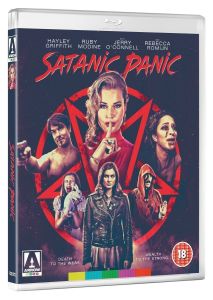 The name Grady Hendrix is becoming synonymous with horror – his novels, including My Best Friend’s Exorcism, have become hits, as has his non-fiction treatise on Paperbacks from Hell. His screenplay for Satanic Panic, out now from Arrow, shows his love for the genre, and he chatted about all things goopy with Paul Simpson…
What inspired your own love of horror?
I never was into horror as a kid; the covers freaked me out too much.
I have realised where a lot of it came from – when I was seven, my dad worked for a little over a year at Guy’s Hospital in London. We all moved over to London, my sisters and my family and I around 78-79 and we traded houses with this guy who lived in this huge Victorian house in Dulwich. In their library, on a really high shelf, there was this book called Myths and Folklore, a black cover with a gold embossed mask on it.
 It was put out by Readers Digest and it was amazing, heavily illustrated, but they seemed to only go with myths and so forth that involved people being burned at the stake or tortured horribly or murdered. It was on a really high shelf and I would scramble up like a monkey because I knew people wouldn’t want me reading it.
I really loved this book. It made sense to me – “oh, yeah, it’s like always rainy and overcast here because there are ghosts everywhere. Got it!” I think that was the first taste, and even now I prefer rainy days, and I like old woodcut illustrations and tintypes – it’s all the influence of that book. Be careful what your child reads when they’re young because it sticks with them for ever and then warps them!
Satanic Panic feels like a wonderful homage to so many different sorts of horror – I can see bits of Dennis Wheatley in it, with the power groups, and the Cronenberg/Carpenter mode. What were your influences?
 One of the things I like to do with horror is take things that are accepted, the standard tropes, and apply the reality principle. Sometimes that makes them ridiculous, and sometimes that makes them fun and really new again, and my job is to walk that line, to keep that fun but not spill over into ridiculous.
I love that Gothic 1960s, 70s Satanic – the red robes and the swords and the medallions. The Devil Rides Out – I feel like all that class stuff is also implied in there, this lovely country house. It’s a little bit the same in Night of the Demon, the Jacques Tourneur film where [the hero] goes out to meet this magician in this country estate. There’s this idea of rich Satanists – now they’d all live in a gated community and be organic and into juicing!
It feels like an upgrade of the Wheatley.
 That class stuff exists in the States now more than it ever has, with the gig economy – people like Sam trying to make ends meet with jobs that were designed originally for teenagers. You’re not meant to make a living delivering pizzas but a lot of people do. It wasn’t originally a job, it was something to get a bit of money, to be a first job, to get experience. It is this weird vampiric trap.
The other thing I loved putting in was, there’s so many podcasts and so much corporate culture right now about self-improvement and bettering yourself. “The only thing that stands in the way of success is you” and that’s so classic Satanism – live for today, do as thou wilt shall be the whole of the law – that really bleeds over into this corporate cheerleading self-actualism-speak that we hear on podcasts and see on MBA programs.
The other influence is more of a colonial thing – I lived in Hong Kong for a while with my wife. Hong Kong movies she and I love – there’s a whole string of really goopy black magic Hong Kong movies which have never really been done in the States. People puking up their intestines and eating worms and all that kind of thing. I love the images from that, and not really seen it in American movies.
I wanted to bring all that together into a giant goopy pizza – with extra cheesiness!
There’s a certain amount of Cronenberg with Videodrome as well; there’s been some British B movies, “video nasties” that have gone that route.
And the Italians do it. If you pursue any line of horror far enough it ends up being body horror, so you almost always end up with some Cronenberg influence, the fear of your body being turned against you.
There’s a very self-aware element to the film – how much of that was emphasised by the direction and the actors, or was it something you clearly indicated was the tone you wanted?
 I don’t think I did it intentionally but I think the way I write is very self-aware – I can’t help it. Chelsea [Stardust], the director, is really attuned to that. Even the town being called Mill Basin – Ted Geoghegan, who I originally wrote the movie with, who wanted to call it that, because that was the town where the heavy metal band goes to perform in Black Roses. From names on through a general tone, it was all self-aware because it was made by people who love horror for people who love horror and you’re already starting out with a common language. Even if you don’t have those common references, you can get the tone. This is something you can show in the clubhouse.
How much did it alter from the original concept?
The original draft was something I was writing for fun – when I’m waiting to reread a draft or do an edit on a book, I’ll write something else to clear my head. I really wanted to write about a Satanic cult and a pizza guy and he goes and gets involved and he’s a virgin – basically the movie you saw, but with a guy as the main character.
 Ted was looking to make his second movie and was really bummed out because the producers wanted to hit certain elements and he didn’t want to do it. They wanted a female protagonist, they wanted it to be really into heavy metal, they wanted a lot of satanism in it. I said, “Well, I’ve got this script I’ve written if we just flip the gender, this would be the movie that is in the ballpark of what they’re looking for.”
He and I worked for about six weeks together. We sat in my little stinky office and I typed and we knocked everything around and went back and forth. We wound up with this movie. It was announced in the trades as his next movie but then the producers went with Mohawk instead. They had a crew ready to go and they had a tax shelter to take advantage of in Canada so it made more sense to do that. So this movie got dropped by those producers and picked up by Fangoria.
Then it was working with Chelsea and the folks at Fango to really focus it a lot more, and then Chelsea and I worked really tightly the day before shooting just to tune the lines for the different actors and sort out problems like who goes through a door first – the short of thing you have to know before you go on set but you don’t think about when you’re coming up with the script.
The script was remarkably similar but the big change was the gender swap.
What did that give you as a writer?
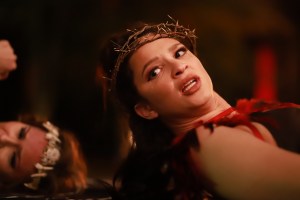 That goes back to the body horror thing – the ultimate horror is that your body is no longer yours, it doesn’t belong to you any more. That’s the horror of possession or Shivers, or someone casting a spell on you.
I know there are people who say that when they wrote Alien they just made Ripley a female character and never changed a thing in the script. I had to change so much when Sam went from boy Sam to girl Sam because there’s a very different movie about a male virgin running away from a Satanic cult to a female virgin running away from a Satanic cult who want to impregnate her with a demon. That suddenly gets into a lot of stuff.
I’m more comfortable writing women to be honest – it really opened it up in really fun ways. Particularly in the States women don’t feel that their body belongs to them, that someone else is telling them what to do with their body. Suddenly it becomes really rich and really fertile and really resonant (no pun intended with the fertile) but my job was to thread that needle very carefully because what I leave out and what people project onto it becomes really powerful all of a sudden. It really changed everything.
Thanks to Louise Buckmaster and Erin Mullis for their help in arranging this interview
Satanic Panic is available to digital download and on Blu-ray™ and DVD now from Arrow Video; click here to order from Amazon
 Doctor Who News Star Trek News
 Sci-Fi Bulletin: Exploring the Universes of SF, Fantasy, Horror and Spy-fi!