Host: Interview: Rob Savage
Host director Rob Savage has talked a lot about the genesis of the film and its use of the Zoom medium, so for this interview to promote the release of […]



Host director Rob Savage has talked a lot about the genesis of the film and its use of the Zoom medium, so for this interview to promote the release of […]
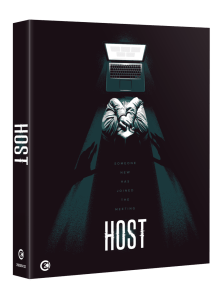 Host director Rob Savage has talked a lot about the genesis of the film and its use of the Zoom medium, so for this interview to promote the release of the movie in a limited edition Blu-ray from Second Sight, Paul Simpson asked him about some of the production challenges and his influences.
Let’s start with something very particular – when the mask pops up that’s like a Snapchat mask, one of my colleagues was wondering if this is a reference to Alice Sweet Alice?
It is, it is. I love that film, that’s one of my favourite slashers. We were testing out lots of different masks and I was like, “Fuck it let’s just put Alice Sweet Alice in there.” There’s lots of little in jokes and stuff like that. We had a lot of time in post production to add in a bunch of little references like that.
 How long did you have on post then?
The whole thing was very truncated, it was twelve weeks from conception to release. But the thing is, when you’re filming something on Zoom, the shoot is actually really short. We shot the bulk of the film in a week because there’s no lighting and makeup – all of this stuff that eats up time – and the camera was already set up. We actually got through it really fast. The bulk of the time was put into post production and doing all the effects, building the Zoom interface and all this sort of stuff.
People were obviously shooting at their homes so how did achieve those effects shots where you were shooting in their homes?
 There’s lots and lots of hidden cuts between different people’s apartments. Almost every single one of the girls, their apartments are made up of multiple different locations. We’d say ‘I want Emma’s lightbulb to explode’, and obviously she can’t do that herself. So I’d call our pyrotechnics guy and ask ‘What part of your house looks vaguely like Emma’s?’ And he said ‘Here, I’ve got this lightbulb and this shade and we’ll send this lampshade between houses. So she can look up and then I’ll make the light blow up in my apartment and we’ll do a little blend.’
There’s lots of bits like that where it seems like the girls are doing these impossible things that they’d never be equipped to do that are shot all across the country, in little bits.
Things like the character who falls from the ceiling.
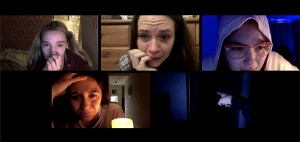 Yes, Radina’s boyfriend. That was actually shot in their apartment. That was actually one of the very first things – that might even be the first thing – that we shot because we started shooting the film just as lockdown restrictions were starting to ease up and we were able to get people to travel. We got the stunt team to go to their house and keep a safe distance and got Radina to rig up her boyfriend so there was no contact. We had all these little processes that we had to go through to make that work.
But that’s actually a person dropping from the ceiling and slamming into the floor. The only thing removed there is a little rope that stops him just at the last minute so he doesn’t fully faceplant.
Or like the Looney Tune cartoons, with the coyote bouncing up and down.
(laughs) Yes. The thing is, with that gag, there’s a little mechanism that’s meant to stop him and give him a tiny little bit of bungee before he hits the floor. We did about fifteen takes of it and it was never quite right. I was never quite happy with it. On the last one, the bungee mechanism failed and our stunt performer just literally slammed into the floor and of course that’s the take that we ended up using.
 What gets you excited when you’re looking at a horror film – and do you read horror as well?
A little bit. I tend to watch a lot of horror and if I’m reading stuff it’s normally short stories. It’s M.R. James, it’s these little bite sized horror stories. I think there’s something to that. I look at a lot of short form stuff for inspiration because I think the best horror ideas are normally very simple and can be boiled down to something that you can almost describe in one sentence.
I think our primal fears are actually quite stripped back and basic and fundamental. If I were to pitch you something in a sentence and you go ‘Oh yeah, I get it. I know that, I know what that’s going to feel like’, that’s really the trick I think.
 I’ve been reading a lot of Junji Ito recently. He’s got some great fucked up imagery. I’ve got a little folder that I keep on my computer of images that will set ideas off and I’ve got some Junji Ito. I take screen grabs from films, not just horror stuff but when I’m coming up with something or I’m building a horror idea, I’ll just flick through those because it’s so hard creating this stuff in a vacuum. I’m always bouncing off of other people’s creations.
What was the first horror film you saw then? I’ve got a guess as to what it might be…
I don’t know what the very first one was but I think Evil Dead 2 was the first one that I really remember being a revelatory film.
Oh that’s handy [given he’s working now with Sam Raimi].
(Laughs) Yes. As in, I watched that and I had the realization that there was a filmmaker behind it. I began seeing through into how films are actually made and constructed. What were you going to say?
 I wondered if it was The Exorcist.
I tell you what, The Exorcist was the one film that I was always banned from watching.
The Exorcist holds a really special place in my horror film experiences because I wasn’t allowed to watch very much horror as a kid. In fact my parents tried to raise me without a TV at all, so a lot of the stuff I was watching, I had to sneak in and watch when they were out of the house.
The Exorcist had scared my Dad so much. He had a religious upbringing and the way he spoke about it, it felt like if I was to watch that then I’d carry a curse with me after watching it or it would change me in my DNA somehow.
So even as I was watching Cannibal Holocaust and Faces of Death and the gnarliest video nasties, The Exorcist really had this aura about it so I put it off for a long while. It rattled me and does every time I watch it.
In terms of storytelling, your films and television episodes, story and plot are driving them but I get the feeling that what happens to a character in an horrific situation seems to be what drives you more. Would that be fair?
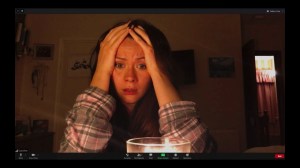 Yes, I tend to get more from the moments on set where I really feel like things are clicking. It’s always something that a performer is doing that’s bringing a truth to a moment – which sounds really obvious but I think it’s something that’s really lost. All the plot in the world, the biggest twist you can think of, isn’t going to land unless you feel like you’re there shoulder to shoulder with the characters.
To me the only reason to be making these films at all is to explore human behaviour. All art is about that ultimately. To give people an experience, that should always be centre in your thoughts and I think that was part of what was so energising about the process of making Host is that we were working off a fifteen page outline. I knew the beats that I needed to make for this to be a story, to have a beginning, middle and end and to be satisfying. But it was just the shell of something and it didn’t have the personality I knew these actors would bring to the film. So every day, turning up and working with the cast, figuring out that we need to give the audience a piece of information but it’s totally bland on its own, so how do we make it interesting? What are your characters going through? How can we subvert this?
The question we were always asking ourselves was “What’s the movie version of this? Let’s do the opposite. Let’s do something that feels really grounded and energises us.” That for me was the best part of the whole process.
A couple of weeks ago I interviewed the directors of the original [REC]…
Masterpiece.
One of the things that they said that was new for them there but which I also think applies to Host is that they make the camera and the audience feel that they’re part of the movie which with Zoom you’d think you wouldn’t get. It doesn’t feel like I’m in the room there with you now but you do have that effect in there.
 Yes. I think the movie we were always referencing was Ghostwatch, the original from 1992. I think [its creator] Steve Volk is a bit of a genius and I think that for me is the best found footage movie ever made. The impact that had culturally is something that I don’t think you could do nowadays, but we were always talking about it because we knew that if this film were to come out in lockdown in this format and be reflecting the way that we’re all living at the moment, there is this possibility that even for a moment you feel slightly more a part of this movie than you would if you were seeing it in a cinema and under normal circumstances. Just that little bit of suspension of disbelief could really take this movie the extra mile.
A lot of people have come back and said that when the pop up window comes up, they move their mouse to try and click it away. That little bit less separation between them and the characters is really fun.
Host is out on 22 February in a limited edition Blu-ray from Second Sight.
Thanks to Debbie Murray for assistance in arranging this interview.
 Doctor Who News Star Trek News
 Sci-Fi Bulletin: Exploring the Universes of SF, Fantasy, Horror and Spy-fi!