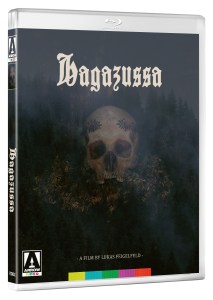
 Sometimes, fine meals need to stew awhile. Spells too, perhaps, bubbling away until the magic curdles and boils over. Haguzussa: A Heathen’s Curse is the feature debut of writer and director Lukas Feigelfeld, originally launching at festivals back in 2017. While it received a wide release the following year in Germany – and a limited release the year after that in the US – it is only now coming to UK Blu-ray thanks to Arrow Video.
It’s a compelling, beautiful and unsettling look at mental illness and victimization, a superb piece of cerebral horror that marks Feigelfeld as a talent to watch. Whatever his next spell turns out to be, there’s little doubt it’ll be a potent and lethal piece of cinematic sorcery.
Sci-Fi Bulletin’s Guy Adams recently had the opportunity to talk to both Feigenfeld and cinematographer Mariel Baquero to delve a little deeper into the movie. Our conversation contains the occasional spoiler, the film is highly recommended and would best be appreciated cold, so be warned!
 You worked together on a number of short films before Hagazussa. Could you give us some background as to how you started working together?
Mariel Baquero: We studied at the same film university and there was a strong bond right away. We became friends and then decided to try working together and that went well too!
What made you want to be a director of photography?
MB:: I was always interested in photography, experimenting with cameras from an early age. I also used to watch many movies. My mother is quite a movie buff so I guess this encouraged me to think of the possibility to combine photography with movies.
A strong relationship between director and cinematographer must be essential on such a visual movie as Hagazussa.
MB: Lukas and I’ve always liked to watch movies together, and of course we end up talking, analyzing and discussing them. This can’t help but give us a similar understanding on how we see film, or at least to know what the other likes.
Lukas Feigelfeld: Yes, we certainly managed to establish a common understanding, which came in handy in the process of building the shots for Hagazussa.
 MB: For Hagazussa we watched some specific movies to help us find the mood. We were also lucky to have a nice long period of pre-production.
LF: And during the writing process, I’d already gathered tons of reference images.
Parts of my family come from those regions in the Alps and I was fascinated by the folklore of the area and its inherent darkness from a very early age.
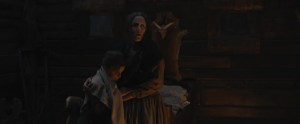
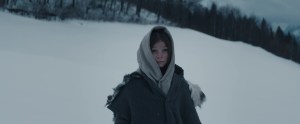
There is something special in the Austrian countryside, different even to the German or Swiss Alps. After analyzing the fear of the witch, the attraction, the power, it all transformed into the tragic story of Albrun and the fight for her place, demystifying the image of the “witch”, giving it as much reality as possible without losing the magic that is so inherent to it.
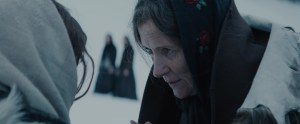 Hagazussa has very little dialogue. It embraces imagery and soundscape far above the spoken word. Is this what film does best? Never use words when pictures will do it better?
MB: I’ve always thought that one of our most important tasks as filmmakers is not to overdo the dialogue, not if the reason is a fear of perception. I think that is unfair on the audience; I think it’s underestimating them.
LF: For me, film works on a subconscious and sensational level. Film happens to you as a viewer, whether you want it or not. To achieve this emotional understanding of a film as a director, you have to work with all the tools that are given to you in cinema. This can also be dialogue of course, but I mostly see film closer to music or even abstract painting, evoking a feeling, an atmosphere, first, telling a story second, or let’s say “within” this sensation.
 When it comes to atmosphere, a great deal of the tone of the film is soaked into the locations you used. From dense forests to wide open snowfields.
LF: Having grown up in the mountains, the locations had a very personal feeling for me. I knew what was evoked by specific parts of the woods, the moss, the vastness of the mountain landscape.
The film could not have been shot or set anywhere else, it is inherently entwined with the Alps, the traditions of the region, the folklore and myths of those times in that place.
MB: I was lucky because they were all places Lukas felt confident with. They were the specific places that gave birth to the story, something you can feel in the movie I think.
We visited most of the locations a couple of times before the shoot to help with preparation but the biggest challenge was always going to be the weather. Mountain weather is very wayward and having no lights with us made things even more complicated.
 The movie evokes a disturbed state of mind very successfully, not just during the latter, more surreal moments but also in the slow, insidious, hollow atmosphere throughout. The slow, frozen moments for Albrun will resonate with anyone familiar with the emptiness of depression. How did you go about channeling this onscreen?
LF: While writing I tried to dig deep into the despair of Albrun, as for me this is the real “witch”. It is the isolation, the confusion between nature, science and magic, the misogynistic society, the abusive friendships, the hate for all that’s different. All of this transforms in her psychotic mind into the “witch”, the woman that actually is pushed to a point where she eats her own child’s corpse. I always asked myself this question: What could bring a mother to this point?
Is all the best horror about a disturbed state of mind?
LF: That is hard to answer. Fear and terror is always created in the mind. Mysticism, ghosts, the supernatural are mental manifestations. They are not real, but that makes them no less of a “real” sensation.
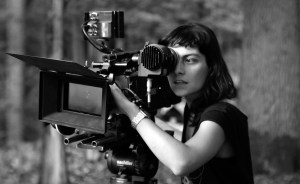 And, Mariel, how do you go about evoking fear and terror through the lens?
MB: It really depends on the script and the cinematic language chosen between DP and director.
The biggest and most important challenge with any movie is the most basic: translating and understanding the wishes and ideas of the director. We are there to contribute and to enrich the conceived project not just to modify it.
That said, every single shot has its difficulty. Either technically, creatively or in its content. For me, the greatest difficulty is when I’m not connecting with the actor. When I don’t feel that creative bond it’s difficult for me to believe in the shot I’m shooting. Not a problem I had on Hagazussa, thankfully.
Aleksandra Cwen’s performance as Albrun is stunning.
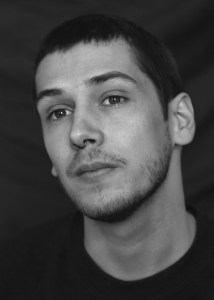 LF: We already knew each other from working on my short “Interference”. For Hagazussa, we talked for a long time. We established an understanding who Albrun is, what her life and her suffering is about. After this, Aleksandra knew very well, maybe better than me sometimes, how Albrun would react to certain things. When the work on set began, a great deal of our work was already done.
The soundtrack is composed by Greek duo MMMD. How important was the music for the movie?
LF: I already listened a lot to MMMD’s music while writing. It felt so fitting from the beginning, so I decided to contact them for a possible collaboration. I am very happy about their contribution to the overall mood and sentiment of the film. They brought another level of uncompromising talent.
You used crowdfunding as a way of partially funding the movie; can you talk about that experience? How useful is crowdfunding as a way of getting movies made?
LF: The film was a graduation project of the German Film and Television Academy in Berlin, so we had an extremely limited budget. After shooting the winter scenes and some studio, we ran out of money and had to halt production for nearly a year. The crowdfunding campaign helped us finish postproduction and I am very grateful for everybody that contributed!
What scares you?
LF: From a young age I had nightmares about witches and similar, which surely came from the region, fairy tales, the particular darkness of these woods. I carried this with me while growing up and had to manifest it into a film at some point. Now I am not scared of it anymore. I managed to make it mine. Now I am scared of politics, neo-Nazis, police violence, sickness. You know, the world we live in.
 What films made you into the people you are today? Was there a specific movie that made you want to become a filmmaker? A particular cinematographer?
MB: I was highly inspired by Scandinavian cinema. I always enjoyed the lighting and the atmosphere. And I really like that certain soberness with deep subjects.
LF: Many movies inspire, so it’s a hard question. You will see a lot of Tarkovsky in Hagazussa, but also the slowness of Tsai Ming-Liang, or the insanity of Andrei Zulawski.
Inspirations differ from project to project.
MB: I am impressed by the work of many cinematographers. I couldn’t name only one. As I mentioned before, I like the Scandinavian aesthetic and I guess the biggest example would be Sven Nykvist. But I am very inspired by early Jarmusch’s movies so Robby Müller is also one great inspiration. And the colourful creativity of Christopher Doyle and… I could just go on!
 If you could pass on a piece of advice to someone who wants to work in film, what would it be?
LF: Stand firmly on your feet and inside your capabilities, but nevertheless try to be as uncompromising as possible. Be your own biggest critic, and don’t blindly fall in love with your own ideas, but love the good ones, once you can identify them.
MB: Try to get involved as soon as possible working on a set. That really gives you a overlook of what your professional life will be like. It’s also where you learn the most.
What are you working on at the moment?
MB: There are a couple of projects in the air but unfortunately nowadays nothing is certain. I still try to do my usual research work of preparation, so I still feel active in a way.
LF: Similar here. Hagazussa opened a lot of doors. Now it is hard to walk through the right one at the right moment. I am currently working on three different projects. I am sure that whoever liked the bleak poetry of Hagazussa, will find pleasure in those as well.
 What would be your dream project?
LF: I don’t think I have a dream project, but I certainly like it when my work takes me to different places around the globe.
And also I really appreciate the projects where I have a lot of time of preparation; that’s dream process!
MB: Freedom of expression with a comfortable budget and a loving team.
Hagazussa – A Heathen’s Curse is available now from Arrow; click here to order from Amazon.co.uk
Thanks to Thomas Hewson for assistance in arranging this interview




 Sci-Fi Bulletin: Exploring the Universes of SF, Fantasy, Horror and Spy-fi!