Beyond the Door: Interview: Ovidio G. Assonitis
Delivering the devil on a budget is always going to be a difficult task, the infernal doesn’t come cheap. But then, if anyone could plumb the depths of hell for […]



Delivering the devil on a budget is always going to be a difficult task, the infernal doesn’t come cheap. But then, if anyone could plumb the depths of hell for […]
 Delivering the devil on a budget is always going to be a difficult task, the infernal doesn’t come cheap. But then, if anyone could plumb the depths of hell for loose change it would be Ovidio G. Assonitis. He proved as much in 1974 with his rich and refreshing spin on occult horror and demonic possession, Beyond the Door.
Assonitis was producer of such movies as Who Saw Her Die? in which a grieving George Lazenby searched for his daughter’s killer in an eerie, melancholic Venice. Hypnotic and beautifully directed by Aldo Lado, it features one of the most eerie, affecting music cues Ennio Morricone ever wrote, a jangling, choral chant that brings shivers like a dollop of melted snow down the back of your neck.
Another early seventies hit for Assonitis was Umberto Lenzi’s Man From Deep River, an ignited pilot light beneath the cooking pot of the Italian cannibal craze that was to trouble jungle sets and unsuspecting wildlife in the years to follow.
With 1981’s Piranha II – The Spawning, Assonitis would even launch the career of James Cameron, a director who has been feasting heartily on the carcass of blockbuster cinema ever since.
Assonitis has an eye for what will bring audiences into theatres, a skill he picked up from the earliest days of his career in film:
I have always been a sort of entrepreneur and a filmmaker, two things that can’t always co-exist! I was a distributor for many years in South East Asia, with offices in Hong Kong, Bangkok, Taipei… all over. That’s how my life in film began. I’d sit and watch the movies I distributed – mainly action movies – in the theatres, watching the audience and trying to identify what it was that interested them, to see what elements in these movies from such distant cultures – European, American – appealed most of all.
 And, in 1968, that keen eye identified a new trend that was to bring a fresh challenge to your career.
Rosemary’s Baby. It was a totally different conception of horror. Before that horror was often confined to a castle, a world of darkness, magical, remote.
Italian cinema in particular had long had a love affair with the Gothic, Mario Bava, Riccardo Freda, they built their horror foundations on ancient stone edifices, curses and cobwebs.
But Rosemary’s Baby brought horror – the devil himself – into our homes. Into a world we could all understand and relate to, part of our everyday life. Demonic possession… It was – and I certainly interpreted The Exorcist like this – like living with a loved one who had cancer, this thing that was destroying them, how would you respond? How would you act? That was the thing that stuck with me and the element I saw audiences relate to, watching a loved one die right in front of you, pure horror. The Devil as cancer.
So I decided to produce Beyond the Door.
Not being a film writer or director I approached script writers I thought could come close to the concept, while keeping as far away as possible dramatically from Rosemary’s Baby or The Exorcist. But I couldn’t find anyone that did it the way it needed to be, nobody seemed to be able to produce a script that understood that the direction of horror had changed. So I couldn’t find a writer and I couldn’t find a director, what else could I do? I did it myself!
I hired one of the best special effects technicians in the world, the second best in fact! Wally Gentleman who worked with the renowned Doug Trumbull on Kubrick’s 2001: A Space Odyssey.
We went to Rome and shot all the interiors in studio, with all the exteriors shot in San Francisco. I tried to keep the American quality, the flavour to the movie. I went over and over the script trying to get the American language, the American mentality, the American culture which, not being American, isn’t always easy.
 I would suggest that slight shift in culture is exactly what makes the movie sing. Yes, it feels American but there are touches throughout that are off-kilter, dissonant, strange, which is where horror always does it’s most interesting work!
Another vitally important element to any horror movie is its score, would you agree?
Music for me is extremely important, in all my movies. I always like to have a score available before shooting because the music is a vitally important voice to add to the camerawork, the acting, the story.
In Beyond the Door you worked with Franco Micalizzi who created a wonderful, rich, funky score that brings a real energy to the movie.
Micalizzi had already worked for me on a love story, a tearjerker, a very successful – very Italian – movie [1973’s The Last Snows of Spring]. I liked the way he interpreted the cinematic language into his music.
But you gave him a very specific steer for this film didn’t you?
I remember hearing Barry White for the first time and it affected me a lot, however you play it, on a brilliant expensive home stereo or a cheap speaker or even phone, the depth of his voice is unlike anything else in popular music. There is something profound about it. That rumbling bass. I told Micalizzi about this and he played with the idea in the soundtrack, replicating that deep, resonating sound through the instruments. And, of course, we had the amazing song Bargain With the Devil.
Released as a single with Jessica’s Theme as the B Side! Vocals by Warren Wilson of The Popular Five, Satan had never had such soul!
 Another great addition to Beyond the Door was Juliet Mills. American audiences were used to seeing her as the charming Mary-Poppins-a-like Phoebe Figalily, the lead in Nanny and the Professor, a successful sitcom that had run for three seasons between 1970 and 1972, with a feature film to boot. From such wholesome family fun to a vomiting, cursing, bestial creature in your movie, it was quite the change of role.
She was very patient, her makeup took hours every day to apply. She liked her face done in this horrific style because it made her part of the story.
She certainly brings her all to it, it’s a fabulous, animalistic creation.
She gave to the movie an excellent performance, she lifted it a great deal.
The movie also stars Richard Johnson. Talk about the profound bass of Barry White, Richard Johnson was his acting counterpart I’d say. So many wonderful performances, the cynical scientist in The Haunting, the charming Bulldog Drummond in Deadlier Than the Male and Some Girls Do (I may be saying too much about my taste in cinema by quoting these as examples!) He was a wonderful actor with a huge legacy of work.
He brought a real sense of weight. He was a true Shakespearean actor, able to modulate his voice in the most marvellous way that really worked for the picture. He became a good friend. We shared a belief that I think is very important and that he brought into his performance: the devils are part of us, they are ourselves. We don’t like to acknowledge them, but they lurk inside us, they are the part inside that encourages us to do irrational and selfish things, not out of love for ourselves, but rather out of fear for ourselves.
His presence permeates every frame, he’s a dark, brooding joy throughout the movie.
 Beyond the Door was a hugely successful picture – so much so that Mario Bava’s 1977 movie, Schock, was retitled Beyond the Door II in order to cash in on that success – and yet it was relegated by some as nothing more than a rip off of The Exorcist, an unfair assessment in my opinion.
Of course, this picture is not an Oscar winner, we never thought that it could be. The picture came closer to The Exorcist than intended somehow, in production, but behind this picture was a lot of work, a lot of effort to make something interesting.
The Exorcist cost 12 million dollars, ours cost three hundred thousand, and there’s a major difference! But still, with our huge limitations of budget, we tried to do the best we could and be original and, watching it again after many years I found a lot of originality in it that went beyond both Rosemary’s Baby and The Exorcist, aesthetic elements that certainly influenced other directors – like Tarantino – the freeze frame, the rhythm. I’m not trying to justify the picture, it’s just what I think. If this picture has touched people – and it has, many people – then that’s something we shared.
Beyond the Door most certainly contains elements that lift it far beyond the dull parameters of a cash in movie. The style and rhythm of the picture leads the way towards 1979’s The Visitor, a wondrous, mind-bending occult experience that I remind to anyone who wants to see quite how elastic the horror genre can be.
Assonitis clearly straddles a line between commercialism and art, a filmmaker that’s always aware of the market but with an interesting eye, a refreshingly skewed perspective that he always brings something enriching to the screen.
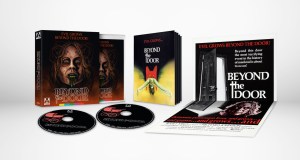
Beyond the Door has been released by Arrow Video in a limited edition Blu-ray set possessed of a legion of extras limited to 3,000 copies and available now. Thanks to Thomas Hewson for assistance in arranging this interview.
 Doctor Who News Star Trek News
 Sci-Fi Bulletin: Exploring the Universes of SF, Fantasy, Horror and Spy-fi!