Archenemy: Interview: Adam Egypt Mortimer
Adam Egypt Mortimer’s latest movie Archenemy has been released by Altitude Films, a very different take on the superhero trope, as its hero Max Fist is sent from another dimension, […]



Adam Egypt Mortimer’s latest movie Archenemy has been released by Altitude Films, a very different take on the superhero trope, as its hero Max Fist is sent from another dimension, […]
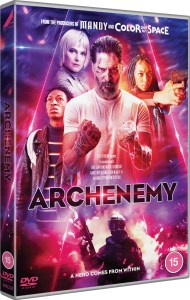 Adam Egypt Mortimer’s latest movie Archenemy has been released by Altitude Films, a very different take on the superhero trope, as its hero Max Fist is sent from another dimension, but ends up a bum on the streets. Paul Simpson caught up with the director on Zoom a week before it came out.
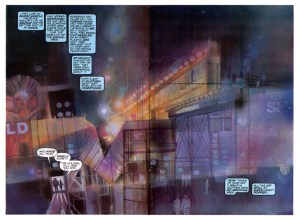
Thank you for a very different superhero film, which once I understood where it was going and what it was, I really bought into. You’ve talked about the influence of Bill Sienkiewicz and the 1980s Marvel output – that was the period that I read Marvel and remember well.
Yes, they were exploding with ideas then.
 The training wheels were off.
Yes. I think all the wheels were off and they were just throwing the bicycle off the cliff, it was completely insane.
The other film it reminded me of in terms of its reality of violence was Lexi Alexander’s Punisher War Zone.
Oh interesting. She took a totally different approach, a gangster movie vibe and then it goes insane. That’s an interesting comparison.
With this, you’ve got the animation opening, and then it’s almost as if, if we were in the old days, somebody put the wrong reel on the projector. It has that complete WTF feel to it. Was that something that you had in mind right at the start when you were working on this?
 I love how you put that, that’s brilliant. To me, it wasn’t necessarily a deliberate choice in that sense but when I was making this movie I thought a lot about Repo Man and how I remember seeing that as a kid. I saw it fairly young and that’s a movie that’s one part social realism, one part there’s a flying car with an alien in it and one part, the third act, everybody’s running around with gun shooting at each other and you have no idea why. I think I saw that movie and I thought, “I guess this is what movies are, this is how movies work.” Then I was surprised to discover over the decades that’s not how movies tend to work but I always said ‘But wouldn’t it be cool if a movie had ordinary people but then there was an alien invasion about 70 minutes into it. That would be a cool movie’.
I think that idea of mixing up genres or playing with the levels of reality or the groundedness and things like that has always been really interesting to me. Again, you bring up Sienkiewicz: part of Elektra: Assassin looks like photorealistic painting and part of it is scrawled in crayon and part of it has a piece of fabric glued to a poster board. That sense of mixed media and mixed reality was really appealing and I felt like I could get away with it on this movie.
Does that make it harder to get a through line for story? You can do that with character certainly but a through line for story presumably must be quite hard to make sure that’s clear.
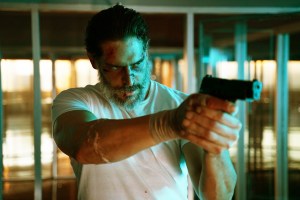 To me, once the crazy concepts and things like that are down on paper it’s entirely for me about finding the truth in the performance. The actors are the ones, I think, that give it the through line. If you find that that thing that Max Fist is all about – What is the spine of this character? It’s his heartbreak, his desire to be loved – and you keep that going through the movie then I think all the aesthetics around it can keep changing. But the throughline is there in the people.
But yes, this movie was a real challenge to edit. We didn’t have a lot of additional footage. We shot this movie on a really low budget, really fast but there was still a lot of shuffling around and understanding how to turn things into sequences that would make sense.
Of course the animated sequences, I was getting to continue to play with and rewrite right up until the last minute, so they turned out very different than how they were written before we shot the movie.
So you worked on those after you got all the live action shot?
 We didn’t even wind up hiring the animators until we were editing the film. Which was insane, horrific…
We’d had some people onboard at first and it didn’t work out and then we scrambled and put people together, but the net result was a positive which meant that as we were massaging the movie in the edit, I was completely reimagining what those sequences would be and how they would fit together and what story exactly they would be telling.
I suppose it’s like anything where you’ve got a load of ADR built into a script that you’ve got that opportunity to drop as much as you want in. How different was it beforehand? Can you give a specific detail?
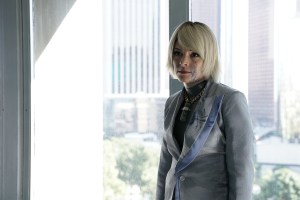 As soon as we started working on the movie, I was saying ‘These scenes should feel more expressionistic and more dreamlike, more Pink Floyd – The Wall than X-Men cartoon’ but some of the scenes were written in a way that made that hard. They were maybe too specific, too grounded.
There’s a scene where you see Cleo’s giant head and she starts to cry and her tears hit the statue and the statue breaks apart. That kind of imagery wasn’t originally in the script, it was something much more literal, like she’s in an electricity cage and they’re having a conversation and it explodes. I’d gone fairly far down the line with a sequence where a little kid is holding a Max Fist action figure and then he explodes because of a fight that Cleo and Max are having.
But as we went forward it was about more and more abstraction although there was a short period of time where the script that I had written had Max punching giant robots outside of a black hole. At one point I thought maybe it needs to be really cosmic and action packed like a Saturday morning cartoon and then we [realised], no, that’s not really what the story is. The story should have this more sad tragic ambiguity. I think it was raising the emotions and diminishing the articulation.
If you go for that sort of realism, you’re heading into the Alex Ross’s Marvels territory, which I love.
Absolutely, the best.
 But it’s almost too realistic. I think what worked for me most about Archenemy was the fact that you go from this ultra impressionistic animation into the projects, into an area that you or I walk into, we’re likely to get the shit kicked out of us.
Yes, you’re totally nailing it. Those two pieces of reality had to feel as different as possible. So what we shot for live action, you just could not mix that up movie world with what was going on on Chromium.
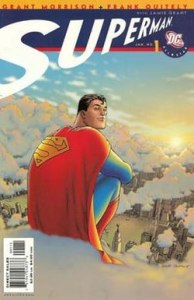
You mention Marvels, I think there were two comics that really played an interesting dynamism to me. On the one hand was Grant Morrison’s All-Star Superman and I gave a copy of that to everybody involved with the movie. I was like ‘This is my favourite Superman comic, it completely nails the mythology and all this’. So that on the one hand was the dream, that’s Max Fist’s, his inner life is this perfect Superman comic.
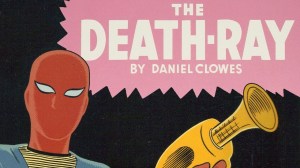 And then on the other hand there was Daniel Clowes’ The Death Ray which is this super grounded story. It’s about a fourteen year old boy who discovers that his father was a supervillain and had a death ray and he and his friends go out and try to shoot people for stealing a wallet.
These are two completely oppositional ideas of how to tell a superhero story in a comic book. So these two opposites, I wanted to do both of them at once in a super short movie.
You said the edit was challenging; what was the biggest challenge of the live action element?
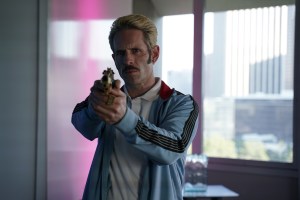
 It felt like we were cursed by a witch. People were getting sick, we’d show up to a location that didn’t exist… We only had 18/19 days to shoot it. So being able to do this action, have Max Fist walk into a room and have this crazy close combat in super slow motion with somebody, and pull that kind of stuff off in a way that would feel quite intense when we’d only have a couple of hours to shoot things like that was deeply challenging. Luckily in having Joe Manganiello as my star, he’s such a physical person and he just wants to jump to his feet and start tackling people as soon as you put a gun in his hand (laughs).
That made it easier to pull this stuff off but I had this ethic that every sequence of violence and action has to have its own idea. There’s one where he comes in and beats these guys to death with his hands but the whole thing is shot on his face because it’s all about his emotional intensity there. Then we have something else where he has this fight with somebody and it’s very slow motion and it’s supposed to feel like cosmic and transcendent. Having every sequence like that, have its own language, have its own style while being told you’ve only got 90 minutes to shoot it and somebody’s got pneumonia and a camera broke (laughs) is… not fun – but once you’re done with it all you’re glad you did it.
Did you storyboard out the action sequences before you shot them? Obviously Joe’s got a good grounding in this stuff.
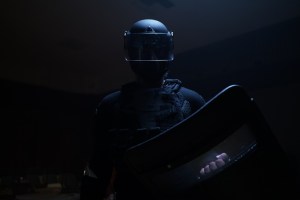
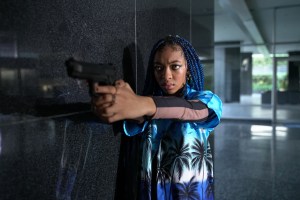 We treated each one differently. That one where he bursts into the apartment and kills those two guys, we rehearsed that with our stunt team, shot it on the iPhone, edited that sequence together in the location that we were going to do it. That was completely prevised, I knew exactly how we were going to do that and still, the camera broke. We got ready, we were like ’We’ve only got one take, he’s got to come in tackle this guy, break the coffee table’ We were all there, shot it, it came out beautifully – and the camera battery broke and we didn’t get it, we had to come back the next day. We had to glue the coffee table back together and come back the next morning and shoot it again but yes that was perfectly prevised.
The whole ending sequence with Indigo and her brother and the blood on the ground, that was storyboarded. That was drawn out by my art director who’s a very good storyboard artist.
Everything was prevised one way or the other, we took different approaches to each of them. I think for the big slow motion fight, I just knew what that would be in my head. They came up with a fight sequence and I said ‘We’re going to be over here in this room’ and we just worked it out on the day but I knew exactly what it should look and feel like so we didn’t need to draw it out.
When you were scripting or co-writing it, were you including camera angle descriptions within the script or was it very much more the dialogue and what the actions needed to be?
 I don’t usually go in so much for directing it on the page when I’m writing. The script is really focused on the story and the dialogue and then when I pick up the script as the director, even if I wrote it, I’m looking at it like ‘Who is this asshole that wrote the script and what’s he trying to say?’ Then I reconstruct it scene by scene as a director.
Maybe that gives me loads of extra work that I should probably think through, if that’s how I always want to be working? Pretending to be two different people is probably inefficient but it’s how I do it.
You’ve said that you saw this as the second part of a trilogy with Daniel Isn’t Real; was that a flippant line or were you serious?
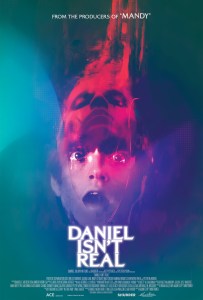 No, I really do and when I made Daniel Isn’t Real, I felt like that story ought to be able to continue. I imagined at the end of that movie, Daniel is established as an entity and this vortex between worlds is established and even Luke is maybe disestablished as a person but might be out there. So I imagined ways that it could go on.
When I was working on Archenemy, which is so literally and specifically about the existence of alternate worlds, I always had it at the back on my head and then surprised everybody in the edit by really insisting on it having the same opening shot as Daniel. It doesn’t look exactly the same but it is the same; we used the same footage we created of the vortex.
Daniel Isn’t Real begins with this void of creation and destruction and it shows up several times throughout the movie and we created that using cloud tank. We dipped back into that same exact footage and found a piece of it and treated it colour-wise but it’s still the same thing that starts Archenemy.
So that right there is saying these are connected parts of a multiverse where there are these tubes of reality connecting all of us so I do have this idea in my head.
For a third movie we’ve got Indigo in the situation that she ends Archenemy in and we’ve got Daniel out there somewhere and we have who knows what iterations of Max existing throughout the multiverse and I could certainly put those all together.
I do like to think of these things as science fiction movies and connected to the tradition of science fiction.
 I think the interesting thing would be to just watch the animation sequences on their own.
That would be an insane Aeon Flux meets Pink Floyd – The Wall – that was always the ultimate fantasy of what that could be if it was a full animated sequence.
Yes, it’s made me want to go back and rewatch The Wall.
I rewatch The Wall all the time. It’s the movie that traumatised me the most in my life and I always go back to it for inspiration. We don’t think about it enough as a movie. We think about it as part of Pink Floyd’s prog rock project but the movie itself, Alan Parker’s movie The Wall is just an incredible piece of cinema that connects memories and time and trauma and it’s just a brilliantly made film. So I always return to it as an inspiration.
Thanks to Tom Hewson at Fetch for assistance in setting up this interview
Image of Adam Egypt Mortimer on set by Stacy Jorgensen and used with permission
Archenemy is out now from Altitude Films; click here to order from Amazon.co.uk
 Doctor Who News Star Trek News
 Sci-Fi Bulletin: Exploring the Universes of SF, Fantasy, Horror and Spy-fi!