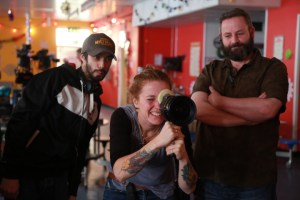
 John McPhail is the Scottish director of Anna and the Apocalypse, the zombie Christmas musical that is coming to Blu-ray from Second Sight this December. Highly enthusiastic about the project, he chatted with Paul Simpson…
The Blu-ray of Anna looks as if it’s going to be packed with extras.
I have been so excited about the Blu-ray – I’m a big fan of owning stuff on physical media, I have a library in alphabetical order – and particularly the second disc, the way they went about getting all the extras together and the original festival cut and the theatrical cut.
What difference is there between the two cuts?
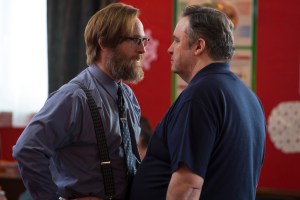 It’s miniscule in places – we lose a song between the adults (Which Side Are You On) in the canteen. For the theatrical, it was the strangest thing – we were getting dictated to by cinemas how long the film could be. The thing you want, the thing you strive for the most, to get a theatrical release, and the moment you do it, they say your film’s too long!
When the Americans bought the film, they wanted it shorter for their theatrical release; myself and [producer] Naysun [Alae-Carew] got quite excited at the prospect of reopening the film. We’d seen it so much, watching it at festivals, but we’d had a couple of months away from it and we could go, “We can trim that, we can trim this”, and make it that little bit tighter. In retrospect, it was lucky to be able to do it, but there was the pain and anguish of cutting your baby up.
J Michael Straczynski used to say you can fiddle with stuff until the heat death of the universe; there’s always something to tweak.
And David Fincher said films aren’t finished, they’re abandoned (laughs)
 What’s surprised you about audience or critical reaction?
What’s been great about it has been the mix of genre fans and the audience it brings together. There are some hardcore horror fans out there who just love this movie, and folk who don’t like horror at all – it’s not their kind of thing – who are loving it. They love pop movies, and this has got gore and violence but it’s something they’re really enjoying. It’s bringing horror and musical fans who are not the traditional Rocky Horror Picture Show fans, more fans of Little Shop of Horrors. That’s brilliant – you can see these polar opposite accounts shouting and raving about how much they love the film.
That’s been welcome – you want people to enjoy the movie, that’s the whole reason you made it, and these two polar opposites are coming together under one banner and that’s really nice.
 What was your initial reaction to the script?
I loved it. It was the characters, I just loved the characters, and there was so much heart to it. When Naysun said to me would I be interested in a zombie musical set at Christmas? Of course, I said, 100 per cent. But I was expecting something like the game Dead Rising on the Xbox – all the villains are pantomime and it’s all a bit over the top – but by the midpoint reading the script, I’m sitting there hoping nothing bad happens to these kids! I loved that aspect of it – the teenage angst of it all. There was a real sense of heart behind it.
You had a strong cast – was that through auditions or did you have people in mind?
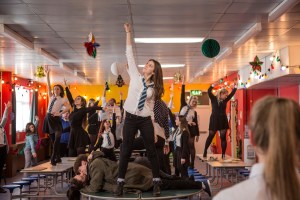 All auditions. We were really lucky when we put our first call out and we got a whole bunch of tapes through. We whittled that done and in amongst there was Ella Hunt, Ben Wiggins, Sarah Swire and Christopher Leveaux; Marli Siu I saw in a play up here in Scotland in Dundee, and I wanted to see her for Lisa. We pretty much found those guys and cast them by July 2016.
The only person we didn’t find until the November was Malcolm Cumming, who played John – we were trying to find the fire, the pocket rocket with the physicality, the boy next door. He had graduated university by that time.
They were all found early doors which was great – we could get them in to do some of the singing so they were singing along to their own voices, an authenticity to it because they owned the song. Once we found the main kids, it was an absolute breeze.
Were there alterations to the script after casting?
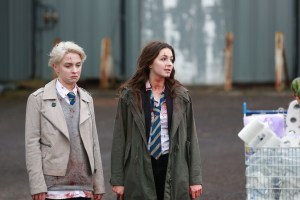 I’m a firm believer that it doesn’t take one person to make a film; it’s a collaborative process. I won’t sit down with my DoP and say “You’re using this, and the second cameraman’s using this, and get a blast of light through here…” I would never dictate how it’s going to be done. Same with my cast – when they came on board I wasn’t going to see them for months, and one of the things I wanted them to do was go through the script and tell me anything that doesn’t sound right, anything they want to talk about.
I wanted them to think about the physicality: the very first day of rehearsals I got them to do a clown class because I wanted them to find the physicality of the characters within them. The same with the dialogue – there are certain jokes and ways of delivering certain parts of dialogue that we all worked on, but if there was something in their voice that didn’t sound right, we could change it.
I wanted them to feel part of the process rather than tripping up over this. It was all up for discussion. They all did take ownership of their characters – and it’s so funny watching them with the little walks or shuffles. The physicality is all them.
Did you take inspiration for the zombies from any particular films or shows, and were there any things you consciously wanted to avoid?
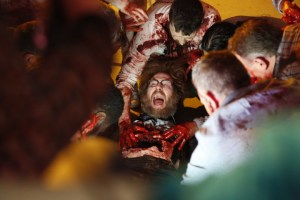 I’m a zombie fan. Sarah Swire, who plays Steph, is also the choreographer and this may sound silly but we did a “How to Zombie” video for all the extras coming in, to get them all excited about it. They could then practise it when they were in the holding areas.
I’m a big fan of the original Romero movies; there’s a certain pacing to this film, and there has to be a little bit of leeway between running zombies and really slow zombies. We were never going to be doing 28 Days Later rave zombies, or the Day of the Dead ones. I wanted to keep a bit of colour in them, so we made them look a bit more jaundiced, a bit more yellow in certain parts of their faces, so not all grey-ed out like Shaun of the Dead. This is Christmastime so you want some colour and an infection like jaundice is going to put that little bit of colour in them.
What was the biggest challenge?
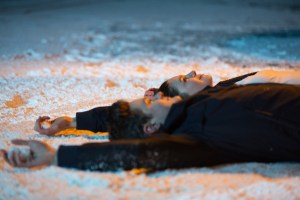 Time and money… honestly it’s the thing that’s the killer.
Being in Scotland, the weather – there were days when you’re filming and it’s cold and grey and rainy and windy and the next day, the sun is splitting, not a cloud in the sky… and you’re trying to match stuff.
I had such a great cast – the kids threw themselves in with so much enthusiasm and passion and I was working with a Scottish crew that I used to work with in the camera department: out in the wind, rain, snow, sun, you just push through it. They all just loved the movie – you’d see the sparks, who are never happy, skipping along singing songs and you’d think it was absolutely mental. There was a real passion to get this film over the line. I was so lucky in that sense.
Do you think that was connected to Ryan McHenry [the originator who passed away before the film was made]?
 Yes and no. There were some who knew Ryan and understood what he was doing; then you’ve got your crew – sparks, camera department, runners – who had never known about Ryan.
A lot of folk signed on because I was directing it – they’d worked with me for years. I came from a technical side, I worked my way up the camera department, and working in Scottish crews for the last 12 years, I’ve gained a lot of friends as well as work colleagues. Folk were coming out the woodwork to come and help me.
And people just loved the film – you don’t know how mental it is to hear so many people humming the songs for months. Complete strangers who aren’t really musical fans!
Overall, if you had to choose one moment from the shoot or the movie itself that sums up the experience for you…
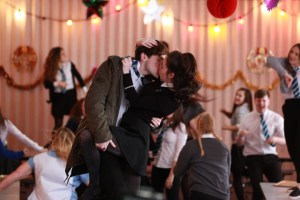 [long pause to think] On the first day of shooting we’d shot Break Away, the first sections of that, and the second day was all about Hollywood Ending, which we had to do over two days. I’d never directed a musical before, and had never worked with a crew or a cast this size.
I remember on day 3, the second day of Hollywood Ending, everything was mid-flow, and I was looking on the monitor, and I thought, “This is working, John!” Not only had nobody turned round and said “you’re a fraud, you can’t direct, get out;” it was what it was supposed to be – colourful, big, ridiculous and bombastic.
There was a part of me thinking “If we can get this to work three days in, we’re onto something.” The following day, my editor cut the whole Hollywood Ending dance sequence, and at the end of the first week we played it back to the crew. It blew everybody away the standard of what we were doing and what we were making. All the self-doubt, the pressure of what I thought could go wrong didn’t and it was going right… if we had made this film any other way, it would have gone so wrong. By pushing through the loss and the pain and the pressure, we came through with something that people are loving, that’s ridiculous and silly and bright and colourful.
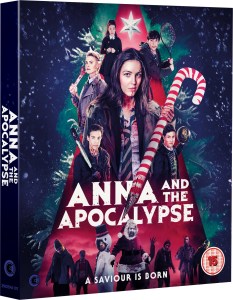 Anna and the Apocalypse is out on Blu-ray from Second Sight on December 2
Read our interview with Ella Hunt and Malcolm Cumming here
Thanks to Debbie Murray for help in arranging this interview.




 Sci-Fi Bulletin: Exploring the Universes of SF, Fantasy, Horror and Spy-fi!