After Yang: Interview: Kogonada and Justin H. Min
Kogonada’s new movie After Yang, starring Umbrella Academy’s Justin H. Min, is out now in cinemas, and on Sky Cinema. During a brief visit to the UK, the pair chatted […]



Kogonada’s new movie After Yang, starring Umbrella Academy’s Justin H. Min, is out now in cinemas, and on Sky Cinema. During a brief visit to the UK, the pair chatted […]
 Kogonada’s new movie After Yang, starring Umbrella Academy’s Justin H. Min, is out now in cinemas, and on Sky Cinema. During a brief visit to the UK, the pair chatted with Paul Simpson about the movie, which is based on the short story by Alexander Weinstein…
Kogonada, what was your initial reaction to reading the original short story and Justin, what was your reaction to reading the script?
 Kogonada: I read the whole collection [Children of the New World]. A producer had given it to me, had told me to read another story – I think it was The Cartographers, which is great and captivating – but I didn’t think at that point in my career that that was the path that I was going to take. [But] I was really drawn to ‘Saying Goodbye to Yang’ because it was so deeply grounded and it was really like a family drama.
I love this novel by James Agee called A Death in the Family, about a family dealing with the death of a family member. This sort of reminded me of that but with a sci-fi twist that would make you rethink death itself or what absence means and that element of it really struck me. There was just some quietness about that story that I was just immediately drawn to.

Justin: I was given the script by my manager who said it was the best thing he had read in a really long time, and as soon as I saw the title page, I knew who Kogonada was. I was familiar with his visual essays, I’d been such a huge fan of Columbus, so I was bracing myself.
It was unlike anything I had read in a really long time.
I feel like the industry is shifting towards a more fast-paced, page-turning type of script style, mainly because I think it’s harder and harder to keep the attention spans of most people reading and audiences, with the advent of things like social media. So I’ve spent the last few years reading these very intense action-packed scripts and there was something about the quietness that K was just talking about and the confidence to be what it was as simply as it was, that really struck me.
And again, knowing his work, I could start to visualize how someone like K could make something like this come to life. I just got so excited and wanted to do whatever I could to be part of the project.
How detailed in the script were the descriptions of the montages such as the glimpses that we see of Yang’s memories? Were you very specific in the script as to what they were or were you writing it knowing you were directing it and could leave it till then?
 Kogonada: Yes, I think when I’m writing something that I’m going to direct – and everything I’ve written knowing that I’m hoping to direct it – I don’t have a lot of direction written into it. I think with the memories I just try to explain the emotion of it, that we’re going to come across this series of memories, and I think I gave a few light examples of it. But really, in the description I just wanted to capture the emotional revelation of it, so it wasn’t like ‘Oh here are the…’ because I thought ‘That’s going to be a discovery.’
The same is true in the direction of it. As a writer, I’ll read scripts that have so much direction in it and maybe it’s because a writer has to hand it off and they want to offer some visual template but for me, because I know that I’m going to direct it, I want that to happen later. I just want to deal with the emotional architecture of a script [when I’m writing].
So to answer your question, it was a little less specific
There’s the old saying that a movie’s made three times: on the page, in the directing and in the edit room. Did you find that as you were directing it you were finding things that, using the visual part of your brain, you hadn’t expected when you were using the writing part? And then later in the edit room… Did you see different versions of the story in the film in the different phases?
 Kogonada: Definitely, yes. I think each role created its own possibilities for me. And certainly, in collaboration you identify actors that have a certain kind of presence and quality, and you do really want to give them space because that’s why you want them to be in the world.
What actors do is almost like magic to me. You create the scenario and you have all these ideas but I think the best actors are always surprising and they’re always offering you layers that maybe you couldn’t ever write because there is some limitation to words. Suddenly in this dimensionality what someone like Justin or Colin brings into a scene…there aren’t words for it, truthfully there aren’t words for that and so I’m very excited about those surprises and how we’re going to approach this space.
Once we started building out this space it offered other possibilities and then editing, yes. That final writing, you really get to process it differently so, yes.
Your visual essays as well feel very much like you work backwards from the edit.
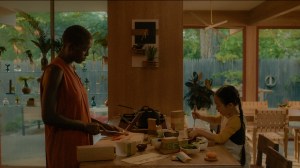 Kogonada: Yes, I feel like editing is like cooking. Everything is about getting the best ingredients possible. This is how me and Benjamin [Loeb], the DP, would talk about a day: ‘Oh, every day is like going to the market.’ And you have this recipe in your head but if the vegetable or the ingredient that you wanted is not good that day, a bad chef would just insist on [following] the recipe and use bad ingredients but I think, in the realm of cooking, you pivot and you’re like ‘God, this is the best ingredient for the day so let’s rethink what we wanted to make.’
I think when you’re editing, really, when you have the best ingredients that you’ve brought together then you make the best dish out of that.
I learned that from the essays. I never scripted those essays and then tried to find images to fill. It was very much, ‘I have this incredible footage and this incredible director, what can I make out of it?’ That’s, to me, the very exciting part of the medium that we’re a part of.
Obviously, Justin, to readers of SFB you’ll be known from Umbrella Academy which presumably has a far more rigorous set process of making it – you’re not adlibbing lines and changing stuff as you go along. How did it feel for you, as an actor and as a creative, to be involved in a far more fluid situation?
 Justin: Yes, I would just echo what K said and what you said, Paul, with regards to the fact that K is the director, writer and editor and so he’s the person that I can go to for any and all questions.
As an actor it is such a gift and a luxury when the person directing you is the editor and has such a precise vision in the way that K does because, as you’ve already pointed out, there’s very standard things that we do in television and even a lot of movies. You get the master [shot], then the wide, then the medium and the close up… and you have no idea what’s going to be used because the director has no idea what’s going to be used because it’s saved for the edit.
K did not necessarily waste time doing all of those things. If he knew he was going to use a wide for a shot, we would just shoot the wide, and that really created such a sacred place for us to play and explore because we knew how this scene would be edited and work. So we could really focus and hone in our time and energy into these beautiful compositions that K made and I really appreciated that while working on this.
Looking at the final movie, are there choices that he made in the edit that you were surprised, that you thought ‘Ahh, I did this differently, I would have expected that one to be there’?
 Justin: Oh yes, the biggest surprise was the memories. He did not tell us and it was never written in the script that there would be that… what would you call it?
Kogonada: Echoing, the repetition.
Justin: Yes, echoing, the repetition. We just shot multiple takes of the scene and we would discover new things and new things would come about through the process of filming these sequences and then the way he edited them together in these echoing, repetitive patterns was, I thought, really beautiful and really emphasise the subjectivity of memory.
It was such a beautiful pleasant surprise to see that on screen.
That is one of the things that really strikes me is there’s almost bouncing back, echoing back through time as we go through the movie and what we learn. How much did you shoot it chronologically or was it the usual production issues of ‘I’ve got Colin for six days’?
 Kogonada: (Laughs)
How much did the realities of filmmaking impinge on the creative, I suppose, is what I’m getting at?
Kogonada: I hope one day I can do a film in chronological order, I think that would be really lovely. I’m sure for an actor too.
Justin: Oh my gosh, that would be amazing, yes.
It’s like doing audio work – it’s often done, pretty much from page one to page thirty six or whatever. It’s such a novelty.
Kogonada: Or like theatre.
 It’s such a challenge for actors in those fragmented spaces but it’s really their craft too. They’re able to bring and track their emotional arc even though we present it to them as a salad. It is I think, also what they do, what really great actors hone in on.
What was nice though, there was a sense of that when we got towards the end. Most of the film exists in the house, so that made it less fragmented because not often do you have a film in which more than 50% of the film takes place in one location. We had a real house, so we suddenly had two weeks – maybe even a little more than two weeks – where we just shot all the house scenes. Even though it wasn’t exactly in order, it did give a cohesiveness to that family space, I thought.
That came across. That’s why I was wondering, particularly with the wide shots. I love the number of times we’ve got the focus on the centre and things are happening to the sides. Emphasising the husband and wife going their own ways as they come out from the centre was one of those ‘Oh that’s nicely done’ moments.
Kogonada: Thank you for noticing that; that’s really great, appreciate that.
The idea of clones is in the original story – George has clone daughters – but the focus in the movie becomes more on the relationship between Yang and a clone. What made you want to go down that route and make those changes?
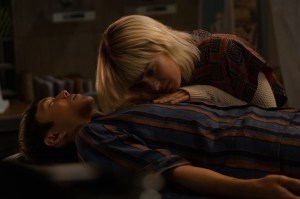 Kogonada: I think that a big part, for me, of what this film was going to be about was kind of going deeper and deeper into Yang’s temporality, that’s there’s this whole [other] life.
I didn’t know that I was going to write this second level of it but there was just something about him encountering another being, not necessarily another A.I.
It felt like I was Jake when I was writing it, that there was just this moment where I knew that he was exploring Yang’s memory and in that moment, I felt like there was some deeper level of time that he was going to enter. And this clone felt like the perfect bridge to that and when that discovery happened, it really was a surprise.
 I think that’s the great thing about writing fiction. It was my first foray into sci-fi and that genre allowed me to play with time. I love time in cinema – this medium is a medium of time – so to be able to explore it in that tangible way was really exciting for me.
After Yang is out now on Sky Cinema
 Doctor Who News Star Trek News
 Sci-Fi Bulletin: Exploring the Universes of SF, Fantasy, Horror and Spy-fi!