2036: Origin Unknown: Interview: Katee Sackhoff
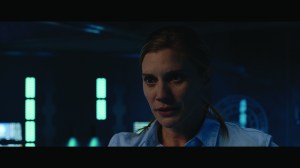
2036: Origin Unknown is a new SF film arriving next week that stars Battlestar Galactica’s Katee Sackhoff as Mack, whose life has been changed by a disaster in her past… […]



2036: Origin Unknown is a new SF film arriving next week that stars Battlestar Galactica’s Katee Sackhoff as Mack, whose life has been changed by a disaster in her past… […]
 2036: Origin Unknown is a new SF film arriving next week that stars Battlestar Galactica’s Katee Sackhoff as Mack, whose life has been changed by a disaster in her past… and when an “origin unknown” comes from Mars, she’s in charge of the investigation from Mission Control on Earth. However, it soon becomes clear that computer ARTi can give instructions – and Mack’s sister isn’t helping a situation which starts to escalate! At the start of July, Sackhoff took time away from her new role as star and executive producer of Netflix’s Another Life to chat with Paul Simpson…
2036: Origin Unknown is a fascinating movie and looks fantastic even on a screener link.
I’m so glad you enjoyed it. The second time you watch it, in my opinion, it’s almost like a different film, because you watch it with a different set of eyes.
We need to be careful of spoilers, so perhaps it’s wiser to stick more to the practicalities: how did you get involved?
My manager had this script come across his desk; he is one of the smartest people I’ve ever met, intellectually speaking. He said, “You’ve got to read this script, but do me a favour and read it twice, and then call me and we can talk about it.” I did; not only did I read it twice, but I read it a third time because I was like, “Oh my God, what’s going on?!” Then I went back and read it again – Did I miss things? What’s happening?
It intrigued me so much. It felt it was something ground-breaking in science fiction, which is not easy. Everything seems to have been done before; I’m not going to sit here and say that it’s not been done before, but for me, in this way, to have a one woman show in film as opposed to on the stage was intriguing. I thought that would be an interesting challenge.
 Was the script written objectively so it told you what your character did, rather than giving insight into what Mack was thinking at the time? I would have thought it would be difficult to write it without giving away certain elements if there’s any degree of subjectivity in it…
Exactly. You had no idea what Mack was thinking at all; you just read it in present time, on her journey. And then the last 30 minutes of it moved so fast, you got to that point and you were like, “Wait a second, what the hell’s happening?” You had to read it a second time to understand what the whole metaphor of the movie was.
In terms of that, a lot of it is built round the two relationships – the one with her sister, and the one with ARTi. Which did you find the more challenging to play?
I think the relationship with ARTi was probably the most challenging just because I think that they do have a relationship. If ARTi was in human form it probably would have been a romantic movie…
You reckon?
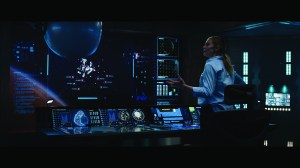 In the sense that it’s a man and a woman stuck in a room together, well of course it might lean you in that direction. Especially if you’re two-like minded scientists, you have a lot in common, and you spend a lot of time together, you’d probably look at each other sidewise once in a while. I wanted to make sure that their relationship felt… (pauses) familiar and confusing. Like when she’s sitting there and talking to him about whether he feels? And she tells the story of her father. You could see a person having that same conversation with a human being.
It was interesting, and hard and challenging, especially as I was having the entire conversation to absolutely nothing on the ceiling.
The scene that felt very in-, or un-human was where Mac’s telling jokes and trying to get a reaction from ARTi to the jokes – and there’s nothing coming back (or rather what does come back is frightening when you look back at it). If that had been with another person, you’d have some serious concerns about them…
Of course! You’d probably think that they’re a serial killer.
 How much did the script alter between when you read it and filmed it?
It was identical – well, maybe not identical. We had a week of rehearsals and communication when I was actually in the UK, then I had the script for a month before. So much of the dialogue stayed exactly the same because it was based in science and I couldn’t change it.
Some of the emotional stuff changed, but not really. The one speech at the end of the movie about humanity I completely rewrote that myself. The reason being, knowing the end, it felt a little wooden, a little like she wasn’t included in the conversation, so I changed it to make it more simple. I took something that was initially a page long and turned it into three lines. Mack’s running out of air so in the circumstance she finds herself in, you wouldn’t be able to talk that much longer, and I really wanted to strip it back so the audience would understand what the point was of this speech.
Often less is more in that sort of circumstance in terms of communicating the character.
 I think so. I think a lot of times, and it is absolutely no criticism of writers at all – and the Battlestar writers did it too – writers want to write. It’s what they want to do, and very rarely do they say [what they’ve written] out loud. Something can look beautiful on the page, but you say it out loud, you realise that it’s not right. Partially it’s not right because the person who’s inhabiting that character that you’ve written for knows that character better than you ever will.
Sometimes shifting the way something’s written makes it feel more real, and becomes more real because of that. I have an 80% rule – unless somebody comes to me and says, “This has to be word for word,” I usually do 80% [of what’s there] and give myself 20% to play with it a bit and change it the way my character would.
I usually get a script for TV and go through it crossing out redundancies. I like simplicity. Not with every role obviously, or every scene, but I think you should be able to convey every single thing you’re feeling with your face, and if you have to say it, in my opinion, then you did it wrong. My goal is to try and take an audience on a character’s journey with the expression on my face and less of the dialogue if you don’t need it.
You’re working on Another Life for Netflix – how much of what you’re talking about here about paring back dialogue are you able to bring into a series where you’re involved from the start?
 So much. On Battlestar, I did it and didn’t always ask permission. My goal has always been that if the writer’s on set and I’ve said their dialogue they shouldn’t be able to tell that I’ve changed it at all, because the intent is still there. And if I change it I should have a pretty damn good reason why. On Battestar I was known for completely writing myself out of a four page scene – they said, “Why?” I said, “She’s drinking, she’s hungover, she literally would not be here.” They said, “You’re right, go!” It’s the truth – she wouldn’t be there.
So being a producer on a project is sort of a dream come true for me, particularly in science fiction. I have logged so many hours on set in the 20 years-plus I’ve been in this business that there are a lot of times in my career where I walk on set with probably more on set experience than most of the people there. To be able to have that little bit more responsibility is a dream come true.
Right now, the scripts are being written in the writers’ room in Toronto, and I’m sending notes off, saying, “This wouldn’t happen, I think she should do this.” Within reason, of course – Netflix signed off on a show that’s one thing, and it’s not as if I can change that. But I have a firm understanding of who I want this woman to be, and it is exciting for them to have to listen to me.
I n terms of 2036 what was the biggest challenge for you?
The preparation. This is not a big budget movie. This is a movie that we shot in seven to nine days; it was a fast moving truck. Not to mention we had an issue with my work visa in the UK and they kicked me out of the country after three days so I went and sat in Dublin for five days waiting for my work visa. Every day I was in Dublin was a day we lost on set.
They did as much as they could with a body double – hand motions, walking – but we lost days and on a film like this to lose days is terrifying. I showed up on Day 1 and because there were no real scenes in this, had I not prepared it like a play, and I could have gone from front to back in one take, I don’t know if we could have made this.
I’m so thankful that I did all of that prep work. I hired a reader to come to my house every day for a month before this project and we did nothing but memorise this for two to three hours a day. Had I not done that, there’s no way we would have finished. That was the most challenging thing but also what I’m most proud of.
My first day on set we did a 26 page take, and just kept going. The director said, “How far can you get?” I got my visa at like 3 pm, jumped on a plane from Dublin and I was on set working for four hours before we wrapped for the day. I went, “Let’s see how far I can get.” I was shaking, my adrenalin was so high!
I love science fiction and to give audiences something they may or may not have seen before is always a challenge, but it’s one I will continue to embrace
2036 Origin Unknown will be available on iTunes, other platforms and DVD from 13th August.
 Doctor Who News Star Trek News
 Sci-Fi Bulletin: Exploring the Universes of SF, Fantasy, Horror and Spy-fi!