Eureka, out now Celebrating its centenary is this two-part earliest adaptation of Thea Von Harbou’s 1917 novel of tiger hunters, Maharajahs, and magicians in exotic India. Von Harbou was obsessed […]
Eureka, out now
Celebrating its centenary is this two-part earliest adaptation of Thea Von Harbou’s 1917 novel of tiger hunters, Maharajahs, and magicians in exotic India.
Von Harbou was obsessed by India, but like many other Europeans, British and otherwise, was mostly taken with the mysticism and mystery of the various different nations and cultures within it – which is probably why the film ends up being filled with a blend of Hindu, Sikh, Muslim, and Buddhist design and imagery. Likewise, most Europeans at the time who did visit or read about India were faced with and intrigued by the street magicians, and ascetics, without thinking through which culture is which, or indeed whether this was just the local form of entertainment.
This was, after all, not just the era of the British Raj, but of Theosophy and Charles Fort, and the swelling awe at eastern tales and trappings which were different than the recent and fading fashionability for the Gothic.
With that in mind, it’s perhaps less surprising that we’re offered a novel, and here the movie, which opens with a vengeful and lovelorn Prince Ayan (Conrad Veidt) digging up and resurrecting a 150 year-old buried Yogi, Ramigama (Bernhard Goetske) and using his powers of telepathy, bilocation, psychokinesis, and hypnosis to recruit noted architect Herbert Rowland (Olaf Fonss) to come to India and build a tomb for the Princess Savitri, who isn’t dead. Yet.
This is where it gets complicated: the Princess has been dallying with a tiger hunter called Mac Allen, and Ayan keeps sending henchmen to kill him, while planning to bury his love (the emotion, and probably the Princess as some sort of meta combo) in a new tomb built by Herbert. However, Mac keeps escaping, and Herbert’s fiancée Irene (Mia May) crosses the world in pursuit of her man, despite Ramigama’s sorceries, until she reaches India in time for the Princess’s servant Mirrhja to plead with her and Herbert to help save Mac. This complicated by Herbert’s leprosy, which only Ramigama can cure….
It sounds very melodramatic, and Indiana Jones-ish, and it is. Though advertised, then and now, as an adventure melodrama, The Indian Tomb is actually rather more fantastical than that description implies. Ramigama is, to modern eyes, strong in the Dark Side of the Force, able to change his appearance by force of will, control minds (if this sounds a bit like The Shadow as well, you’d be right, it’s the beginnings of that era of genre), teleport objects from miles away… In many ways he’s almost a prototype of the kind of villainous magician that Veidt would subvert as Jaffar in 1940’s Thief Of Bagdad, except that of course neither of them are truly villains; Ramigama is bound by sacred duty until things even get too much for him, and Jaffar in the later film does everything for unrequited love.
One of the more interesting elements is that this film gives as kind of a stillness-off, a muscular control contest between noted master of stillness Conrad Veidt, and his henchman Bernhard Goetzke. Veidt does it better, but also has to perform some theatrical reaction moments that Goetzke doesn’t, so we see more of it from Goetzke, and he almost manages to steal the first part of the film – The Mission Of The Yoghi – entirely. Veidt comes to the fore in the second half, The Tiger Of Eschnapur, and controls it from there, bringing a level of facial acting that none of the rest of the cast can match. It’s not his best performance, but we do get an awesome moment when he tries to seduce Irene by appearing painted gold in what looks more like an Inca outfit with miniskirt and jewellery, which basically wins Drag Race almost a hundred years before that show was created.
Olaf Fonss is personable enough as Herbert, giving a good show a character who learns something by his travels, while Mia May is fine as Irene. It’s worth noting that her arc is one way in which the film improves upon the novel, by making her an independent adventuress who pursues her stolen man, whereas in the novel she just appears at the Prince’s court with no real explanation of how, and is much more subservient.
Directorially, Joe May does a decent job, and you can see in some moments that Fritz Lang probably was very specific about certain sights in the script, as there are recognizable shots that compare well to Lang’s other films – but thereby hangs a tale. Lang was originally slated to direct, until the financiers refused to fund such an expensive film (adjusted for inflation it’s still the most expensive German film ever made) for a directorial debut.
Being a 1922 European film it has flavouring of Orientalism, and even more obviously German actors in brownface makeup – primarily Veidt and Goetzke – in the lead Indian roles.
If there’s any comfort to this, it’s that none of the Indian characters are treated as savages or in any way inferior, and if anything the European characters are more looked down upon. Except for the heroine, played by Mai May, the producer/director’s wife, and we probably have to excuse him that particular personal bias.
May had made Mistress Of The World the previous year, and taken flak from the Chinese community from their portrayal, and as a result he… listened to them, changed the film accordingly, and tried to do better this time. It’s 1922, it’s not a paragon of progress by today’s standards, but he and Lang tried to be understanding and progressive. Of course we still get tableaux of Yogis on beds of nails and meditating upside down, and May can’t resist showing off amputees as lepers in the their enclosure as if they were carnival sideshow exhibits.
Character-wise, thankfully, things are a bit more balanced, with all the characters – even relatively minor ones like Ayan’s guard captain or major domo – are given some depth and the main characters all have both flawed and admirable characteristics.
Being a century old, it should come as no surprise that some parts of the duo have visible damage, though the 2K restoration has reduced this a lot, and so the picture quality is far better than ever before, with the coloured tints much more effective, if occasionally somewhat random and undercutting the original intent of tone-setting. Somehow, though, that kind of adds to the centenary feel. In terms of sound, well, obviously there’s less to consider, as it’s a silent film, but there is a modern (2018) score by Irena and Vojtech Havel applied to it, and it’s pretty dire. It’s a mix of tinkly piano, and endless context-free bassoon droning, and, frankly, viewers with an interest in creating score playlists or composing their own music would probably better enjoy the chance to dub their own choices on.
Unlike most Eureka and Masters Of Cinema releases, there’s only one extra, a 45-minute video essay by Fiona Watson and David Cairns, narrated by themselves. (Jessica Martin, who narrated their essay on last year’s Hands Of Orlac release here provides some evocative illustrations too.) This is a good piece, with plenty of background material about the convoluted political and love lives of makers of the film, and stills and clips from not just this but other films made by the same people, some of which we might hope will get restored releases in future – and sadly some of which are now lost. Best of all there’s actually a visit filmed last year to what’s left of May’s studios and the sets from this and other films. This really impresses with the contrast between what seems to be blazing India on screen, and a rather autumnal Berlin beachfront!
There’s also a booklet by Philip Kemp, which is a fascinating read, though does cover a fair amount of similar ground to the video essay.
Verdict: It’s an interesting piece of film history, and impressive production on the creative front, and has outstanding stars – it’s not Conrad Veidt’s best film or performance, but it is Bernhard Goetzke’s – and the fascinating early influence of Fritz Lang, but it’s too long, suffers from the static camera when a moving one could have shown off the impressive sets and set-pieces more, and the Mac Allen character is pretty much redundant. It’s also a mixture of early inclusive progress – especially with depth of foreign characters, and the role of the female characters – while at the same time being somewhat exploitative to the grotesque. It’s certainly worth seeing, especially as a piece of cinematic history, or if you’re a fan of one of the performers or director. It’s probably not one you’ll rewatch often though, at least not without hitting the fast forward button to get to the good or noteworthy bits. 7/10



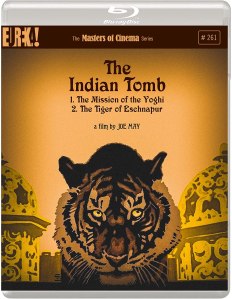 Eureka, out now
 Sci-Fi Bulletin: Exploring the Universes of SF, Fantasy, Horror and Spy-fi!