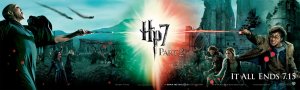
 And so it comes to this. The final chapter in a cinematic saga spanning one decade and eight separate entries. An undertaking the like of which had seldom been attempted before with a continuous narrative, the same actors (wherever possible) and a tale of good vs evil. David Yates took the helm for the final time to bring the Potter series on film to a close. But with Deathly Hallows Part 1 having opened to monumental success and a box office beaten in the series only by Philosopher’s Stone, Greg D. Smith asks whether there was a chance that high expectations might see the bubble burst at the crucial moment?
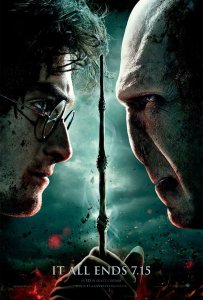 Freed again by the intervention and sacrifice of Dobby, the Boy Who Lived must find the final Horcruxes and a way to destroy them before he can face Voldemort and bring the Prophecy to its conclusion. On the way, he will find out the most shattering of truths, as he faces up to the realities of his destiny and discovers that he might not have known Dumbledore as well as he imagined.
If there’s one thing that I noticed more than anything in re-watching the final entry in the Harry Potter film series, it’s that there really isn’t an awful lot of dialogue, considering the breadth of the cast. It had struck me from the first time I saw it at the cinema that it is not an especially complex film – having ended the predecessor at a point nearly three quarters of the way through the narrative of the book, I had expected this finale to concentrate mostly on the Battle for Hogwarts, and in this I was proven – unsurprisingly – correct. But as I sat here watching massive battle scenes unfold with a cast of luminaries from across the ten years that the franchise had been on screen making their appearance, I was struck by how very little most of them have to say. Julie Walters, for example, as the redoubtable and formidable Molly Weasley, the biggest maternal figure in our young hero’s life, gets precisely one line of actual dialogue; “Not my daughter, you bitch!” True, to fans like myself, this is one of the most iconic lines (and scenes) in the entire novel saga, but that such a character played by such an actress should be resolved to this one line of dialogue as a shorthand for their character sort of sums up this film in a nutshell.
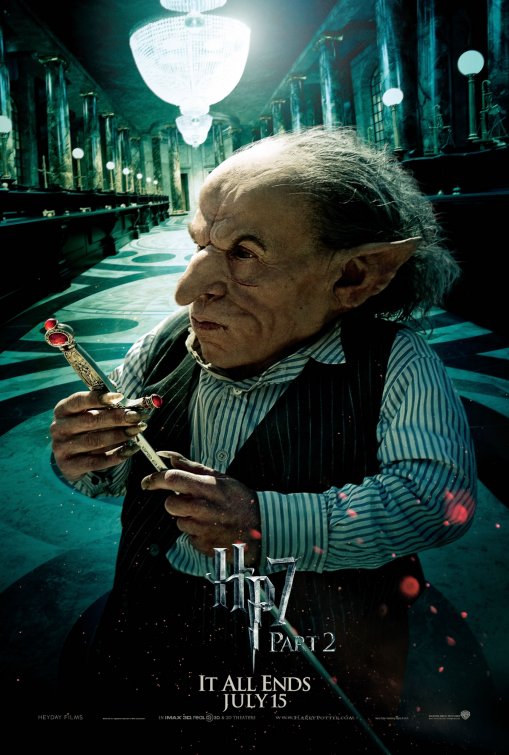
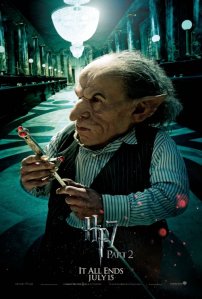 For the first half hour or so, it’s all about resolving all the loose ends of plot that got left dangling by the last entry – the deal with Griphook (played by Warwick Davies – surely the most hardworking actor in this entire series by dint of number of parts alone), the raid on Bellatrix’s vault in Gringotts, the escape on the back of a dragon – all of this is rushed through so that we can get to the bit that the director (and more importantly, one senses, the studio) really wants to get to: the big battle.
And let’s be clear – the Battle for Hogwarts is enormous, and multi-layered. The majority of the pupils, the teachers and whoever else is left from the Order are fighting and dying against the legions of Darkness thrown at the school by Voldemort. Meanwhile, Harry must find the Lost Diadem of Ravenclaw, Ron and Hermione must find an alternative to the Sword of Gryffindor to kill Horcruxes, Snape must play his own part, Harry must run into Draco and pals, the exact loyalties of the Elder Wand must be determined and Harry must die, chat with Dumbledore in the afterlife, resurrect and then kill Voldemort once and for all. There’s a lot going on!
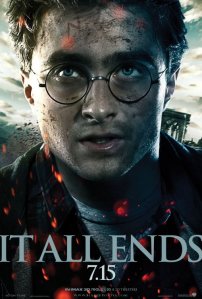 What we find here though, is that quite a few of the more important parts get skated over somewhat. Most glaring of these is Dumbledore himself. In the novels, Harry discovers many things about his erstwhile mentor, not the least of which centres around his relationship to a man called Grindelwald, and the path he almost trod with that man as they both vied to outdo each other in feats of magical greatness. Rowling’s after-the-fact asides about the sexuality of Dumbledore notwithstanding, these revelations about Dumbledore in the novel put a whole new slant on the character both Harry and the readers had come to know and love. Knowing that Dumbledore had made mistakes – some of them with dreadful consequences – helped to understand not just his determination to do right, but also his understanding of his enemy. Dumbledore is able to anticipate and outwit Voldemort not simply by virtue of being extremely good and clever. He’s able to do so having almost become that same character – someone so consumed with the idea of his own power and greatness that he loses sight of anything approaching morality. Not only that, but he was drawn inexorably towards the power and charisma of Grindelwald, and so is able to understand (and even in some cases, like Snape) forgive those who have been in thrall to the Dark Lord. All of this is vital in understanding the man that Dumbledore was and is, and why he is able to make the decisions he does. The film ignores all of that. All it tells us is that Dumbledore and his brother didn’t really get on, that they had a sister who was somehow ‘sacrificed’ by Dumbledore, and… that’s it. The relationship to Grindelwald is not mentioned. Grindlewald himself gets the briefest flashback scene of Voldemort interrogating him about the whereabouts of the Elder Wand. Who Grindelwald is, what he represents, even the very fact that he knew Dumbledore at all beyond whatever encounter led to Dumbledore being in possession of the Elder Wand, are all left unsaid.
 This is important, because all of these things have a great deal of import, not least on the Snape subplot which is similarly cut back here. When Harry uses the Pensieve at Snape’s suggestion (in a line added by the movie) he sees a subtly altered series of events to lead him to the conclusion that Snape is a good guy. This is partly arguably necessary because the film short changes Dumbledore as above, but also actually works to undermine the subtlety with which Rowling had invested the character in the book. The point about Snape is that he is neither a wholly good or bad person. The book makes it clear that Snape’s motivations in switching sides originally were purely selfish, and that his protection of Harry is far more about his own attachment to Lily than about doing the right thing. That’s not to say that the Snape of the novels is not a brave man who does extraordinary things, but his personality and history are more nuanced than the movie allows here. It starts to feel, oddly, that Yates is trying to slightly simplify some of the subject matter of the book for the movie going audience, as if he doesn’t quite trust them to grasp a character quite so complex.
 That’s in keeping with the overall aesthetic of the movie – it favours broad, bold strokes of action with minimal dialogue and a simplistic certainty in terms of good and evil. Where it starts to struggle is in certain elements of plot it was unable to discard which carry the traces of that nuance, and which feel odd and out of place. Aberforth is one example – his part is essential here but cut right back as discussed, so we learn nothing of him beyond his antipathy for Dumbledore. Griphook is another– his perception of Harry as a curious example of a wizard because he ‘buried the house-elf’ makes absolutely no sense here because the entire House-Elf part of the Potter books – how they are a servile slave caste within magical society, Hermnione’s campaigning for their better treatment, etc – was dropped from the movies. When Griphook makes this observation, you could argue that perhaps as a teller at Gringotts he’s only used to dealing with monied wizards like the Malfoys and maybe he saw how they treated Dobby, but it still doesn’t quite hang right in the context.
 As the shortest entry in the franchise at 130 minutes, it starts to remind me of the third entry in Peter Jackson’s Hobbit trilogy – both have the feel of narratives that have not only been stretched too thinly but cut oddly. Each has the issue of being the shortest and yet somehow managing to feel like the longest, and each invests far too much time in a battle which didn’t last all that long in the source – in the book, the Battle of Hogwarts lasts 118 of the novel’s 607 pages, from the very beginning until the death of Voldemort and the slinking off into the shadows of Harry. Odd choices are then made with that ending – in the book Harry vows to re-inter the Elder Wand with Dumbledore and hope to live a long life and die of natural causes, such that the power of the thing will be dispelled forever. Here, he just snaps it in two and throws the halves in the ravine. As to the Resurrection Stone, confusingly its fate barely registers here where again in the book Harry makes the conscious decision to drop it in the forest and never go looking for it, knowing that nobody else knows where it is. This is again important character note stuff for the character – per the tale of the Three Brothers, Harry, possessing the cloak and the stone and being the true master of the Elder Wand, is the master of Death. This is the position which Voldemort, through his scheming and murderousness, has sought for his entire existence. It is this which has made him the shrivelled husk of despicable humanity which he is. Harry’s realisation of this central truth, and his conscious decision not only to avoid this fate himself but to ensure that none after him can try to become the next Voldemort, is the literal point of the journey. The murder of Voldemort is just a part of that journey, and not one our young hero faces with any relish. Here though, Harry is simply there to kill Voldemort, because that one act will make the sun shine, the birds sing and all the world return to its natural order. Like Part 1 before it, it’s not that this makes for a bad movie, just not one that feels as if it really understands the source material from which it is drawn.
 What this feels like, at base, is the very opposite from the goal Rowling had set that decade previously with Philosopher’s Stone. With her strict insistence on English actors and locations, it was clear from day one that Rowling wanted her story to be told on screen, not a Hollywood-ised adaptation of it. As time wore on and the books got longer and various directors wrestled with what they could reasonably get away with cutting to prevent the attention of young audiences wandering, the Deathly Hallows duology in general and this final entry in particular feel like the final threshold being crossed. It would be unfair (and disingenuous) to suggest that this is the ‘Michael Bay’ version of Harry Potter, but certainly it is removed enough from its source to be something lesser. Our hero becomes a typical cinematic cypher, here to win the girl (who it must be noted barely appears here except to turn up every once in a while for a chaste little kiss before Harry moves onto the next Thing He Must Do in the Journey To Kill Voldemort), kill the bad guy and accept the rapturous applause of the crowd when he’s done before wandering off into the sunset to emote a bit about how hard it’s all been really. Small details like Neville’s final confrontation with Voldemort playing out differently, the total absence of Grawp, the location and manner of Snape’s death all add up gradually into a mountain of missed points, and leave us with a movie that – unlike Goblet of Fire and Order of the Phoenix – gives us not so much the impression of the source material without all the detail, but more the idea of someone wanting to make a Young Adult action movie and then draping it in a Harry Potter-themed skin to sell to the kids.
 The one part that Yates does weirdly get righter than anything else is the epilogue. Re-filmed after the original footage leaked onto the internet and was roundly derided, it too misses some trivial but scene-setting detail but still catches the very essence of the scene. When Harry assures youngest son Albus Severus that he is named for two headmasters of Hogwarts, one of whom was the bravest man he even knew, it’s a great reflection of the novel, though perhaps with different emphasis here thanks to Yates’ direction virtually canonising Rickman’s Snape rather than giving us the full picture of the character as he should have been.
Staggering achievement though the movie was in so many aspects, it is that lack of nuance which will stick with me, together with the waste of getting so many luminaries of British stage and screen into one place and then rendering them mostly mute bystanders to the CGI mayhem coursing around them. Though it started with a roar, the Harry Potter movie franchise ends on a definitive whimper.




 Sci-Fi Bulletin: Exploring the Universes of SF, Fantasy, Horror and Spy-fi!