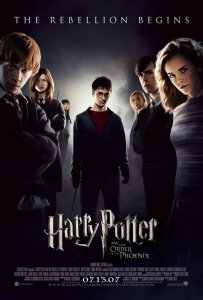
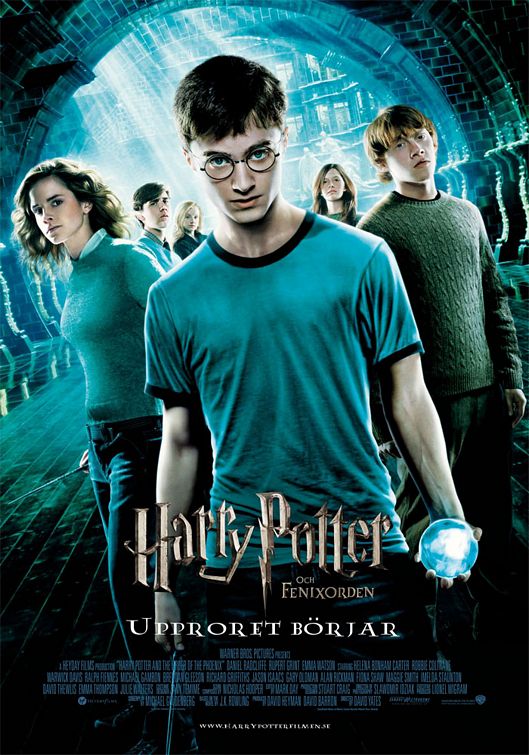
 The fifth instalment in Warner Bros’ Harry Potter movie franchise saw David Yates take up directorial duties. Not only was Phoenix the longest of the Potter novels, but also it was infinitely more complex than what had come before it, dealing with themes of institutional corruption, denial and the political engagement of youngsters in ways that the previous entries had not. Rowling’s work had always reflected the growth of her young characters over time, but this was the line in the sand where they crossed from slowly darkening optimism to full-on disillusionment. Yates’ background as a TV director of shows like State of Play and Sex Traffic was – he believed – why he had been approached to do this ‘edgy and emotional’ film with it’s ‘political backstory’, but, asks Greg D. Smith, could he distil a novel over 100 pages longer than Goblet of Fire into a manageable film while doing justice to the source material?
Harry must face a new kind of infamy as the Ministry of Magic firmly denies his claims of Voldemort’s return and his explanation of Cedric’s death. When he is unfairly expelled from Hogwarts by the Ministry, it sets in play a chain of events that will force our young hero to make some desperate choices to stand up for what is right, as he and his friends prepare for a war nobody wants to admit is already on their doorstep.
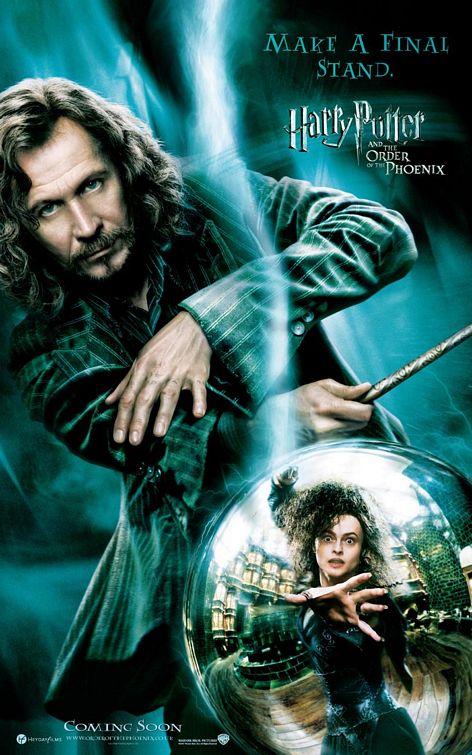
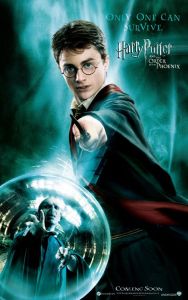 The fifth book in the Harry Potter franchise is often cited as the most difficult to read first time round by fans. Harry spends so much of the book being incredibly angry at just about everyone around him that it’s difficult to sympathise with him as a character, even as he goes through some truly awful trials and tribulations. It also contains the first death of a significant character – Cedric’s death is tragic but up to the point it happens, he is really only an opponent in the Triwizard cup to Harry. When Sirius is killed in the Ministry’s Department of Mysteries, we see Harry lose someone who is the closest thing to actual family that he has left, and it necessarily carries more significant weight, doubly so for being at the hands of Sirius’ own cousin.
But Order of the Phoenix is also in many ways the most important. To this point, Voldemort has been a singular threat, with perhaps a handful of odious but relatively easily dealt with followers. Wormtail is a coward, Barty Crouch Junior is quite mad and Lucius Malfoy is a wealthy, powerful man who got fooled by a kid with a sock. Even the handful of Death Eaters who appear at the beginning and end of Goblet of Fire seem little better than a secret society of malcontents, happy to cause trouble when they can get away with it and lurk in the shadows otherwise. Here, we begin to appreciate the reach of Voldemort and his followers. We begin to see the fear which grips the authorities and the lengths to which they will go to deny reality and comfort themselves, and we begin to see that what is coming is not a bit of trouble, but an actual war.
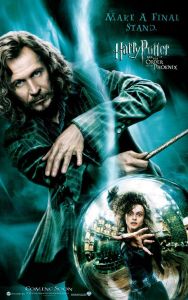 That theme begins early, with an opening scene of Harry morosely sitting alone and then being interrupted by Dudley and his gang. The situation quickly escalates as Dementors appear, Harry is forced to defend himself and his cousin with a Patronus charm and then receives his letter from the ministry informing him that he’s expelled. Much is there to unpack – Dudley’s insistence on poking at his cousin but knowing exactly when to stop. His need for an audience as he does so. Harry’s unquestioning decision to save Dudley from the Dementors despite the fact that he’s had to live with Dudley and his parents making his life unbearable for years. That last is another flash of that nobility that runs deep and instinctive through our young hero’s veins. Nobody is going to give him any awards for saving Dudley (indeed his Aunt and Uncle are convinced he has attacked him) and in fact what he gets instead is punishment. Nevertheless, he acts anyway – Harry’s curse and blessing in equal measure being that, like his father, he is wont to act in the moment and figure out the consequences later.
Barrelling forward, we get our first taste of that institutional corruption, as Harry finds himself up before the Wizengamot on a full criminal trial for his use of magic in front of a muggle while underage. Here we get an extra detail about Dementors – that they are not visible to muggles – which means that his defence is ready to be dismissed by an almost excited Fudge. Compare this to the Fudge of Azkaban, reassuring Harry that he won’t be expelled for ‘blowing up his Aunt’. The rot runs deep, yet in Fudge’s case is not a result of evil intentions so much as a deep-seated fear of Voldemort’s return and an urgent need to deny any possibility of it being real. We also get a hint of pressure being applied to Fudge by Lucius Malfoy, and then we get introduced to perhaps the movie’s second most loathsome villain in the form of Dolores Umbridge.
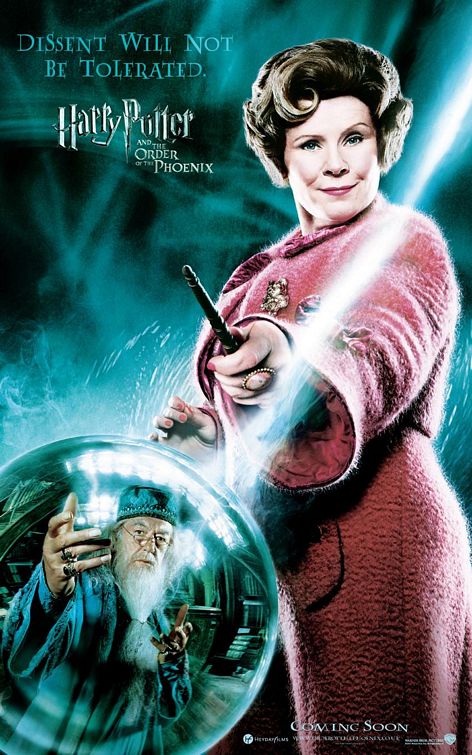
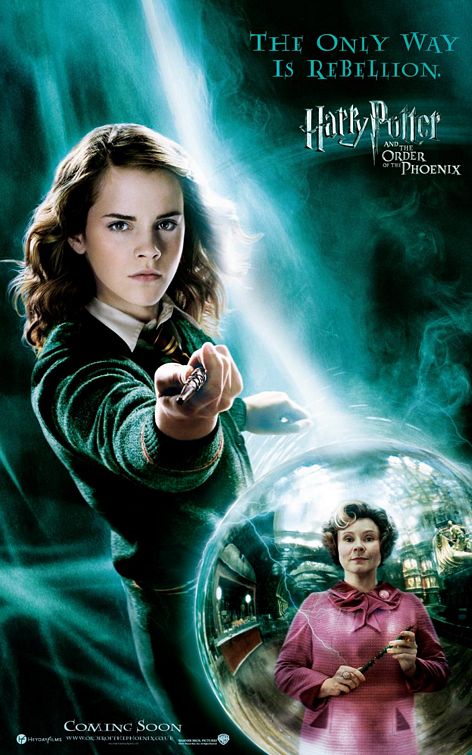
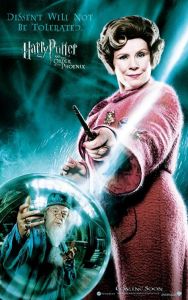 Rowling’s need to apply pun-worthy names to characters aside, Umbridge is perhaps the greatest example of both the type of character she represents as well as the best symbol in the movie of how the series is evolving as it goes forward. Dressed head to toe in pink, punctiliously polite and almost always softly spoken, Umbridge is what an author friend of mine once described to me as ‘an accountant of evil’. There’s a level of banality to the badness of this sort of character which makes their deeds even more repulsive. Her slow takeover of the school lulls the viewer into a false sense of parody at first – the ridiculousness of her appearance and manner, her educational ‘decrees’ which involve boys and girls remaining 8 inches apart at all times among other things, her constant use of a clipboard. This is too often how evil sneaks in in the real world, not with flourishes and rhetoric and mad cackling but with well-presented, neat, unremarkable little people with a pathological adherence to rules and a hankering for a better time that’s conveniently never quite in living memory because it never existed. When Umbridge says that ‘innovation for innovation’s sake’ must not be pursued, it’s a line that could come from any political satire right now, let alone eleven years ago. Imelda Staunton’s portrayal of the character is every bit as easily loathsome as the book leads us to expect, and it can become difficult at points to remember that there’s an evil Dark Lord out there we need to worry about when we have this right here. Her treatment of Professor Trelawney in particular makes us actually root for a hitherto distinctly unlikeable character, in itself an achievement.
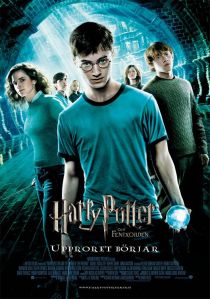 Having comprehensively shown us in the first act just how bad things really have become – the Order of the Phoenix (the unofficial organisation which fought Voldemort the last time) being reconstituted, Harry’s visions of Voldemort’s evildoings getting worse and the Ministry literally staging a coup at Hogwarts, the film then runs into a second act which shows us what the kids are actually going to do about it. In the tradition of these things, what they’re going to do about it is form an organisation of their own to fight the power. Breaking that mould a little bit, the journey on which they embark to achieve this feels – if you’ll forgive the turn of phrase – a little more ‘real’ than it might have in the hands of a different director. The formation of ‘Dumbledore’s Army’, which starts as a secret club for Harry to teach people practical Defence against the Dark Arts after Umbridge’s disappointing insistence on textbooks only, feels organic in its development. The use of this setting for Neville’s confession to Harry of what happened to his parents feels absolutely natural, distracting from the fact that it happens totally differently in the book. Moreover, it’s nice that the film allows Neville the ability to come into his own without making it feel artificial or forced. Neville doesn’t suddenly just get good at magic – he improves in the classes over what the film tells us is a long period of time, in increments. As he does so, he gains slowly in confidence – credit to a young Matthew Lewis for a nuanced and complex performance which never feels like it overdoes any part of the character.
 There’s also hints here – for those paying attention – of Harry’s future romantic entanglements. Though he only has eyes for Cho Chang in this film (until she betrays Dumbledore’s Army to Umbridge – though as we find later because she was given veritaserum), it’s another member of the Weasley family who’s sizing him up. In hindsight, it’s easier to spot the glances, the frowns and the other subtle reactions taking place from Bonnie Wright usually at the edge of the frame or the back of a group, but they are definitively there, placed with a deft eye by the director and executed perfectly by the actress.
Being a Harry Potter film, there’s a lighter side. Ron’s older brothers, Fred and George, provide most of the film’s less serious moments. Their triumphant exit from the school by broomstick as they disrupt the final exams is a fitting end to the character’s tenure at Hogwarts (though again substantially altered from the book) but all the way through they provide the comic relief, with their boxes of tricks, their constant insistence on mischief and their back and forth banter.
 The emotional centre of the movie is generally assumed to come from Sirius, and Harry’s relationship to him, and while Gary Oldman puts in another fantastic performance as Harry’s godfather, on this rewatch I found myself drawn inescapably towards a different conclusion – the emotional centre of the film rests with Harry’s relationship to the Weasleys, specifically Molly and Arthur. At one point, Molly literally says that Harry is ‘as good as’ her son, but that’s a slightly clumsy note from the script given how absolutely unnecessary it is – it’s clear from her first appearance welcoming Harry to Grimmauld Place that she feels a powerful maternal protectiveness towards him, and it’s also clear that Arthur feels a similar level of fondness for his son’s young best friend. In previous movies, this could possibly have been written off as a simple by product of Harry’s importance to the cause, but here there is genuine affection being displayed. It is, after all, Arthur who accompanies Harry to his hearing. It’s Molly who refuses to let Sirius get carried away and induct his young Godson into the Order of the Phoenix, and when Harry saves Arthur with his quick warning to Dumbledore after seeing Arthur struck in a dream, Harry is welcomed as a literal family member to see Arthur’s return to the Order’s base.
 Speaking of Dumbledore, Gambon has a tricky job to do here as the Headmaster spends a great deal of the film’s run time ignoring and avoiding Harry as much as possible. His bundling of Harry off with Snape to begin lessons in Occlumency seems almost cruelly dismissive, as does his constant refusal to look Harry in the eye for most of the film (resulting in Radcliffe’s one moment of shouting in character, which shows how much he has progressed as an actor between Azkaban and this film). That said, the few appearances the character has are absolute classics. From the clipped precision of his appearance in defence of Harry at his hearing to his compassionate defence of Trelawney, his dashing escape from the clutches of Fudge and his epic final showdown with Voldemort, Gambon commands the screen for every second he is on it. Gone are any memories of the late Richard Harris’ twinkly grandpa version of the character – this is a Dumbledore one can well imagine scaling the heights the character is known for and being the one wizard whom Voldemort fears. When he addresses the latter simply as Tom, it’s an exquisite moment, demonstrating without shouting, preening or bravado just how little he fears the so-called Dark Lord.
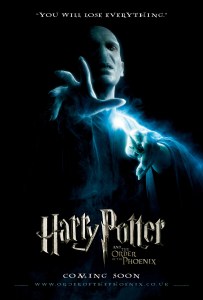 And on the subject of Snape, in another area where chunks of the books were cut and rendered down into one single sequence, we get a memory flashback of Harry seeing his father bullying Snape when they were children. On screen, this is the first hint that Harry has of his father maybe not always having been the perfect man he had thought. While Harry pays it little attention, being almost immediately bundled out by Snape afterward, it stands out as a turning point for the understanding not just of James but also of Sirius and even the welcomely returning Lupin. After all, Sirius has always evangelised about how wonderful his old mate James was, and been equally sneering and dismissing of Snape. Lupin, by comparison, has always been a little more circumspect, offering Snape if not respect at least a sort of patient tolerance entirely lacking in Sirius. Here then, we begin to see the truth of things, both as the audience and from Harry’s own perspective. Sirius is noble but flawed – a good man lacking in patience and impulse control, not unlike Harry himself. It is the ultimate irony that it is Harry’s own impulsiveness that leads to the third act showdown which gets Sirius killed – one could potentially write whole essays on the apportionment of responsibility between the two, but the fact remains that Sirius, in dying, will teach Harry the most valuable lesson of all about himself, though whether he can truly learn that lesson – at this point – remains to be seen.
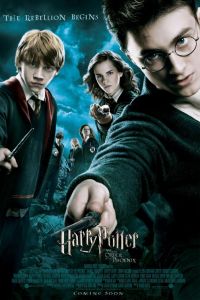 What struck me as I watched this film is just how much of a step up it was in how epic it made the tale feel. Despite being shorter than its predecessor by almost twenty minutes, this film feels like it has much more happening. The clarity of the three act structure here belies just how much goes on within it, and despite large chunks of the source story having been cut for length, the intention of the screenwriter and director to convey the same ‘feel’ through a shorter, more concise story is absolutely realised at every turn. By the time the credits roll, you feel like you’ve watched a much lengthier movie than you have, in the best possible way – all that content jammed into a shorter running time and without anything feeling rushed or overlooked? Now that truly is magic!




 Sci-Fi Bulletin: Exploring the Universes of SF, Fantasy, Horror and Spy-fi!