 With the Harry Potter movie franchise now a well-oiled machine, 2005 saw the next entry in the franchise, which would bring challenges of its own. With the original text almost double the length of Prisoner of Azkaban, new director Mike Newell would have his work cut out to slim down the source material enough to make a reasonable length of film without losing too much of the story. Even setting that aside, the darker tone of the fourth novel would present its own complications for a franchise so far mainly marketed as child-friendly. The studio had a decision to make, and which way they went could have serious implications for the appeal and success of a franchise into which significant time and resource had already been sunk, as Greg D. Smith explains…
As Harry enters his fourth year at Hogwarts, Voldemort, Wormtail and a third unidentified dark wizard are haunting his nightmares. The appearance of the Dark Mark and a group of Death Eaters at the Quidditch World Cup are just the start of his problems though, as Harry suddenly finds himself mysteriously entered into the deadly Triwizard Tournament. Isolated from his friends, stuck in a competition that could kill him, and with Voldemort’s followers growing ever more bold, can Harry overcome the odds?
 Azkaban marked a huge departure from its predecessors in terms of visual palette and subtlety of tone. Cuaron’s signature style had fully embraced all aspects of the cinematic medium to deliver an entry that felt – in all the right ways – like the first stage of the franchise ‘growing up’. Newell’s entry picks up where Cuaron’s left off, and uses a number of techniques to let us know that all vestiges of the happy-go-lucky life Harry had formerly enjoyed at Hogwarts are now firmly behind him.
Starting as it means to go on, instead of the relative light relief of a Privet Drive-bound opening with Harry railing at the caricature-ish Dursley family, we instead open on a scene of murder. Specifically the murder of an innocent muggle caretaker by Voldemort. It’s the first time in the franchise that we’ve ever heart the Death Curse uttered in anger, and that it’s delivered by a tiny, half-formed Voldemort in a bundle of rags makes it no less chilling. Unpacking the scene further, it gives us the first hint of Barty Crouch Junior’s unique facial tic, which will become an important detail as the movie progresses. It also shows us just how in thrall all of Voldemort’s companions, including the giant snake Nagini, are to him. Nagini slides straight past the old caretaker without even touching him, merely reporting his presence to Voldemort.
 It’s a clever bit of filmmaking, leaving the audience as discomfited as Harry himself right from the first moment, and it very much carries on in that vein, refusing to give detailed explanation and context to us as much as the titular character as the movie progresses. Of course, if you’ve read the book already, you know the basic shape of what’s coming, but if you don’t, well that’s a different matter altogether.
There’s a general feeling of fatalism about this film, and that starts with the colour palette and general presentation – it’s not so much that everything is darker, as it’s greyer. There’s a desaturation of the colour, meaning that although the school itself and the magical world generally still have colours in them, they are more muted and subdued. This represents both the grimmer time in which our heroes find themselves and also the fact that this is Harry’s fourth year – he’s no longer wowed by every single thing he sees; he’s become used to the colours and the explosions and weird and wonderful creatures, as have we. By not starting the movie in the muggle world, and downgrading the colour of the film in this way, the film emphasises this shift without overselling it.
 This also extends to the music, which sees John Williams finally stepping away from the franchise entirely due to work commitments and Patrick Doyle stepped up to deliver his own take. Though originally the soundtrack was planned to be based on much of Williams’ work, in the end only Hedwig’s theme – that perennial tune which springs to the mind of any person with the vaguest knowledge of the character – reappeared, with everything else Doyle’s own creation. There’s a more intense, brooding aspect to this soundtrack, favouring lower notes on both strings and brass, and even some of the more whimsical entries such as Quidditch World Cup go from the light jig of the Irish anthem to the pounding percussion of the Bulgarian one. It’s not a soundtrack which lacks for lighter moments, but it does deliver them more sparingly and it never has that same ‘soaring’ element of Williams which generally associated with heroics and/or hope.
 Then there’s the way that Harry himself inhabits this film. Radcliffe picks up his game immensely here from the ‘Shout Louder to Emote’ style of Azkaban. Harry is isolated in this movie in a way we haven’t seen before, on several different levels. To start with, he’s isolated simply by the fact of his nightmares and the fact that, though he can share them with his friends, he has nobody who really understands or can relate. When he’s picked by the Goblet of Fire to enter the tournament, he’s isolated both from his fellow competitors, who are all older than him, from the rest of the Hogwarts student body who mostly suspect he has deliberately cheated to get into the tournament and acquire more glory for himself, and from his best friend who assumes the same thing and becomes especially angry at him for having hidden the secret. That last one lands most of all – Harry and Ron have been best friends from the beginning, and Ron’s anger is as palpable as Harry’s frustration. This is foreshadowing on a grand scale – for much of the time from this entry onwards, Harry will find himself alone, unable or unwilling to call on others to help him for various reasons. Here, he gets his first real taste of that.
 The introduction of foreign wizards (and the opening of the movie being at the Quidditch World Cup) sort of help to broaden the world the films have created, again working in concert with the main character as his appreciation of the world grows. What’s a slight shame in regards to the other schools is that the film doesn’t really take the opportunity to explore what this means beyond the obvious cosmetic differences, making the comparison rather one-dimensional and pointless. The Bulgarian students of Durmstrang are all rough-looking young men with perma-scowls and fur hats, and the students of the Beauxbatons academy are all young girls whose main quality of note seems to be that they are attractive. It isn’t exactly that the book did much better with this aspect, but it still stands out here. Even the headmasters of the two schools – Karkaroff the former Death Eater and Madame Maxime the half-giant – aren’t really explored here. Karkaroff gets a flashback scene to his plea bargain trial and Maxime gets a date(ish) with Hagrid, but mostly the whole idea of the schools feels wasted due to a lack of them being there for anything much beyond providing Harry’s opponents in the Triwizard tournament.
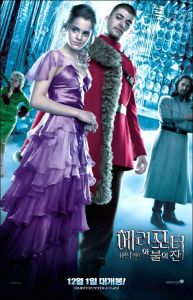 The tournament itself is another element in which we see the film pulling no punches with regards to where the story now is tonally. Harry’s first challenge, against a dragon, is genuinely dramatic to watch, and there’s no longer a sense that this is just another whimsical adventure for our young hero to easily make his way through. There’s a real sense of the constant danger that the tournament represents and not just because the adults keep harping on it – Harry doesn’t escape either of the first two challenges unscathed, and in both of them there are moments where death seems a real possibility. The challenges also give us a chance to see the nobler side of Harry – he feels compelled to warn Cedric about the dragons when he gets a hint from Hagrid, and he attempts to rescue all of the ‘treasures’ from the bottom of the Black Lake (and indeed does rescue Fleur DeLacour’s sister after Fleur herself is forced to retire from the challenge). These are instinctive actions, and they are important in context – neither of these acts is visible to the wider world and neither is calculated to give Harry any particular advantage. He simply tries to do the right thing. This is doubly important when one considers the way in which Harry is viewed by much of the magical world – not helped by fairly aggressively negative press coverage from Rita Skeeta and the general attitude of a Ministry of Magic that would rather not believe that Voldemort is capable of returning. It adds to that sense of isolation – here is Harry, always trying to do the right thing, but it never matters.
 On top of that, we get the first real sense here of just how useless the adults of the magical world are in the real fight that needs to be had. Previously, it was in that slightly comical, semi-petulant way that all kids feel adults won’t listen to them – in Philosopher’s Stone, it’s likely if you follow the logic that Voldemort would never have cracked Dumbledore’s final protection for the stone and obtained it, so the intervention of Harry and friends is dramatic but pointless from a practical standpoint. In Chamber of Secrets, Harry’s ability to finish the fight is more down to his (extremely esoteric and rare) ability to speak Parseltongue than because of any lack of talent on the part of the adults around him, and Azkaban resolves because Dumbledore steps in to offer the solution. Here, we have multiple examples of wizards in authority being either helpless or wilfully stupid when it comes to the challenges they face. Although Fudge’s denial of the truth of what Harry saw at the graveyard is cut for time here (appearing as part of the opening of the next film instead) there’s a sense that none of the threat is really being taken seriously. Dumbledore fails to notice that he has a Death Eater masquerading as a teacher in his school, despite some fairly compelling evidential factors (not least the Polyjuice potion ingredients going missing from Snape’s stores) and also fails to notice the cheating that puts Harry’s name in the goblet as well as the fact that the cup itself is turned into a Portkey. Considering his portrayal as basically infallible to this point, it’s a rude awakening. It’s not that it’s unreasonable for him to have missed these things, but added up, it strips away a layer of certainty for Harry and the audience – suddenly everything isn’t just going to be automatically fine as long as Dumbledore is around.
 This stretches beyond him of course – Barty Crouch Senior is presented as a man unable to see the truth under his nose from his very first appearance, accusing Harry of having cast the Dark Mark in the sky when context alone should clearly reveal this to be nonsensical. Portrayed by the late great Roger Lloyd-Pack, every tic and twitch of the character adds to an impression that he’s not really all there, and the flashback of him seen by Harry through the Pensieve only really adds to this impression – even at the height of his powers, there’s a suggestion that Crouch Snr was never more than a slightly overachieving bureaucrat who was out of his depth when confronted with the chaos and destruction wrought by Voldemort and his followers.
And then there’s the ending, which here is thankfully unvarnished and every bit as impactful as its book counterpart. Voldemort’s chilling ‘Kill the spare’ is a powerful line and lets us know just how evil he is – of course we have seen him kill before, but to see such naked contempt for human life as to address it as ‘spare’ and to delegate the killing as beneath himself both reveal just how much of a monster he is. His return runs the risk of dipping into pantomime in places – the simpering idiocy of Wormtail, the monologuing about how he will murder Harry and restore his name as the all-powerful dark lord – but Fiennes manages to keep just the right side of the line. His treatment of the whole situation is exactly as one would expect of a man who believes he is simply the superior of everyone around him, and his cruelty is unquestionable. The confusion as their wands meet and his prior victims emerge to swamp him fits perfectly with what we know of him – even though he realises it was old magic which protected Harry from his killing curse all those years ago, he hasn’t learned anything.
 Harry’s arrival back at Hogwarts with the cup and Cedric’s body is proof in and of itself how far Radcliffe came in the intervening 18 months between Azkaban and this. His distress and emotion are raw, painfully real and that discomfort is notched up by the juxtaposition of the triumphant brass band striking up and then slowly dying off as the screams start and people realise what they’re seeing. It’s a scene that could have been overacted as Dumbledore tries to drag Harry away from the corpse and Harry clings on, crying and screaming, but instead it lands perfectly – credit to the actors and the directors for that.
For all that it packs in the grimness – and it does – the movie isn’t without its lighter notes. Ron’s awful dress robes, the awkwardness of Harry and Ron trying to secure dates for the ball, Snape’s delight in clipping their ears when they aren’t paying attention and Malfoy being turned into a Ferret. There’s also the next stage in the Ron/Hermione saga, which unusually for a film aimed at this sort of age group actually dares to be a little (though not overly) nuanced. Obviously they are keeping in line with the books, and bearing in mind that that they have a whole story to tell over the course of the films, but it’s interesting to see a ‘kids film’ treat the subject of blossoming feelings between two leads with this much delicacy.
 If Philosopher’s Stone was the kid-friendly fun ride, Chamber of Secrets was the stealthily dark one and Prisoner of Azkaban was the beginning of darker, more adult things, Goblet of Fire is the full-on commitment to the darker end of the Potter universe. The stark realisation that the adults really don’t have all the answers, and that sheer pluck and refusal to follow the rules won’t necessarily be enough to overcome the obstacles being faced. Newell does indeed achieve his task of condensing the source material down without losing the spirit or feel of the story, and this in hindsight may well be one of the best entries in the series as a whole.











 Sci-Fi Bulletin: Exploring the Universes of SF, Fantasy, Horror and Spy-fi!