Review: Doctor Who: Season 1
Ncuti Gawa’s first season in the TARDIS hit at a dead sprint and never stopped moving. Ambitious, wildly different in scope and full of energy, it’s an immensely impressive year […]



Ncuti Gawa’s first season in the TARDIS hit at a dead sprint and never stopped moving. Ambitious, wildly different in scope and full of energy, it’s an immensely impressive year […]
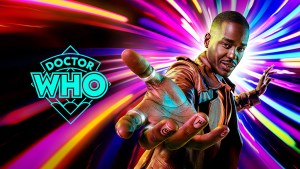 Ncuti Gawa’s first season in the TARDIS hit at a dead sprint and never stopped moving. Ambitious, wildly different in scope and full of energy, it’s an immensely impressive year that defies categorisation, as all Doctor Who should. But it sure is fun to try! Here’s Alasdair Stuart’s look at the season including the four-episode run that can and should stand with the show’s finest hours to date.
 “The Church on Ruby Road”
Directed by Mark Tonderai
Written by Russell T Davies
The Doctor meets Ruby Sunday and her family in this season opener that reads far more as a chapter 1 now than it did at the time. Ruby’s somewhat odd nature, 15’s swashbuckling tornado energy and the deep seam of compassion that would define the season is all here.
Most interestingly, this is Doctor Who does Labyrinth. Fairy tale logic is very much to the fore here, and music is used as a language, tool and weapon for the first time in a season which will circle back to that idea. This feels like new ground, and dangerous ground to boot, and the episode does a great job of setting up and exploring that drastic change in tone.
“Space Babies”
 Directed by Julie Anne Robinson
Written by Russell T Davies
The Doctor and Ruby visit a space station inhabited entirely by babies. If this was a Friends episode, it would be called The One That Nobody Likes. Season openers are always choppy and this is no exception, but it knows exactly what it is and there’s some clever stuff going on under the hood. A great cameo from Bridgerton’s Golda Rosheuvel anchors the heart of the story and nicely counterpoints the deliberately childish elements. Also, as is often the case, there’s a couple of lines in here which really speak to the show’s core themes. ‘Most of the universe is knackered, babes’ is especially resonant. Also a thought to hold…
“The Devil’s Chord”
 Directed by Ben Chessell
Written by Russell T Davies
The Doctor and Ruby fight the Maestro, and find out music and art are a family affair and that family pretty much hates their guts.
This is what a series hitting its stride looks like and there’s a delightful, espresso black sense of mischief to this one that wraps around the sincerity of Davies’ best scripts to create something which may not be a classic but can damn well see one from where it is. Jinkx Monsoon as the Maestro is one of the most memorable villains the show has ever had, curdling the established logic of the narrative into a musical in much the same way magic has begun to seep into a universe at least notionally powered by science.
Nothing in the show’s history moves quite like this episode. It’s a musical where music is both villain and salvation. It’s a historical about alternate history. It’s a story about the Beatles which features one note of Beatles music. It breaks the fourth wall a dozen times. The most interesting the show has been in years and if not an out an out classic certainly incredibly good.
“Boom”
 Directed by Julie Anne Robinson
Written by Steven Moffat
Moffat is a hard writer for me to love at times. When he’s bad, the story collapses under the weight of the fifteen clever things in there that get in each other’s way. When the story’s good, there’s an emotional cost whose bravery is matched only by what it asks of us. When the story’s great, you get both of those engines working in unison. This is a great story.
A superb science fiction conceit, a brilliant idea for a locked room episode and a script which throws three memorable characters at us and makes us care about them even as it locks down on the worst day in the Doctor and Ruby’s lives yet. The entire cast are fantastic, the special effects are top notch and the script seethes with the exact sort of anti-capitalist rage that far more big-name series need to embrace. It’s also an incredibly sweet, kind, story that plays with a lot of the author’s favourite tropes in a manner which presents as far less calculated than they have been in the past. What starts out as an exploration of the horrors of war becomes a look at the indestructible nature of love and how, eventually, it will always win. The first breakout classic of a season full of them.
“73 Yards”
 Directed by Dylan Holmes Williams
Written by Russell T Davies
And here’s the next one. Millie Gibson gets handed one of the toughest spotlight scripts I’ve ever seen and spends the entire episode patiently knocking it out of the park again and again and again. The central premises echoes modern horror classic It Follows and the work of Sapphire and Steel creator PJ Hammond. It also sprinkles some folk horror on for seasoning and some very well observed beats about the English in Wales.
A lot’s been written about how the central premise doesn’t quite work, even with the implied explanation in Empire of Death. For me, that’s not an issue because this is the show taking a hard left turn deep into the woods. The offhand comment about UNIT starting to have to plan for supernatural events (and remember the Toymaker was sealed in salt in The Giggle…), the persistent sense of menace and the tangible relief of the ending all mark this out as an episode of a dark fantasy show with time travel, rather than a time travel show with dark fantasy. Immaculately focused, brilliantly acted, brave enough to be ambiguous and the second of this season’s run of stone-cold classics.
“Dot and Bubble”
 Directed by Dylan Holmes Williams
Written by Russell T Davies
Speaking of classics, this is another. Not just in terms of subject matter either but how it’s shot and plays out. Holmes Williams gives the slightly too quiet, slightly too clean streets of Finetime and the endless parade of pastel coloured content the sort of cheery nightmare quality that British SF excels at. Davies’ script asks a lot of everyone, but most particularly it’s two lead guest stars. Callie Cooke’s Lindy Pepper-Bean is pathetic, pitiable, resolute, sympathetic and monstrous, her arc describing the arc of her society all in the space of one episode. Tom Rhys Harries’ Ricky September is a wickedly subversive Doctor-stand-in, and possibly the only sympathetic character in the episode which makes his fate doubly harsh.
But most of all, this is the episode where the season’s twin narratives of the stories people tell themselves and the screaming rage against injustice that defines the Doctor combine. The ending is, for me, shatteringly great. The Doctor’s heroism defined and denied in one scene and the show, the Doctor, and us, left watching people sail into bigoted oblivion rather than risk being helped by those they think beneath them. The episode would ring true at any time. In 2024, as we’re thrown around by wave after wave of performative, passive aggressive bigotry in fandom in particular, it rings like a bell.
“Rogue”
 Directed by Ben Chessell
Written by Kate Herron and Briony Redman
The fourth straight up classic in a row is so good I would be happy to see Kate Herron and Briony Redman back again, on a regular basis. In one episode we get an extended salute to Bridgerton, a very fun new alien race, a nicely sketched in exploration of toxic fandom and Rogue.
Jonathan Groff doesn’t steal the episode because he doesn’t need to. Rogue, the time travelling bounty hunter who falls for the Doctor almost as fast as the Doctor falls for him, is a quiet, calm man carrying his own damage. In the space of their whirlwind romance we see that damage acknowledged if not healed much as the Doctor’s is. They are hot, on screen. There is no other word for it. The chemistry between the two shifts from flirtatious, to compassionate, to goofy and back. The ballroom dancing scene and the ending are worth it alone, but the entire episode is incredibly good fun. This era’s River Song has arrived and he plays Dungeons & Dragons. Glorious.
“The Legend of Ruby Sunday”
 Directed by Jamie Donoughue
Written by Russell T Davies
The episode spends much of its running time convincing us, and the Doctor, that the big reveal here is the return of the Doctor’s granddaughter Susan. It wraps that around the closing act of Ruby’s search for her family and presents both of those in the context of what must surely be the imminent UNIT spin-off. Bonnie Langford is fantastic here as Mel and she feels like part of a coherent team of interesting characters. Alexander Devrient and Tachia Newall as the Colonels Ibrahim and Chidozie and Lenny Rush as child genius Morris Gibbons are especially fun. Yasmin Finney’s Rose Noble is back too as is, mentioned in passing, her mum and her ‘Uncle’. We don’t get more of Ruth Madely’s incredibly good fun Shirley Anne Bingham but hopefully she’s back next year.
The episode lingers at UNIT and does some great stuff with their experimental time window and how delightfully sneery the Doctor gets about it. Even then, we have this incredibly complex, delicate, janky piece of technology used to try and solve Ruby’s case and…it doesn’t work.
The reveal on what’s really going on is beautifully handled and shows just how misled the Doctor has been. UNIT’s fall was never going to be permanent, but it’s handled with real grace here, as is the exploration of Susan Triad. Susan Twist is the overlooked MVP of the season, turning in excellent work in every one of her roles but never more so than here. The reveal first that Susan is nice, and second that Susan is also a victim rattles us. The Sutekh reveal knocks us flat.
So, another pseudo-UNIT episode, the Doctor’s family weaponised against him, a villain who isn’t a villain and a villain who’s been hiding in plain sight for decades. There’s a lot going on here, most of it brave and all it very successful.
“Empire of Death”
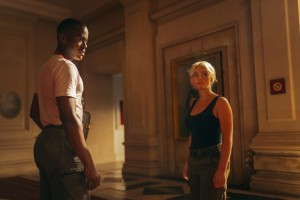 Directed by Jamie Donoughue
Written by Russell T Davies
Sutekh has won, and the Doctor’s entire life has been tainted. The universe is empty aside from the Doctor, Ruby and Mel. But they have a plan.
While the fate of the universe (It’s back, hurray!) is never in question, Davies finds some really fun stops to make along the way. Not the least of which is the Memory TARDIS from Tales from the TARDIS, now a canonical artefact and vital to the story.
The details are what matters across this two-part story and Davies never loses sight of the vast weight of consequence the story has. Mel crying with happiness when she realises Six’s coat is in the TARDIS is lovely. The Doctor’s respectful, but still definitive foiling of the newly possessed Mel doubly so.
What’s really interesting about this is how Chibnall-ian it feels. The quiet universe, the importance of individuals (Fleabag’s Sian Clifford is incredible in a subtle cameo) and most of all the sheer scale of the story all call back to Flux. So much so in fact that the ending here seems to both acknowledge and fix the state of the universe at the end of Flux. There’s been some criticism of the ‘Death of Death’ reveal, and the relatively simple way that Sutekh is defeated. But, again, it’s in lockstep with the fantasy tone and motifs the series explores. The universe may be knackered no longer, and the TARDIS is certainly free of its unwanted passenger.
There’s been a lot of discussion about what this episode doesn’t resolve, and there’s a lot. Ms Flood is clearly going to be a major part of season 2, the possible reason for the events of 73 Yards sprints by and while Ruby’s parentage is resolved, some elements of her plot aren’t. Davies has said she remains central to the show in season 2, as does Mrs Flood, and I’m happy to take that assurance. The resolution we get here, on a cosmic level, is pretty complete. The resolution on a personal level is doubly so. The end sequence dealing with Ruby’s reunion with her mum is both very sweet and just a little tinged with darkness. The Doctor’s past as an orphan and the events of The Timeless Child have left a mark and Gatwa and Gibson do some of their best work exploring that. Ruby’s exit from the TARDIS is especially well handled: not a tearful departure or a blazing argument but a wryly sincere acknowledgement that it’s time for her to move on, at least for a while.
That’s my big take home from these two episodes, that they feel like a pause in a longer story rather than a finale. Nothing seems forgotten and the core emotional resolution of the plot is multi-levelled and very successful.
But there’s more to come. If it’s half as varied and interesting as this season, we’re in for a treat.
 Doctor Who News Star Trek News
 Sci-Fi Bulletin: Exploring the Universes of SF, Fantasy, Horror and Spy-fi!