Review: Doctor Who: Series 12 Episode 10: The Timeless Children
The Master takes the Doctor through the boundary to Gallifrey where he reveals a secret that he believes will break her forever. Ho, closely followed by hum. This is another […]



The Master takes the Doctor through the boundary to Gallifrey where he reveals a secret that he believes will break her forever. Ho, closely followed by hum. This is another […]
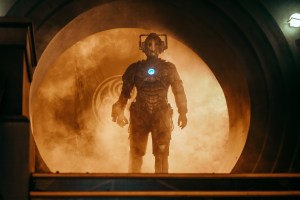 The Master takes the Doctor through the boundary to Gallifrey where he reveals a secret that he believes will break her forever.
Ho, closely followed by hum. This is another episode that sums up the strengths and weaknesses of the current period of Doctor Who – the lead character has things happen around her, and has things explained to her, until the last moment when she has some agency (and even then someone else comes in and does the dirty deed to save her). The Time Lord and her “fam” are kept separate for a good portion of the narrative; elements of weird and wonderful continuity are re-awakened; and there’s a definite vibe of the Virgin New Adventures about the whole thing. “Oh, I am more than just a Time Lord,” the seventh Doctor was meant to tell Davros 32 years ago – but he didn’t, and according to this, it’s because he didn’t know that was the case! (Equally, this episode might explain the end of the mindbending match in The Brain of Morbius – when Morbius learned the Doctor’s secret, it blew his mind?)
There’s a lot to enjoy about this – the special effects on the whole were excellent (the Cybership over the Capitol notably), and Sacha Dhawan’s performance as the Master picked up on the manicness of the 21st century portrayals, while still retaining a degree of self-awareness that John Simm and Michelle Gomez sometimes lacked. (The moment where he kicks himself for not thinking of the quip at the right time did have me laughing aloud.) The Cyberleader came to a surprising end, and there were some tense moments when the humans were in the Cyber-suits (although I missed an explanation as to how Ashad didn’t cotton on to what was happening). There were pleasant echoes of the last time the Cybermen were on Gallifrey in the parading in the hills (The Five Doctors) and some payoff for Ryan’s basketball playing. The Cyber-Time Lords… well, I’m afraid this was one moment where what was a good idea at design stage didn’t pay off (for one thing, could they have got in their power units with those doilies round their necks?)
The biggest problem for me was that the episode was packed with exposition, as Chibnall reworked some of the backstory to fit his own vision – in line, it has to be said, with all previous showrunners this millennium (Davies with the Time War, Moffat with the War Doctor). In practical terms, things haven’t changed that much – in this life cycle, the Doctor has fled Gallifrey in a TARDIS with Susan, landed on Earth and is, to all intents and purposes, the first Doctor. But we know now that there were other life cycles before this – although the combination of the redacted portion of the Matrix and the Master’s own unreliability as a narrator are a huge get out of jail free card for future showrunners, assuming that things aren’t further complicated in series 13. We didn’t get proper answers as to why “Doctor Ruth” called herself the Doctor or had a Police Box as a TARDIS – both things, we’ve been led to assume, happening during the “current” lifecycle’s first incarnation. Maybe, given “our” Doctor has been imprisoned for Doctor Ruth’s actions, we’ll learn more in the special…
Jodie Whittaker ran with the material she was given, and – as she’s done in the previous two episodes – feels more like the Doctor than at any period during series 11. Jamie Magnus Stone’s direction felt assured, and never let the sometimes ridiculous moments lapse into parody (the aforementioned Cyber-Time Lords notably). Segun Akinola’s score was one of my favourites of the season – the whole year has been noticeably stronger than the first and I’m looking forward to the chance to listen to it as a separate entity.
Was it a disaster or did Chibnall stick the landing? The answer has to be a qualified yes. It was a suitably epic series finale which managed to have other elements than purely an exploration of who the Doctor is/was at its heart. But after a year of being very much its own thing separate from previous continuity, has the pendulum swung too far the other way and the show is starting to navel-gaze too much again?
Verdict: Style and some substance – a retcon that isn’t as much of a change as it’s made out to be (“everything you know is a lie” was overstating the case considerably). An enjoyable end to a considerably stronger second series for Jodie Whittaker’s Doctor – but not a classic. 7/10
Paul Simpson
 Doctor Who News Star Trek News
 Sci-Fi Bulletin: Exploring the Universes of SF, Fantasy, Horror and Spy-fi!