Review: Doctor Who: Books: The Black Archive 19: The Eleventh Hour
By Jon Arnold Obverse Books, out now A comprehensive, if short, look at Steven Moffat’s debut as showrunner. Let’s get this out of the way first: Jon Arnold’s The Eleventh […]



By Jon Arnold Obverse Books, out now A comprehensive, if short, look at Steven Moffat’s debut as showrunner. Let’s get this out of the way first: Jon Arnold’s The Eleventh […]
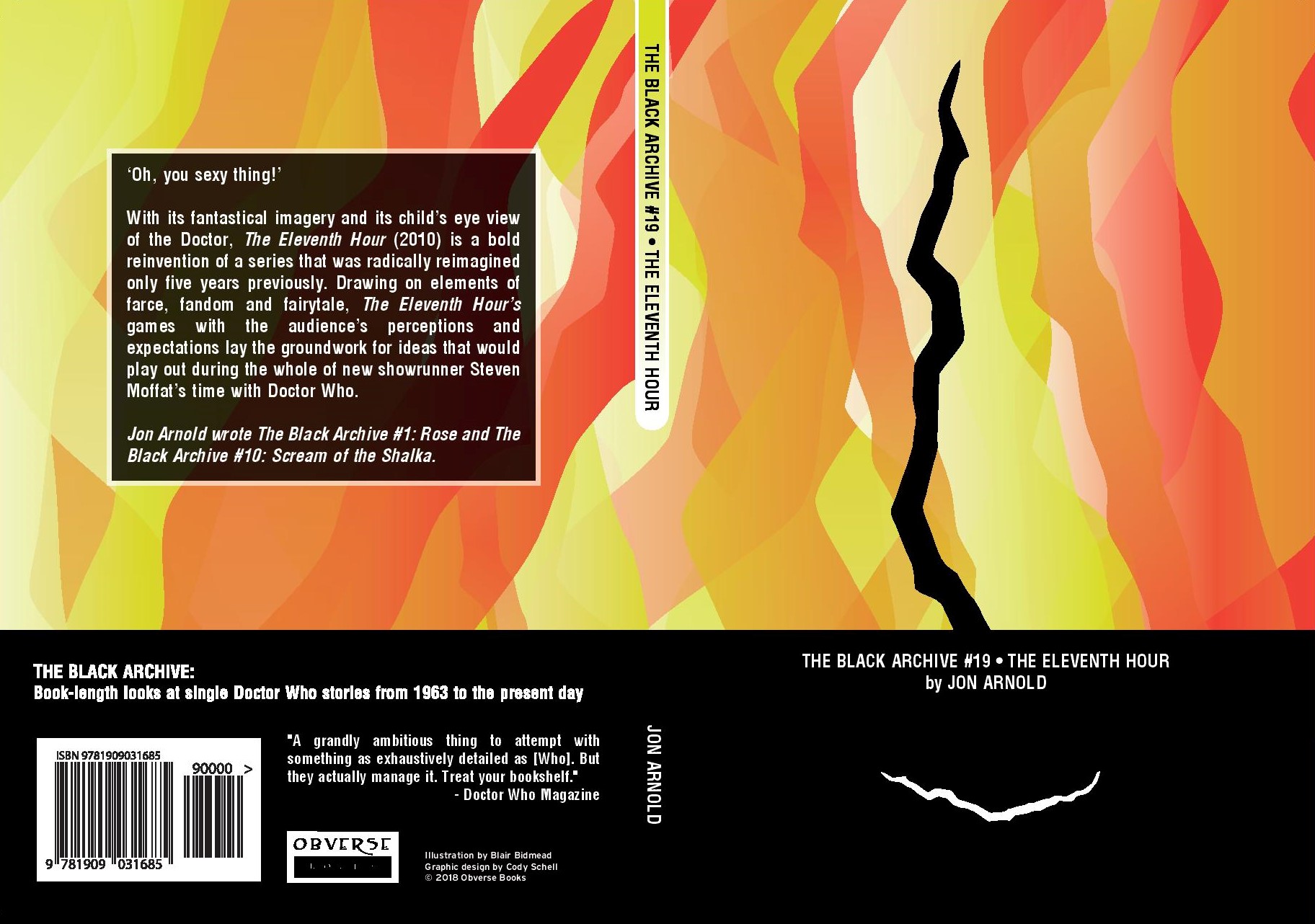 By Jon Arnold
Obverse Books, out now
A comprehensive, if short, look at Steven Moffat’s debut as showrunner.
Let’s get this out of the way first: Jon Arnold’s The Eleventh Hour is marred – as are so many of these compact Black Archive books – by an excess of footnotes. Almost 200 footnotes in just 84 pages of textual content is simply bizarre. Referencing the episodic source of events, then footnoting every one (three or four in a single sentence) to the same episode-naming footnote is not only odd, but overkill. That said, some of the best points Arnold makes comes in several footnotes!
One of those points is the question of how pre-meditated is the Doctor’s regeneration process. In a neat retroactive fix (a retcon), Arnold takes in Moffat’s The Day of the Doctor 50th anniversary special to suggest that the Ninth Doctor’s accent came from the last person he spoke with, Jenna Coleman’s northern accented Clara Oswald. In this theory, Tennant’s 10th Doctor takes his vocal cue from Billie Piper’s Estuary-accented Rose Tyler (as confirmed in the recent novelisation of The Christmas Invasion); Smith’s 11th may have taken his from the last person his previous incarnation heard from, Ood Sigma; while 12th Doctor Peter Capaldi kept his Scottish accent (unlike Tennant), supposedly – according to Arnold – lifting it from Amy, whose hallucinatory form he last heard from prior to regenerating. It’s a neat idea that just about works, but it is confined to footnote 54, when it could have been an avenue of deeper legitimate exploration in the body of the text.
Arnold’s second chapter examines things from Amy’s viewpoint, paralleling her experience with the Doctor to that of Madame de Pompadour in The Girl in the Fireplace in that they first meet the Doctor as children while fearing something in their bedrooms, and then re-encounter him in adulthood and see him as a possible object of romance. Arnold here plays up Moffat’s considerable prior history as a writer of television rom-coms, importing those tropes and approaches into Doctor Who, where his predecessor had appropriate the family drama or soap opera as a template. Amy’s family is a structuring absence for most of her time on the show.
Moffat’s tendency (until Bill Potts) to have his companions as mysteries for the Doctor to solve is explored, with Arnold pointing out that whereas Davies’ companions tended to be regarded as equals to the Doctor (something some fans complained about), Moffat sees the companion role as one of dependency, either relying on the Doctor or, in the early Capaldi days, functioning as his ‘carer’ (making him the dependent one). Arnold also addresses the question of Amy as a ‘Mary Sue’, a fan avatar deployed within the screen text.
Chapter three engages with an idea that has always been a personal favourite – that Moffat’s charity skit Curse of Fatal Death serves as a template for his time on the show proper. The celebrity charity Doctors almost parallel his actual choices, as do many of the deconstructions of characters (the Master) and situations (time travel, Daleks), right through to ending his tenure as the Doctor becomes female.
The fourth chapter examines (from a sceptical viewpoint) the question of the influence of fairy tale on Moffat’s take on Doctor Who, humorously comparing Matt Smith’s hyperactive Doctor with Winnie the Pooh’s Tigger. The concluding chapter looks at the various story arcs kicked off by The Eleventh Hour (including the first hints of the Silence/Silents), and questions whether or not he was able to adequately pay them off, and whether the writer had complete mastery of his material. Although not in The Eleventh Hour, the River Song story arc (even more impressive in retrospect now it is completed) does show that Moffat was successfully engaged in long term planning, with trap doors and get-outs along the way to reconfigure things as necessary (such as casting Smith rather than Capaldi, as Moffat had first intended).
Verdict: A bright, brief read where the flow of interesting ideas and interpretations is annoyingly interrupted by the far-too-frequent footnotes. 7/10
Brian J. Robb
 Doctor Who News Star Trek News
 Sci-Fi Bulletin: Exploring the Universes of SF, Fantasy, Horror and Spy-fi!