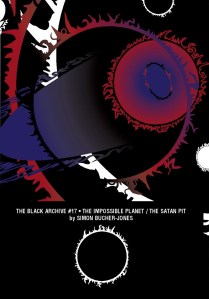
 By Simon Bucher-Jones
Obverse Books, out now
An oblique examination of the appearance of the Devil in Doctor Who.
It is both a strength and a weakness of the Black Archive series that there is no overall approach to writing about Doctor Who – each author is free to come at their assigned story in whatever way they wish, from textual analysis to production history, personal recollection to semi-academic essays. In this volume on the two-part David Tennant tale The Impossible Planet and The Satan Pit, Simon Bucher-Jones takes a slightly left-field approach that he, unfortunately, doesn’t entirely pull off.
Bucher-Jones’ entry point is certainly interesting. The revived Doctor Who’s second series is so long ago, it can sometimes be difficult to recall the context of the broadcast of the original episodes. Bucher-Jones reminds readers that this two-parter featured the first genuine alien planet featured in the new series; hard-to-believe, but apparently true. He rehearses showrunner Russell T Davies’ oft-quoted ‘Planet Zog’ story and highlights the earlier tendency for alien worlds in Doctor Who to be simply Home Counties quarries, with some Quantel special effects skies added in the show’s later years. This is all by way of signalling that the audience for the new Doctor Who, raised on Hollywood SF spectaculars, would simply not put up with such poor on-screen realisation of these worlds, suggesting this was behind the production teams’ reluctance to stray far from Earth or Earth orbit in the early episodes.
There is another way of looking at this that Bucher-Jones fails to raise. While Davies and his team certainly had ambition, perhaps they lacked the confidence in their own and the BBC’s technical abilities to bring such worlds convincingly to the screen? After all, no-one had made anything like Doctor Who on British television for a long time; there had to be some questioning whether it was even possible given the kind of budget the BBC made available. American television had the know-how and the money to do it, but could Doctor Who? Of course, as the show and its makers gained in confidence, things loosened up, so much so that Steven Moffat could sometimes planet hop across a variety of more-than-convincing worlds in a single episode (A Good Man Goes to War). It’s certainly an interesting starting point for this volume.
Thereafter, Bucher-Jones considers black holes, both from a fictional and a scientific viewpoint. Some readers may get lost amid the numbers and the graphs and the equations in this attempt to apply real science seemingly to every word of dialogue in The Impossible Planet.
The thorny question of the existence of the Devil (and therefore, by implication at least, God) in the Doctor Who universe is next up. How does this change or affect Doctor Who (the show) and the Doctor (the character) in terms of altering the outlook and boundaries of both? Bucher-Jones compares the Beast with popular depictions of the Devil, but perhaps too much time is spent delving into Biblical lore than is strictly necessary to this thesis. Of course, there is much reference to The Daemons and the events of that story, as well as connections to Pyramids of Mars (the use of the voice of Gabriel Woolf makes this inevitable). Later, the writer goes a bit Douglas Adams in his explanation of humanity’s creation of the concept of the Devil – to quote Marvin the Paranoid Android on this bit: ‘It’s rubbish.’
Having entertained – with some caveats – so far, the book then ends on something of a weak note with a brief (almost half-hearted) look at the function of the Ood in the series in and beyond The Impossible Planet and The Satan Pit, and a final section that relies upon extensive script extracts (and not even the best bits of the script, either). There are other problems, such as excessive footnotes; the readers of this series are fans, so don’t need every story title noted. There are 30 footnotes in first 20 pages, with 260 overall in a manuscript of 126 pages, an average of two footnotes for every page! It’s not bloody House of Leaves! Finally we have the pointless appendixes, one being a itemisation of how many alien worlds each Doctor visits (a space filler if ever there was one; this is best left to ‘list’ books or those graphics-driven tomes), and a rather weak and pointless attempt at reconciliation between the two episodes under discussion here and Pyramids of Mars, attempting to connect the Beast and Sutekh.
Verdict: A strong, interesting start unfortunately tails off to a weak conclusion. 6/10
Brian J. Robb




 Sci-Fi Bulletin: Exploring the Universes of SF, Fantasy, Horror and Spy-fi!