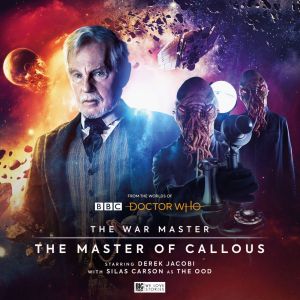
 Callous – a colony world constantly on the brink of extinction. A place ripe for the Master’s particular brand of manipulation…
Although I’ve been trying to review box set stories singly over the past few months, this latest series is quite definitely one story, told over four discs, rather than four separate ones with an umbrella theme. That’s not to say each disc doesn’t stand up on its own merits, or that each doesn’t have its own distinctive feel, but there’s a progression throughout as the Master entwines himself into the lives of the people of Callous, and in particular Cassie and her wife Martine.
The story is inspired by Nostromo – no, not the ship in Alien but the Joseph Conrad story after which it’s presumably named – with a healthy dose of Needful Things, all filtered through the last six decades of Doctor Who. We get side references to IMC, and there’s oblique mentions of the conflict that gave birth to the War Master, but everything you need to understand the story is contained within the episodes. (It helps if you know who the Ood are, but even that’s not vital.)
The story opens with James Goss’ wickedly titled Call for the Dead, which is almost the equivalent of a Master-lite episode: the focus is firmly on the inhabitants of Callous, and with this amount of time, we get a much more rounded view of the colonists than normal. Goss gives us a clear picture of what drives many of them – sometimes thanks to the interventions of the Master by phone at suitable points – and we learn the ins and outs of the politics, notably the… how can one put it… Machiavellian machinations of the governor (a wonderful performance by Pippa Heywood – oh for the chance to have had Teremon and Servalan in the same universe, let alone story!)
Goss also pens the next part, The Glittering Prize, which brings the Master to the centre of attention. Derek Jacobi’s Master has never been more insidious than here, inveigling his way into the heart of everything – something that we saw to a small extent with Roger Delgado’s original incarnation but dialled up to 11 here. David Menkin’s Herschel is another very credible character whose fate seems entirely appropriate.
Guy Adams takes up the reins for the third episode, The Persistence of Dreams, which brings Samantha Beart’s Martine to the fore. There’s some forensic psychological examination of her character with Adams throwing in plenty of red herrings along the way (and allowing Jacobi to “foreshadow” John Simms’ Master’s actions in his final TV appearance). You may occasionally allow yourself to forget that this is a War Master story – not because of the lack of Jacobi, but because stories don’t go this way when the Doctor’s involved (well, not usually anyway) – so the end, which draws heavily on the Conrad text, is still shocking.
Adams wraps things up with Sins of the Father, one of my favourite pieces of Big Finish drama this year. It’s one of those stories that makes you want to go straight back to the start of the set and listen to the whole thing again, knowing exactly what’s going on, with Maeve Bluebell Wells excellent as Cassie. The scenes between Jacobi and Heywood are simply delicious.
Scott Handcock gives each episode a very different air, but you’re never in doubt that this is one ongoing tale, and a strong cast keep the story grounded – Silas Carson’s many and various Ood included. Rob Harvey’s sound design and music are equally effective.
Verdict: A strong, and at times disturbing, drama. 10/10
Paul Simpson




 Sci-Fi Bulletin: Exploring the Universes of SF, Fantasy, Horror and Spy-fi!