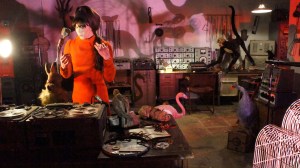
 “It’s a very particular environment, that we’re not sure is altogether… healthy.”
So Delia Derbyshire (Caroline Catz) is told at her job interview for a position which would cement her place as the godmother of electronic music. This is a documentary that revels in the peculiarities and eccentricities of those part-boffins, part-artists who enriched so much BBC radio and television between 1958 and 1998. I say “documentary” but just as the Workshop’s work was often pieced together with bits of tape and razor blade, so this programme takes material of various types and from a number of sources to create a piece of art in itself.
As writer/director/star Catz (best known for ITV’s Doc Martin) has pointed out, there isn’t really an awful lot of solid biographical information about Delia. She left the business before her reputation really bloomed, and the story of her life is one told, here as elsewhere, largely via anecdote. As such Catz weaves interview footage with friends and colleagues into the narrative, which itself is a mix of standard biopic re-enactment and dreamlike, almost Brechtian, imaginings of how things may have happened. Numerous sound clips of Derbyshire, presumably from the too few years after she was “rediscovered” before her death in 2001, punctuate the action. For the re-enactments Catz impresses as Derbyshire, focused and elegant but never allowing her performance to overwhelm the material, as does Julian Rhind-Tutt as Brian Hodgson, and it was a pleasure to see Saskia Reeves as the rather less remembered workshop member Maddalena Fagandini.
Elsewhere we’re joined by the presence of musician and performance artist Cosey Fanni Tutti, formerly of the group Throbbing Gristle. I was somewhat thrown by her involvement in many of the more abstract sequences, but Catz has stated that as a non-musician herself she wanted to bring someone onboard who could illuminate that aspect. It’s also worth noting that when Delia entered her profession it was seemingly almost entirety male-dominated – at one point she’s told at an interview for Decca Records that women are not allowed to be employed in studio, but there may be a secretarial role for her – so illustrating how things have changed for the better may have been part of the point here, or perhaps just to show how her legacy continues.
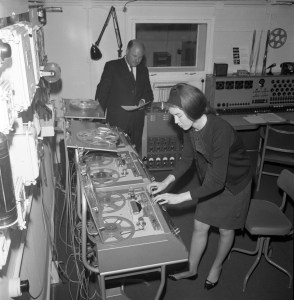 This is an SF website so let’s deal with the Doctor Who stuff in some detail – despite her extraordinary body of work it is of course what she’s best known for. We have a sequence where Delia and Brian Hodgson are given Ron Grainer’s score, with its mood description of “wind bubbles and clouds”, with Delia translating the notes into inches of tape (she was as much a mathematician as she was a musician, arguably moreso). There’s a charming snippet of sound interview footage at this point, where Delia sweetly gives Grainer much credit for his “brilliant imagination”. It is noted near the end that it took until 2013 for Delia to be given an onscreen credit for her ground-breaking work on the theme tune (in The Day of the Doctor).
Later, having reached the 1970s, Delia is rather disappointed in the sounds obtainable from the new “Delaware” synthesizer, strictly speaking a modified EMS Synthi 100, the nickname coming from Delaware Road where the workshop was located. This is the point where fans will exclaim “eh?”, as we’re told the new version of the theme (the rather infamous “boingidy-boing” one used on the UK trailer for the 10th season and accidentally for a couple of episodes in Australia) is because the show is “going into colour now and there’s a new Doctor”. This despite being told onscreen seconds before that it was to mark the 10th anniversary of the series (that’s not quite right either of course, it was the tenth season being marked but it was still only nine years old).
I understand there are times when simplifying or bending the truth is necessary for drama, but “they want a new version for the 10th season – all three Doctors will be in it” would have been perfectly clear. One then automatically wonders how many other “facts” presented here are equally wrong. I’m happy to give Catz the benefit of the doubt, she’s clearly passionate about her subject and extremely talented, but this is something surely someone involved in the fairly long process of bringing this full-length version to the screen should have picked up on (it’s developed from a short film first shown in 2017). We’re also privy to her work for the Out of the Unknown episode The Prophet, which features strange singing from robots who went on to appear, with a respray, in Doctor Who’s The Mind Robber. Very tangential but it was nice to see some photos from that married up to the music from this long-wiped production.
Delia’s life post-BBC is dealt with sensitively, and with more good grace than it usually is. Throughout she’s presented as an individualist (Catz in character states as much) and her decisions were hers alone and simply what she wanted to do at the time. Fans have all heard the myths (as referenced in the title) and I don’t want to repeat them here, so it was pleasing to see this part of her life presented, albeit fairly briefly, as an extension of her ethos for life.
What strikes me as especially interesting about much of Delia’s work (and that of the workshop as a whole) is that it is of course music, but music usually designed to illustrate visuals (on TV) or else to evoke visuals in the imagination of the listener (on radio primarily). It was never really intended to stand alone, although the best of it can, and of course much of their work wasn’t avant-garde soundscapes but various jingles and comedy boings and shambling monster sounds (something not really touched on here beyond a reference to Hodgson working on an exploding Dalek effect). Nonetheless, combining her best work with imagery both abstract and realistic here illuminates it and presents it in its best possible light.
Verdict: A cleverly made labour of love, a little bit artsy for some perhaps but appropriate (Arena is an arts strand) and very evocative of her music and the changing times in which it was made. 8/10
Andy Smith




 Sci-Fi Bulletin: Exploring the Universes of SF, Fantasy, Horror and Spy-fi!