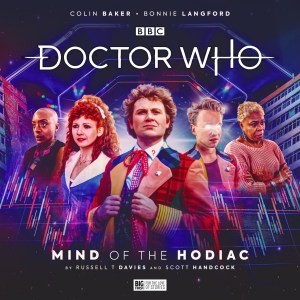
 Russell T Davies’ first Doctor Who script, Mind of the Hodiac, dating back to the mid-1980s has been resurrected and completed by Big Finish for release this month. Shortly before it was announced that Davies was returning as showrunner for the TV series, he and stars Colin Baker and Bonnie Langford took part in a virtual roundtable, which Paul Simpson attended…
(The following is edited for clarity and length.)
Russell: Colin, could I say thank you for doing this, I’m so delighted.
Colin: It’s like saying thank you for a dog eating his dinner.
Russell: No seriously, what a joy and what an honour. I wrote this for you two million years ago when I was thin and ginger and gorgeous…
Colin: It’s a lovely script.
Russell: Oh, thank you.
Colin: What was interesting to me is it shows all the signs of all the other stuff you were about to write. It was all there: that thing about the other…The other trying to adjust within normal life, the outsider. That’s what this is about too and it’s lovely to do.
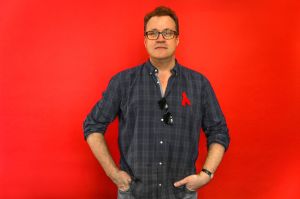 Russell, when did you actually write the script and what stage of your career were you at? How did you submit it?
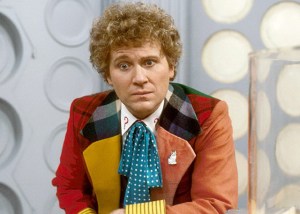
Russell: I really can’t remember. We were trying to work out when it was written because it has Mel in it and it refers very clearly to the Doctor’s coat. I actually make a plot out of the Doctor’s coat, you can see me there wrestling with it. And yes at one point the stage direction says ‘The Doctor puts on his hat, if this Doctor wears a hat’, so these things are dated.
It’s just literally typed out on a piece of paper. It was hilarious because when Big Finish were trying to get hold of it, Emily [Cook] the producer was going, ‘Well, can you forward it to me?’ And I was like ‘Well, I’ve only got one copy,’ And she said ‘Can you send me a PDF?’ (laughs). I was like ‘It’s literally typed, you can’t PDF this.’ Poor Emily, young people have no concept, it’s just typed on a piece of paper.
So, I don’t know when, I was in a flat in Cardiff and I had an electric typewriter. It wasn’t an ordinary typewriter, I was posh, it was an electric typewriter. I don’t know when I sent it off, I just found it in a box.
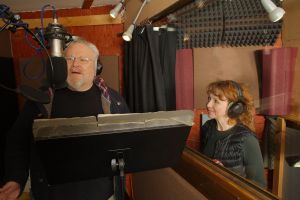 Colin: I played it from ’83 to ’86.
Bonnie: I would have been ’86.
Russell: My God, it’s a lesson isn’t it: date everything.
Colin: So it must have been 1986, because any later it would have been Sylvester.
Colin, you started talking about this a little bit: when you got the script how much did it feel like the traditional sort of script you might have been presented with in 1986 and how much did it feel like Russell’s voice that we’ve become accustomed to from his later work?
Colin: To be honest, I have to say that it exceeded expectations. There is an advantage in an audio script: someone doesn’t have to build a set or take you somewhere bizarre like Mars or Pluto. As audio scripts go, I have consistently found Big Finish’s superior to some of what appeared on television back in the eighties. And this is a script which has an eighties feel about it but it has the 21st century standards.
 Also it struck me that even though he might have been six when he wrote it or whatever age he was, the seeds of the future Russell T Davies that we all know can produce some wonderful drama [are here]. Saving your presence listening to this, Russell, but I still think that The Second Coming is one of the best things I’ve ever seen on television and [your scripts] all seem to examine what it’s like to be on the outside, living as a stranger in a society that you have to live in, which is what The Second Coming was about in many ways and this script as well. It’s about an outsider… well, he’s a villain so he’s trying to do horrible things but he is one person who is different.
It’s about difference. Sci-fi’s always about difference in many ways of course.
Russell: Yes, maybe that means Doctor Who came first in my thinking. There I was in the sixties watching a show about an outsider coming in so maybe that set the template. Maybe everything I’m writing is Doctor Who… oh my God!
What it was like re-reading this thing for the first time in decades.
 Russell: I’ve got to be honest, no one loves my writing more than me (laughs). I actually kind of remembered it all instantly so it’s not like I could read it as a stranger.
Scott Hancock, who’s a very good friend, who’s been a friend since 2006 when he arrived on the set of The Sarah Jane Adventures, it was an honour to share scripting duties with him because he tidied things up. He did more than that, he wrote the second episode and what a joy that is.
So I could never be dissociated from it, I remembered it straight away. I remembered the Hodiac, I remembered the Doctor’s coat, I remembered Mel having all those adventures. So I can’t be dispassionate.
Seriously, I do like the things I write so I’m really proud this has happened, I’m really pleased.
What’s the elevator pitch for this?
Russell: I don’t know, I don’t do elevator pitches. Elevator pitches didn’t exist in 1986.
Bonnie: It’s a wonderful thing about triumph over adversity, about power in the wrong hands and making sure that it actually is treated with respect and love and dignity.
 The thing I love about the script is, I hear Russell, the pace of it, the rhythm of it. Some of the scripts can sometimes be overwritten, there’s a lot of explanation. You don’t need any of that here because it’s all there in the rhythm of the writing, in the spaces inbetween.
And what’s great about doing the audio versions is, as Colin said before, you don’t have to rely on any of the visuals, it’s your own imagination which of course is absolutely limitless.
But I don’t think we can tell you anything about the story except it’s emotional and exciting and yes there is action but ultimately it’s all about power in the wrong hands and making sure it’s in the right hands and that the future of the universe has its integrity sustained.
Russell: Lovely, Bonnie. Please summarise everything I write!
How much of this finished script is the same as what you pulled out of a box last year? What was the process like of turning it from a TV script into an audio script?
Russell: I thought it was really important to preserve the script exactly as it was. There’s no point if you start rewriting it, then it would all unravel – and also I was very pleased with it. There were tiny changes, for example the Doctor’s first line was ‘Um.’ I was clearly warming up… I got rid of that ‘Um’.
Colin: I could have done it, I could have done that ‘Um’!
Russell: Put it back in, it’s not too late!
 That’s all. There was one thing Scott was very brilliant about: it is all based around the Doctor’s coat. I was obviously clearly fascinated by it and that’s a really important plot device which of course, on audio, is pretty useless. ‘Look at that coat.’
Scott went and did some great research on how to describe that coat technically, so that’s been put into the script. You have to literally describe what was going on but I think that was the only change. And that’s just an addition to spell out what was going on.
Scott is obviously an expert on audio drama and talked me through. You can’t cut quite as fast as you would on telly because it just becomes a blur; you have to have slightly more substantial scenes, so a couple of scenes were put together but that’s the basics.
I thought it was really important not to modernise it although there was one thing: it’s very much 1987 thinking in terms of when LGBT or gender neutral might be mentioned… I didn’t want to change that but you have to be more intelligent about it, so there’s a couple of lines just modifying that slightly and allowing room for this much bigger and better universe that we’re in now.
 When you look at this script do you see shared DNA between this and what you’d eventually do on TV in 2005?
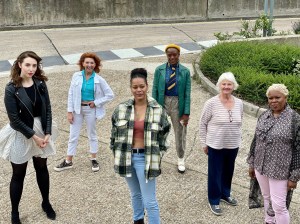
Russell: There’s very clearly a direct line from that to Rose, it’s like, you’ve got great outer big space events and you’ve got an ordinary working class family on Earth arguing. There’s mum and the daughters and there’s grandma. The mum is played by T’Nia Miller. It’s a fantastic cast. We’ve got Laurie Kynaston. So yes, there’s very clear DNA, I think.
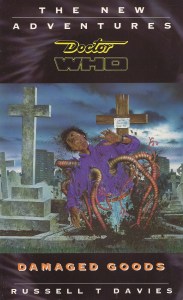 From this through to Rose you obviously had your New Adventure, Damaged Goods, in the middle as well. Is there DNA shared in that?
Russell: Well, it’s the same thing, I’ve only got one script in me, I just keep changing the names. I plough a very narrow farrow but I plough it well.
Well, again, that New Adventures novel is outer space events on an ordinary housing estate so… oh my God, someone will see through me soon, move on! To the turns, talk to the talents!
What do you think sets this TARDIS team apart in terms of the characterisation, in terms of your relationships with each other, from other teams?
Bonnie: Well, for me with Colin, it’s probably about a foot isn’t it? Because I’m that short. And Sylvester was shorter (laughs) So it’s just a case of wearing high heels or flat shoes really was just the difference.
What’s so amazing about it is that whoever plays the Doctor brings something of themselves to it and as they would with any other character, it has to come from your own truth. But there is this wonderful link with all these brilliant actors and actresses who have played this part and the one thing I think is integrity and honesty and authenticity. So that’s the absolute through line of the Doctor, whoever is playing it, male, female or anything.
As far as the companions are concerned, they bring different elements because they have to be the voice of the child who’s sitting there going ‘Why is he doing that at that point?’ or ‘Why are you going down that corridor?’ I used to feel that Mel did that.
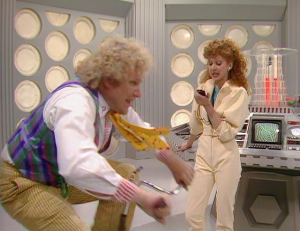 The one thing that always frustrated me with Mel when we were making it was the fact that she was supposed to be a computer programmer and she never went anywhere near a computer or did anything whatsoever except ask slightly banal questions and tell the Doctor that he needs to get fit, which is really annoying, because who needs to hear that?
But I think that that’s the great part about the whole dynamic of the show: as long as you’ve got your inner core of your truth of those two or three characters believing in the same thing and having this wonderful integrity, then you can do anything with it and you can go anywhere and there’s no limits of any sort. And that’s what they’ve proved by staying on screen and on audio for so long. It’s down to the power of your own imagination.
Colin: And in terms of Bonnie and I working together, we worked together years earlier in panto and we knew that we were both pros. I think Bonnie’s the most professional person who wears it lightly that I’ve ever worked with. Bonnie’s not somebody who marks anything, she gives it 100% and that 100% is always right. I had a sigh of relief, when they were bringing in a new companion, the fact that it was Bonnie meant that it was going to be alright.
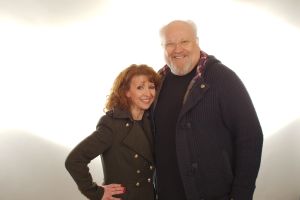 Bonnie: Aww, thank you.
Colin: Bonnie’s a total pro and the relationship between any two people, think of any couples you know, they all work for different reasons. It’s not for us to say why we work, it’s for others really but I know we do. And she’s the antidote to the Doctor’s pomposity; all that stuff that we had in the television about him going exercising and losing weight, it’s the relationship of two people, easy enough with each other to challenge them and I like that a lot.
Russell: Can I just say, these two are so modest. I think the thing about Doctor Who is, he’s constantly blessed by greatness, greatness. This script was written what…thirty five years ago and Colin and Bonnie are still famous. You won’t find many actors like that; they’re still famous, their presence known in the culture. Their work on Doctor Who is still here, that is very rare.
Anne Stallybrass died the other week and that was very sad but no one had heard of her for thirty years but actually, you two have carried on, you have continued, you’ve blazed a path, you are loved and that is rare. That is what is special about them, they are special people.
Colin: Oh, bless your heart.
Bonnie: We’re very lucky, thank you.
Russell, as this is a story for 1986, I was just wondering if there’s any fantasy casting that you had in your head when you were writing this?
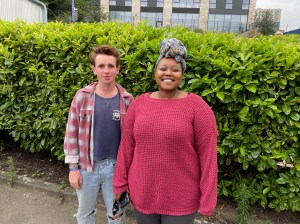 Russell: We don’t tend to do that, I think if you write with someone in mind then their agent says they’re not free, it’s a big mistake to do it. And of course you limit yourself if you pick an actor and write for them, then you don’t explore the character fully. No, all I had in mind was Colin and Bonnie.
Sometimes the world is absolutely lovely. All these years later we get to make this and it’s honestly a thing of absolute joy. I’m so happy
How much has this been expanded from the original story?
Russell: Episode 1 was written completely. Bizarrely, I had adopted the forty five minute format, that’s why it’s a real mystery as to when I wrote this. I’d written the first episode completely, that hasn’t changed, apart from the little changes just to make it more saleable and then gave it a very long, like a six or seven page, scene break down [for episode 2] that Scott has brilliantly worked up into a script.
Bonnie: Do you not remember sitting anywhere and looking out of a window?
Russell: Yes, I remember being in my flat, I wrote it in Claude Road in Roath but that was ‘85,’86 and ‘87. So that’s why it’s a blur: just me and my little typewriter dreaming of making Doctor Who one day, isn’t that funny.
Bonnie: Brilliant.
Russell: Strange though, isn’t it?
Bonnie: Not at all, no. I was actually jealous when you were there on the show running it because… well, because it made things make sense.
 When I did some conventions about twenty years ago, it was interesting to hear the other companions saying that basically the companions are two-dimensional. We don’t really want to know too much [about them], it’s a way to forward the story or else interject or get in the way and create another B stream going through it. And I thought ‘Oh good’ because I was looking for something all that time and never found it but when I saw the new Doctor Who, the way it is, I thought ‘Oh, there it is.’ There’s the anchor on which to base yourself, there’s your foundation, that’s all you need.
You don’t need loads but it was always something and I think I was always busy trying to search for it too much.
Russell: Oh, I think it’s about time Mel hopped off that spaceship and came back to Earth.
How much of this is more like the throwback to the 1980s’ relationship between Mel and the Doctor and how much the more expanded and funnier sixth Doctor of the audios?
Colin: Big Finish gave me the opportunity to do what television, alas, didn’t. They started off very bravely with my Doctor [on TV] by making him unlikeable and it certainly was brave because my first episode ever was at the end of Peter Davison’s series and I was horrible to my companion, immediately after regenerating. Then they had three months to wait to see this horrible Doctor come back.
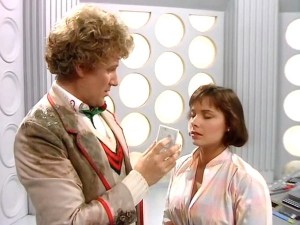 So it was kind of unfortunate timing but it struck John Nathan-Turner and me that regeneration must be a fairly catastrophic event. Whereas Peter arrived and was totally enervated by it and had to be carried round by his sixty three companions for several episodes, they decided to make mine the opposite and make him manic but it kind of frightened the traditional viewers so I had a bit of a battle reclaiming the ground.
The Doctor is the Doctor, and what the Doctor is runs through all of them like a stick of rock. My favourite characters in fiction are always people like Darcy in Pride and Prejudice who you start off hating. You loathe him, all the way through the book and it turns out he’s the only really decent person in it. Take Harry Potter, think of Snape. Those are the interesting characters and I was foolhardy enough to go along with the plan that my Doctor might put people’s teeth on edge for a bit.
 Bonnie: As you say, there’s nothing wrong with that. That is always much more intriguing and much more engaging and also much more fun to play,
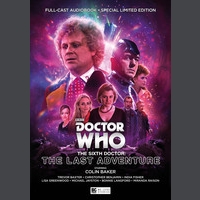
Colin: Oh yes, of course. Big Finish has enabled me to complete that journey and I finally agreed because the script was so good, to record the episode that leads to my turning into Sylvester. Nick Briggs wrote it brilliantly because it seamlessly ends at the beginning of the Rani story where Sylvester arrived but the lead up made me truly heroic. I did like being heroic.
Mind of the Hodiac is out later this month from Big Finish – click here to preorder




 Sci-Fi Bulletin: Exploring the Universes of SF, Fantasy, Horror and Spy-fi!