Interview: Doctor Who: Rona Munro
Rona Munro is the only writer to pen scripts for both the 20th and 21st century incarnations of Doctor Who, with the final broadcast classic era tale Survival, and the […]



Rona Munro is the only writer to pen scripts for both the 20th and 21st century incarnations of Doctor Who, with the final broadcast classic era tale Survival, and the […]
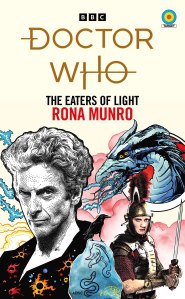 Rona Munro is the only writer to pen scripts for both the 20th and 21st century incarnations of Doctor Who, with the final broadcast classic era tale Survival, and the Series 10 Roman story The Eaters of Light. With the Target novelisation of the latter arriving this week, she chatted with Paul Simpson about the challenges of the different formats…
Were you surprised the Target novels were still going or were you aware that they’d started off again?
I wasn’t surprised because I have mates that have written them, in particular Jenny Colgan. I was swithering about doing it and I had a little conversation with her. She basically reassured me that I did have the skillset to do it and I could undertake it, because it felt like quite a task, in the timescale.
I was juggling other work anyway and then they asked, “Can you do a complete novel, this many words and do it by Christmas?” and I was like ‘Whaaaat?’ But yes, I had a little chat with Jenny and she geed me up so I thought, ‘OK I can do it, I’ll do it.’
Did you have any ideas before you went into doing this of what you might do with it as a book, bearing in mind you did the novel of Survival back in the mists of time?
 When I did that, I’d just had my son and I was extremely sleep deprived. I have so little recollection of what that process was but my memory of doing Survival in contrast to this was [then it was] very much more “represent what was on screen in a prose form”. Of course [the TV story] was much longer so there was a lot to get in.
With this I’d imagined all this backstory, all this world, and of course you can’t put all that backstory on screen. It was an opportunity to really do a deep dive into that. I think particularly for Kar and Lucius: just give them a character backstory that was in my head but there wasn’t space to put in [the script].
Also I think probably it was a reaction to living in a very rural place in the Scottish countryside. Having gone through lockdown, there was that sense of the relationship with landscape which had been really sustaining through all those lockdown months and being able to put that on the page as well. That would have been the Picts’ worldview I think, that very intense relationship with the seasons and with nature, and in a way my life had been reduced to that. So that felt very live and something I very much enjoyed being able to bring out.
One of the things that struck me was that we have two very clear societies. The conflict wasn’t purely ‘humans versus whatever’, it was two worldviews that almost couldn’t survive together. Was that something that you had at the back of your mind when you did the TV story or is that something that you were able to bring out far more in this?
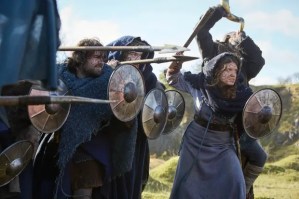 We talked about this. I very much wanted to represent the Romans not as the good guys, because we’re so often presented with the Heroic Romans – “look at all they achieved!”. Well, yes OK, they brought you indoor plumbing but it was colonisation and it was imperialism. The types of societies they conquered and absorbed: we can’t know exactly what their values were – and they may not have been that great in terms of how they treated each other – but on the other hand I think it’s very hard to be an extremely rural society without very organised agriculture, without also being an intensely cooperative society. Then you had that replaced by something considerably more oppressive for the majority of people, so I really wanted to contrast that.
Also there’s the speech that Kar voices in the script and in the book, which was what Tacitus, the Roman historian, reported the Pictish leader who opposed the Romans as saying. Now obviously Tacitus did not hear him say that and in a way that represents what Tacitus thought about Roman military occupation, but it’s a very stinging indictment of what imperial conquest actually does: that thing of making slaves of people and literally conquering the Earth and the destructive force of that.
That was something I really wanted to bring out. I suppose it’s kind of what the whole story is, not to be too pretentious: it’s a metaphor. These apparently uncivilised people are, in fact, saving the world on a regular basis and their culture is built around doing that and you come storming in and destroy their culture and you’ve actually destroyed the Earth. I think it’s a good metaphor for maybe some of what patriarchal capitalism which started with the Romans has done to the Earth – but I would say that as I’m a hippy dippy leftie of a certain age!
Do you think you could have told this story on the show in the 80s?
 Yes actually I do, yes… in terms of the themes, definitely. In terms of the budget to realise it, possibly not.
You’d have been told: ‘You’ve got two people here and two people there and they represent their entire race.’
‘And you’re in the quarry, I don’t care… You can have a polystyrene rock in the quarry but it’s the quarry.’ (laughs)
In fact thematically there are similarities between the two in that sense of what is civilised and what is not.
‘If we fight like animals, we die like animals,’ the famous line from Survival.
Yes but I think also in both you have that sense that the animals might have a more moral relationship or one that’s more accepting. Instead of conquering nature, go with it, and that might bring you to a better conclusion. I think that’s a theme in both as well.
What were the challenges of writing for Peter’s Doctor and Pearl Mackie’s Bill?
 Peter, less of a problem, because I felt like I had an awareness of him as an actor. I peripherally worked with Peter years and years ago and I’ve always followed him. So even though I’m writing it before I’ve seen what kind of Doctor he’s going to be, I’ve got an idea in my head.
I think also there’s a sense of “the Doctor is the Doctor” which is a core thing that I think you realise or are reminded of when you do return to it: yes, OK, it’s a completely different version but in some other ways it’s exactly the same.
I didn’t know what Bill was going to be like at the time I started writing it then I got a look at the script that first introduced her [The Pilot] after I’d embarked on my first draft. So in terms of writing the script, that had to develop as I was doing it, and in terms of the novelisation of course it was a lot easier because by then I knew who she was and I’d done those plot beats with her so that became a lot easier.
Did you sit down and rewatch the episode before you embarked on the novel?
Yes, I did. That was really useful because I had a memory of the stuff that had had to be cut out. Then you go, ‘Oh God yes, we had to cut that,’ So you think, ‘Oh I can put it back in!’ It was nice to see what was there but it was also nice to be reminded of some of the stuff that I had wanted to put in but we hadn’t had room to squash in. So that was good.
 Did it feel then, to an extent, that you were rebalancing the story? It sounds like there were elements that had to go because it had to hit 44 minutes 27 seconds.
Yes, and also it had to honour a series arc. Of course it did: that was the job of that episode, to be part of an arc of episodes over a series. Whereas for the novel, I thought ‘Well, that’s out there, that exists so this is an opportunity to produce a stand alone take on it.’
This is the one where it’s Kar’s story and Lucius’s story as much as it is Bill and the Doctor’s, and that doesn’t exist. So instead of repeating what already exists, let’s do something different. OK, now you’re going to look at this bit of the story that intersects but actually is another story in its own right.
The book has given you that opportunity to step back and say, ‘Right, let’s find out who these people are.’
 Yes, absolutely, otherwise I don’t see what’s in it for the fans. You’ve seen that on the screen so why do you need to read it as well, if you’re just replicating it?
I’m obviously still really proud of the novelisation of Survival but in retrospect that’s something I wish I’d realised I could do more. I probably wouldn’t have been capable at the time of spinning out the story again in another form but it was nice to be able to do that this time.
What was the biggest challenge in writing this?
Time (laughs). It really was.
 Thank goodness I did really enjoy the process and become enthusiastic about it and find myself inspired by the opportunity to include backstory about things I was passionate about. You know that thing where you read all this stuff about ancient Rome and you go, ‘Oh my God I could put it on the page!’ Living in the landscape that I do and going for long walks, especially during lockdown, the only sense of an outside world was the hills and woods around here so I was going, ‘Oh my God, I can put that thing that I love on the page.’ Because had I not discovered that energy and enthusiasm I think the timescale, for me, would have been quite difficult. But it was fine, it worked out fine so that was good.
You’ve got a wide writing CV. Does this genre particularly call to you? Is there something specific about the imaginative genre?
 Yes, when I have these general meetings that you have quite a lot with film producers and TV producers – where they don’t have anything specific, they’re just doing a meet and greet and ‘You’ve done this so what other stuff are you interested in?’ – I always say that the things that I would be most drawn to are history and science fiction.
What they have in common, for me, is that in a sense you can write metaphorically.
If you’re writing contemporary naturalism then the detail becomes everything. You can put big themes on the screen or on the page or on the stage but you have to do it very literally. If you’re going to do a story say about #metoo or the pandemic or institutionalised racism, then you are doing it in a literal story about that literally happening to a character and the detail has to be naturalistic and convincing.
If you’re looking at that through the lens of history or science fiction, you can tell a story that sits sideways to that but still carries those themes, and sometimes that allows you to land the point or the emotional impact in a much more accessible way. It’s very easy to look at the specific story of a literal person who is realistic and go, ‘Yeah but I’m not that person’ or ‘Those ideas are not about me.’
But if you have it in the form, for want of a better word, of a fable, it’s like guerrilla warfare: you get into the psyche and the imagination and then you blow up your imagination bomb and make people go “oh!” and maybe identify with things that they have a resistance to identifying with.
 That’s why, for me, those genres are the things I’m drawn to more than anything else and get excited about using.
Basically helping people to walk in shoes they would never consider? As you were talking I was thinking Ursula K. Le Guin, a classic example.
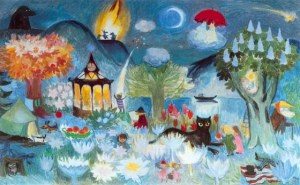
Oh my God yes, yes. Ursula K. Le Guin, she’s my favourite. Ursula K. Le Guin, Tove Jansson, Doctor Who and Star Trek. They are my four foundation stones.
Click here to read our review of The Eaters of Light novelisation
 Doctor Who News Star Trek News
 Sci-Fi Bulletin: Exploring the Universes of SF, Fantasy, Horror and Spy-fi!