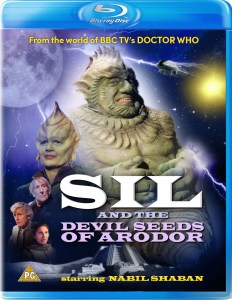
 In addition to the regular Myth Makers productions, interviewing talent from both sides of the camera on Doctor Who (and occasionally other shows), Reeltime Pictures also produces occasional dramas, including the Yeti sequel Downtime, The White Witch of Devil’s End (with Damaris Hayman reprising her role as Olive Hawthorn) and now Sil and the Devil Seeds of Arodor. Producer and director Keith Barnfather discussed the many challenges of the project with Paul Simpson…
We talked about a new Sil drama as something that would be happening at Gallifrey two years ago. What was the actual genesis?
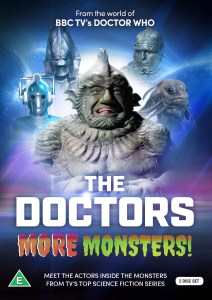 You know we’re doing The Doctors series [a compilation of interviews linked to the various eras of Doctor Who] which will finish next year in June with 13 titles. When we started these I had all the interviews – the first one, Jon Pertwee, was already shot and recorded. I didn’t consider if they were successful I would start running out of interviews. Paul McGann I hadn’t even interviewed!
Over the last couple of years I’ve shot about 15-20 Myth Makers, far more than normal, and was looking at needing to fill up another Monsters disc. I’d always wanted to meet Nabil, so approached him and went to his place in the country and had a couple of idyllic days there with him and his wife. I enjoyed getting to know him; I disagree with him on many, many different ways in his politics, and I agree with a lot of his politics as well. I like him immensely as a human being; he’s an incredibly inspiring person.
At the end we were chatting, and I thought, ‘I’d love to work with him. Hang on, Sil is the copyright of Philip Martin – and I know Philip Martin.’ I mentioned it to Nabil; he knew what I do and the levels of production value I can manage, and asked if he’d be interested and he said he’d love to do it.
So I asked Philip if he would be prepared to do a story and I was blunt with him about what we were capable of doing, and he jumped at it as well.
 This is one of the longest dramas you’ve done…
White Witch of Devil’s End ended up being six twenty-minute sections, so that’s longer. When it came to this, I commissioned Philip for a 50-55 minute drama. He wrote it and I read it through and I got 65 minutes – that was ok, I didn’t mind that. But when we recorded it all in the studio and put it in the edit suite I found myself in the same position as I’d been on Devil’s End. I was on page 15 of the script in the edit suite and already up to 20 minutes. Not only do you have Nabil being Sil, and he stretches everything in the performance, but it’s a courtroom drama, and in those, people take more time because that’s the way a court works.
So what could I do? I realised it would work better as episodic, and weirdly and amazingly, the episode breaks are there.
I did have one problem with episodes 3 and 4 because it wouldn’t sit in the right place. I wanted to finish episode 3 on the end of Sil’s amazing soliloquy but that didn’t work with the way the scenes were structured. That made me look at the edit and there was one scene in there that was not contributing to the drama – it gave you too much information before the final scene in the courtroom in episode 4. So I cut that out with Philip’s blessing – and it’s in the special features on the disc. When I did that, it all fitted together perfectly, so sometimes it’s serendipitous.
 There’s a natural rhythm in Philip’s writing – he’s been doing it so long he’ll put those ups and downs in. To me, the flow works episodically, with those breaks.
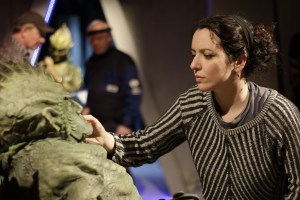
With this production I was always aware there was a fear, because it’s only two basic sets, that it could become too static, so I tried very hard with the editing and the angles of the shots to give it as wide and varied aspects as possible. One of my briefs to [designer] Phil Newman was to create a set in the round so there’s no fourth wall, and I could shoot from all four corners and angles.
Also because it was a courtroom drama you can’t have people moving around too much in the court environment – that’s not what they do – so I thought, ‘I’m going to shoot it from as many angles as possible, each shot, each actor saying their lines through so I can edit in any way I choose in post to keep it moving.’ That worked really well. The only time I could experiment with directing and camerawork were in the prison cells and corridor scenes which I’m pleased with.
What was the biggest challenge for you as director?
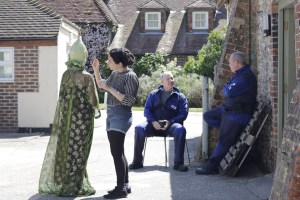 Taking away all the problems of being the producer and trying to bring something in on the budget that was ludicrously low, trying to do what we do with the money that we have…The most difficult thing as a director was using a camera effectively in a tight space – you’re working in a tight environment and you want to use that environment to give that impression. Part of my brief to Phil Newman was to give that feeling of oppression, of claustrophobia to a degree, but not so much that makes people uncomfortable watching because it’s too claustrophobic.
I wanted to get that feeling of everything being on top of it all, focusing everything on that and using it to an advantage, which I think we did. I’m very pleased with the feeling, the lighting, the sets, giving the feel of the massive power of this Moonbase structure.
How much direction did you need to give Nabil as Sil?
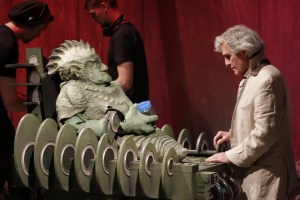 One of the big criticisms that actors have of many directors is that they try to direct them. I try not to be that kind of director. If you put your faith in an actor and choose them because you want them – as I did for this – it sounds a bit pompous, but you have to trust your actors. It doesn’t mean I don’t give them direction: we had the readthrough the Saturday before it started and there are obviously times when I say ‘at this point, this is happening and we really need to do this or that’. It’s like working in the theatre – you’re putting nuances in.
In Nabil’s case I didn’t feel the necessity at all. Nabil is Sil and no one can do Sil better than Nabil. Of course if I did see something during filming that wasn’t working [to match shots] then that’s what I’d need to do.
The one character I worried most – and I was almost completely wasting my time worrying – was Christopher Ryan playing Kiv again. He told me when we first talked about it that he hadn’t watched the Doctor Who when it was done, and hadn’t seen it since, so I was worried he wouldn’t be able to get Kiv’s character, given he was in prosthetics with the make up on when he played hm in Mindwarp. We came to the readthrough, and got to his first line – and it was Kiv. It was amazing.
 The thing with Christopher is he’s such a soft spoken man – kindle, gentle and sweet – such a nice human being, that when he suddenly came into this character and was Kiv again, it was a shock to see this incredible actor assume this role. Sometimes you see actors ‘acting’, but in Chris’s case it was almost a metamorphosis: putting a coat on and becoming someone else. He doesn’t steal the show but he matches Nabil, which is incredible, given Nabil is the star and he is in nearly every scene.
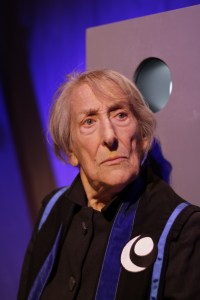
The actor I think has the most difficult time is Janet Henfrey: she doesn’t have things she can bounce off and create a character around. The Adjudicator really is the pivot of the story but with the least character given to her. I think she brought so much to the part and played it so well. She keeps control of it and keeps the focus and doesn’t lose out to the other actors.
The first scene establishes her so well.
That’s Philip’s script.
This is a stonkingly good script. I thoroughly enjoyed working with Philip. I expected in advance to be walking on eggshells. When he delivered the first version, it had mentions of the Doctor all the way through, so I had to go back and say no – my fault for not explaining properly. He came back and rewrote, and I’d go back with suggestions, and he took everything in. He never said to me, ‘Who do you think you are?’ He always listened and was an incredibly good person to work with, and my respect for him – and everybody on this production – just went up and up as we made it.
Is Sil going to return?
My personal feeling is never say never again, but I think I’ve probably done everything I can with Sil in the lead.
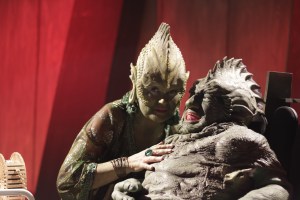 The problem with Sil is that he cannot be anything other than point of focus. Philip wrote me a script that allowed me to play with it and move things around a bit but ultimately Sil can’t get off his chariot and run around. For me, Sil would have to be a supporting character in another story to work. I don’t envisage at the moment that’s a subject I’d be particularly interested in doing. What we’ve done with Sil is what I like to do with all the dramas we do – develop the character from Doctor Who, see more of the personality, give them depth and then move on to someone else.
I’ve already spoken to Nabil about playing a part in a future production but not as Sil because I enjoyed working with him so much. We have two future productions at the planning stages, so I wouldn’t imagine doing anything quickly, even if Sil was a huge success.
Sil and the Devil Seeds of Arodor is out now from Reeltime Pictures; the novelisation by Philip Martin is out now from Telos Publishing




 Sci-Fi Bulletin: Exploring the Universes of SF, Fantasy, Horror and Spy-fi!