Interview: Doctor Who: James Moran
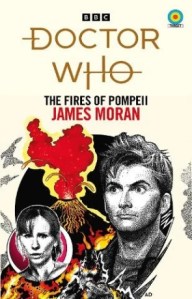
James Moran’s novelisation of his Doctor Who Series 4 story The Fires of Pompeii is out today as a Target Book. He chatted with Paul Simpson about the writing process […]



James Moran’s novelisation of his Doctor Who Series 4 story The Fires of Pompeii is out today as a Target Book. He chatted with Paul Simpson about the writing process […]
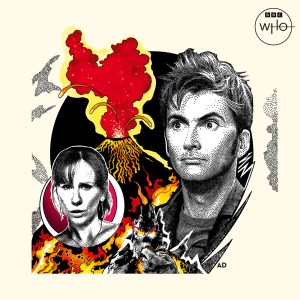 James Moran’s novelisation of his Doctor Who Series 4 story The Fires of Pompeii is out today as a Target Book. He chatted with Paul Simpson about the writing process for the TV episode as well as the book…
You’ve written Severance, Cockneys vs Zombies, various stories in the Doctor Who universe – did you always know what sort of storyteller you wanted to be?
Oh yes, right back from when I was three or four years old.
I was always writing stories as a kid, it was just something I always wanted to do, but obviously, as a kid, you don’t imagine that you’re going to get to do that as a job, do you? This was pre-internet and I didn’t know any writers, so it just didn’t seem like a thing that was possible.
I remember having a story read out in class when I was four that everyone liked. I don’t think it was hugely complicated! I remember as a kid sitting watching Doctor Who and it drove my mum mad because she wanted to change the channel when it was finished but I always insisted on watching all of the end credits to see who did all the different departments. So I was clearly interested in the mechanics of it but I never thought I would ever get to do it for a living.
 It was a childhood dream that I would just be sitting by a window looking out at trees and making up silly stories. I always had a very similar type of thing – it was sci-fi, it was action, it was horror…
You know your first year of primary school, you’d draw your house with the chimney and the smoke coming out and people waving. I’d forgotten this but my sister reminded me: I used to draw those exact same pictures but the houses were always on fire! So clearly right from then I was into the explosions and the mayhem. That’s pretty much what I’ve been doing ever since, just putting people in nice houses for different durations before I blow the house up.
Do you feel that you are character led or plot led when you’re starting a story? Do you think of the people in the house or do you go from the incident that happens?
It’s always the plot idea. What if this thing happened? Or what if that thing happened? That gets me excited and then I figure out who that could be happening to. So I come up with the character and tailor it to the idea so that they are custom designed for that situation.
I like to say that you come up with the scenario and then you find the people who are least suited, who are the last people who would want this to happen, and then you throw them into it and see how they survive… or not. Extraordinary things happening to ordinary people who then become extraordinary by finding inner strength they didn’t know they had. I think everyone’s got that inner strength.
So how does that work when you’re going into a series that’s slightly more prescriptive such as Eve or one of those where you’ve got a very definite set up and an overall season arc?
 I find that easier in a way because you’ve got the show set up, you’ve got all the characters, so then it’s “What can I think up for these existing people that can happen to them?” A lot of the big work has been done for you so you’re trying to think up scenarios and situations that will fit into that existing framework.
It does help to give you parameters to work within. They’re not limitations, although it helps because you know what kind of stories you can’t tell. For example for [the CBBC show] Eve, you couldn’t do a character getting addicted to drugs and killing their parents, it’s not that kind of show. So you’re trying to think of the particular things like the interaction between a humanoid robot and very human people and what they learn from each other, and what can I come up with that’s funny or exciting or scary.
What element of it when you’re actually writing a script do you find the most satisfying?
It’s exciting when you come up with the initial idea and you think, ‘Oh that would be a cool thing to do.’ Because you haven’t expanded it and tested it yet so in that moment it’s just a perfect little idea that works and you haven’t had to sit down and work out what doesn’t work yet. This is why new ideas always seem more exciting than what you’re working on right now because what you’re working on right now is full of plot holes because you’re still working it out. A new idea doesn’t have any plot holes yet because you haven’t thought about it properly.
So that initial excitement is great but when you’re halfway through, there’s always a moment where you think, ‘Oh, this is working now, I think I know how to do this.’ That’s really satisfying and obviously when you’re finished and they say ‘Great, there’s no more notes.’ (Laughs) That’s very satisfying.
The Fires of Pompeii: the TV version obviously was at the height of David Tennant’s tenure, Catherine Tate has come in, the machine in Cardiff is running at full pelt. How did it feel coming into that at that point?
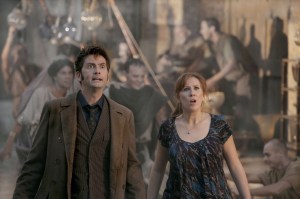 It’s a similar sort of thing: everything’s set up and already in place so that’s comforting on one level. It’s a bit mad and scary because it is essentially the biggest show on TV in this country and it’s been a thing in my life since I was three or four years old.
There is that pressure, but they do support you and look after you. This is the difference between TV and film: in TV, especially on that show, they really look after you and protect you. I always like to say that they don’t let you fail. They let you experiment and do your own thing but it’s like they’re cuddling you and making sure you don’t fall.
At the time it was like I’d had my jacket caught on a runaway train and for four months I was just desperately running to try and keep up and then you finally get thrown off and it’s finished and it’s like, ‘Oh, that was a bit mad wasn’t it?’ Then suddenly you look back and go, ‘That was a weird time, what a strange time that was.’
You’d already done your Torchwood series 2 episode by that point?
Yes I was coming in for either the read through or the tone meeting on that and they called me in an hour earlier that day for a secret meeting. That’s when they said, ‘Do you want to do an episode of Doctor Who?’ And obviously I said yes.
No hesitation?
Absolutely not, no. I’ve been dreaming of it since I was a kid, literally. I’ve been thinking about this since I was a child and I did not so subtly remind them every single Torchwood meeting that I was available for Doctor Who if they should be interested. it was a joke at one point. There was one meeting where I wore a Dalek T-shirt and I was making jokes about it like ‘I don’t know if this is too obvious but…’
Obviously there’s a lot of elements to The Fires of Pompeii, with the Vesuvius plot, fixed point in time, the family etc. What do you look at from that episode and go: ‘It would be completely different if somebody else had written than me?’ What bits are very much James Moran in there?
Blimey, that’s a good question
[When I arrived,] there wasn’t a story. It was going to be in Pompeii, they gave me some elements to add to it but my big question was, ‘Alright, I’m very excited, I’m going to get to do an adventure, it’s Doctor Who, it’s Pompeii, but what can the Doctor actually do here?’ Because Pompeii happened, and we can’t have the episode where he saves Pompeii and changes history because that would be really insulting to the real people who died, quite a lot of people who died horribly. Kids watching the show would be like, ‘But that didn’t happen because I’ve been to visit or seen Pompeii on the internet.’
That was an issue and then as I often do, my mind goes back to Genesis of the Daleks.
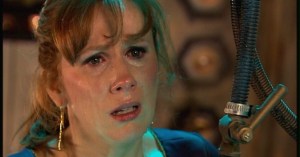 OK, the Doctor can’t save Pompeii so maybe I can make a thing of that in that he can’t save Pompeii but he ends up saving the world. What if he has to destroy Pompeii or he has to set the explosion off to save the world and that it’s more that he has to do this, it was always going to happen and it was always going to be him, it was inevitable.
We talked earlier about that moment where the story kind of clicks, and that was like, ‘OK, that’s the central concept’ and everything else builds around that because it’s all leading up to that climactic moment where he has to choose between Pompeii and the world, and obviously he’s going to choose the world because you’d have to. Because it was Donna’s first trip, I thought if he’s pushing a lever or something, he just physically can’t do it, it’s just so much and then she just puts her hand on his so it’s both of them and not just him.
I was wondering if that concept, that whole ‘can we fight fate idea?’ was something you were given or something you brought into it. The Target novel very much focuses on that aspect. Virtually from the word go that conflict between Donna and the Doctor is there. ‘Don’t get too involved, you don’t want to know these people because you don’t want the pain of losing them.’ Which is effectively what he’s saying to her and then gets caught up with the family. I wondered if that had been as central in your mind back in 2008 as it was, as it clearly is in the novel.
Pretty much yes because it’s such a big thing. In one of the early drafts of the script there’s a moment which I put back in the book, a whole conversation where Donna’s saying, ‘These people are in the past and I’m in the present.’ And then the Doctor says, ‘Yes but if I took you to the future, that would be their present and to them you’d be long dead.’ You have to keep things moving quickly on a TV episode and so it was a bit too long and it may have been a bit too grim, a bit too depressing for a TV romp, but that was very much on my mind. The whole question of interference and what can you change, what can’t you change… again, it was Genesis of the Daleks all over again. What do you have the right to change? What should you? What shouldn’t you?
With the novel, did you consciously try to mimic the tone of the episode or did you allow yourself the space to put stuff back in like that? It does feel a little darker than the TV version, particularly the chapter about the eruption…
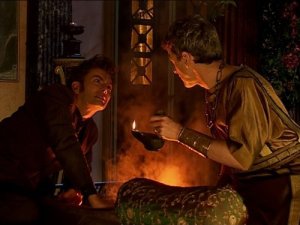 That was on my mind, even before I started writing it.
Pompeii is something I’ve always been interested in, even before I got the job. As a kid it was one of my childhood interests and obsessions because I just found it so horrible and upsetting – but fascinating at the same time and kind of uplifting, because obviously they all died horribly, but now we get to see into their lives and celebrate them and they live again and they will forever.
Obviously there are things you can’t do on a teatime TV kids’ show but books you can push it a little bit more, even for kids. I was reading stuff as a kid that if it were a TV show or a film I would never been allowed to watch and it would have traumatised me, but reading it in a book – because you’re not seeing it, it’s all in your mind and on the page – you can go a lot gorier and darker and scarier. Which is strange because I think books can get in your head more than TV and film so it’s weird that you can get away with more.
What was your reaction when you were asked to do the novelisation?
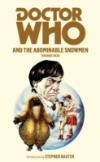 I was hugely excited. it was a similar reaction to when I was asked to do the episode because I’ve been watching the show since I was a kid and I’ve also been reading the Target books since I was a kid. As a child they were the way I could watch episodes that I would never get a chance to see.
I don’t think I realised at the time that there were wiped episodes but I knew there was stuff that was never on TV because they didn’t repeat things very much back then. I grew up in the Tom Baker era. The books were a way to catch up on loads of things that would never get repeated, particularly the previous Doctors. It was nice to read a book of a story I’d seen but it was more exciting to find an old battered copy of something that I would never get to see.
The Abominable Snowmen was one of my favourites, I must have read that about twenty times. I don’t know what it was about it. There was just something about it that I loved. It’s not even one of the biggest splashiest visual episodes or anything. I had no idea it was one of the missing stories so it was only later in life I was like wow, I feel like I’ve seen it even though I haven’t and can’t ever.
The new Target novels are coming out in a very different world to their predecessors. You want to watch The Fires of Pompeii you can go onto iPlayer, you can stick on the DVD, the Blu-ray. Dd that make a difference to you writing it? Did you feel you had to give fans something different?
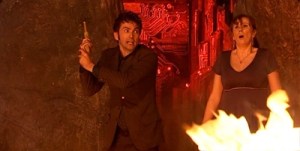 I knew that it would be performing double duty in a sense, in that there’s going to be people who’ve watched the episode and then read the book and if it’s very different then it’s like ‘What’s this? This is weird’. And there’s going to be people who find the book first, like I did a lot of the time as a kid. The kids who read it first, when they watch the episode, they will be like, ‘Oh my God, this is how they’ve done that.’ And ‘This is how that looks.’
Also, for people who’ve seen the episode and also read the book I want to give them a bit more background and information and an expanded experience into what everyone’s thinking and feeling. Background information, inside stories and little tangents that you can get away with that in a book more than you could on screen. They were 45 minute episodes, they zip along. They liked to say, “it’s essentially a movie crammed into 45 minutes, just no time to stop”. So to let some moments slow down and spread out would be fantastically boring on screen but when you’re reading it you get to see what people are thinking as well, so it was nice to flesh some things out. Particularly Donna because a lot of it is told from Donna’s point of view.
I get to fully dive into Donna’s mind and hear what she’s thinking a lot of the time. She’s just so much fun to write for. It meant that I could get more Donna stuff in, more humour and more jokes to balance out because I knew I was going to go darker with the eruption stuff because it was so sad and so grim. I don’t want to make it bleak but it was going to be very very sad and so it gave me licence to just go fully with the Donna mayhem.
Watching the episode the first time I did wonder if the Doctor was going to go back for the family or we really were going down the ‘This is what history has got to be’ and that’s what the season was going to be about. That backlit shot of David in the TARDIS door is one of the show’s great hero moments. Did you have any particular moments in this where you thought ‘I’ve got to capture what people will have stuck in their minds from on screen’?
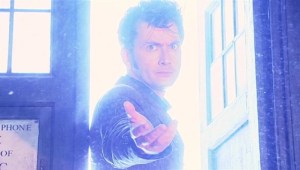 Yes. The big showy stuff with the eruption and the fire and the ash and everything because it is so visual, I didn’t want to let people down with a rubbish description but I think that’s easier to describe because obviously I have the episode and I’ve seen lots of explosions in my time.
The slightly harder thing was just capturing the mood of everyone because I knew I could describe explosions and ash but then going into the forensic detail of how it’s building up, how it’s buckling the roofs, using some of the figures and statistics about how much stuff was being pumped into the city… and then to get across how the general public in the city felt when they were scared and when they weren’t scared and when they’d given up hope.
There’s a moment on screen where Donna picks up a kid because she thinks the kid’s abandoned and then the parent comes out and takes the kid away and what’s not said on screen is that they then go off and die horribly. That was one of the moments I really wanted to just stretch out and take a moment and go ‘This is awful, this is really really sad.’
You also incorporated the mini sequel produced by Emily Cook for Lockdown Who.
 Couldn’t resist, couldn’t resist. I really enjoyed doing it and it was so nice to chat to Tracey [Childs] and Fran [Fowler] and just see how they both got straight back into it. They were both saying, ‘Oh, I don’t know if I’ll remember’ but they just did it immediately, perfectly, brilliantly. Tracey hadn’t even acted for years because she’s got a theatre company now and she’s moved away from the acting side of it and then of course she was amazing and brilliant.
Obviously I wasn’t going to just redo that whole short on the page but when I got the Target job, I thought ‘I’m going to bring a little bit of that in.’ Because the main story has such a dark ending and it’s such an awful sad thing I thought it would be nice to show that sometimes the Doctor does go back and keeps an eye on people – and far more people than you think.
What turned out to be the most challenging element of it? Because it’s much more of a personal thing writing a book, than a television script was.
Well, no not really, it’s the same as a TV show. I did say at the beginning, ‘I’ll probably need some hand holding.’ And I did have my hands held the whole way through, so I was very very much looked after, which is really nice.
Big Finish do that as well, they really take care of you, probably more so me than most of the other people because I don’t know what I’m doing!
 I think the biggest challenge was right from the very first page. In a script the actors say the dialogue but no one outside production will read your stage direction. In a script the stage direction is just to describe what’s happening on screen so it doesn’t have to be perfect grammar or anything, you’re not writing to impress. You need to communicate to the reader – the director and the actors and heads of department – what is happening so they can film it.
But from that very first sentence on the page of the book, I was thinking, ‘Everyone’s going to read this. They’re going to see exactly what I’ve written down, the exact sentence and every single sentence and some kid is going to find this in a shop and open it up and start and read the first line and if it’s not good then…’
You put way too much pressure on the first line. The first line doesn’t have to be amazing otherwise people just throw the book away, but there was that pressure of “they’re going to see every single word that I put down in this”.
I’m a big Douglas Adams fan, he was a big influence on me as a kid as well, and he had such flawless sentence construction, the same way that P.G Wodehouse had, just beautiful sentences. Obviously I’m not anywhere in either of their league but I thought ‘I can’t just do a good job, the sentences have to be good as well.’ So that was an extra layer of difficulty, just trying to make sure of that. They’re not all great sentences but I’ve had to work at that. I’ve written short stories but I predominantly have been TV and film for years now so I’m not used to prose at all.
I’m proud of my table of contents, I was very pleased with that. When I was starting to write the first couple of pages I was thinking, ‘I don’t know if I can do this.’ I’d really lost my confidence with it then I suddenly thought I could do Latin chapter headings but really obvious Latin phrases where everybody knows what they mean. That made me laugh so I thought ‘OK, I’m doing that.’ I did it in an old Greek or Roman font as well for my own amusement but it helped me get into it.
I think the other difficult thing was, in a TV show you can jump back and forth between scenes but you can’t really do that as much in a book because the reader will get a bit disoriented and confused. The editors kept hammering this into me: ‘If there’s one complete chapter, you have to stick to one person’s point of view, or one group of people’s point of view.’ You can’t be hearing what everyone’s thinking in a scene because it gets noisy. I had to keep telling myself, ‘I have to stick to one POV at a time’ even if I break the chapter up into little sections and then switch perspectives.
 They said I could take any approach I wanted with it but I always knew that I was going to aim this at the eight year old me reading, that same sort of style. The Target books always felt like they were written breathlessly, there’s always that breathless excitement of ‘And then, you’ll never guess… they turned a corner and saw something that filled them with fear’ and that’s the end of the chapter. I love that.
Click here to read our review of The Fires of Pompeii novel
 Doctor Who News Star Trek News
 Sci-Fi Bulletin: Exploring the Universes of SF, Fantasy, Horror and Spy-fi!