Interview: Doctor Who: David Devereux (Doctor Who Redacted)
Original music for Doctor Who Redacted has been composed by David Devereux, a familiar name to podcast listeners. They chatted with Paul Simpson about the requirements of the BBC Sounds […]



Original music for Doctor Who Redacted has been composed by David Devereux, a familiar name to podcast listeners. They chatted with Paul Simpson about the requirements of the BBC Sounds […]
 Original music for Doctor Who Redacted has been composed by David Devereux, a familiar name to podcast listeners. They chatted with Paul Simpson about the requirements of the BBC Sounds series…
Were you a Doctor Who fan before doing this?
My introduction to Doctor Who was the Jon Pertwee era, thanks to my uncle who had loads of old VHS tapes. I think my first ever one was Day of the Daleks. Then I was twelve or thirteen at the time the show came back so I was the core primary audience and primed to be sucked in by this.
How did you get involved with Doctor Who Redacted?
 I knew [producer/director] Ella [Watts] before she started working at the BBC. We met through doing audio drama and whenever we got together we’d chat about stuff we were working on. For a long time she was saying, ‘I’ve been trying to get this Doctor Who podcast off the ground.’ That went on for years and then a couple of years ago it was like, ‘Right, I’ve managed to get it off the ground now, we’re actually putting it together.’ Then earlier this year I went down to visit her. We were hanging out and she was telling me about this series – and everything she said about it I thought ‘This is incredible.’
Even just on a basic level, how the story worked and the plot contrivances I thought were very clever. I think the idea of a series where everyone who’s ever known the Doctor is disappearing is a great set up to get around the fact that the budgets are quite small. I think that’s fantastic, that’s Doctor Who at its best, getting around budget restrictions.
She was also telling me about all the people that were involved, which I thought was incredible as well. I never, at that point, was saying, ‘Oh I want to be involved in it.’ I mean, of course I wanted to be involved but I guessed they probably had someone or they’d probably get the music from the series.
 It was maybe a month to a month and a half later, I got a message from Ella asking, ‘Do you have any music from a comedy horror podcast?’ My brain went, ‘This is about Doctor Who.’ But then I thought ‘It’s probably not though.’ Ella is great: she puts me forwards for a lot of jobs, which I absolutely love her for. I said ‘I’ve got the music for one of the shows that I made called Middle: Below’ which is very Doctor Who influenced. ‘I could send the soundtrack for that across?’ Ella said, ‘No, it’s fine I sent the producer your SoundCloud and they loved it.’ The SoundCloud where the top song at that point, the most recent thing, was a song that I made out of samples of my cat!
Then Ella said, ‘I would like to pitch you as the composer for the show’ and tried to sell me on it. ‘These are the people that are involved, this is how many episodes it’s going to be.’ I said, ‘Look, all you had to say was would you like to work on Doctor Who?’ She was being very professional and ‘Can you fit us in? It’s quite a tight turnaround.’
I was coming to it with the background of knowing what the show is about, and I know Ella very well and also James Robinson, the other producer, who I worked with on another podcast a few years ago called Murmurs. That was good because they were like, ‘We want to get indie podcast producers and writers to come in and make this series.’ I got to work on that with people who I’d met socially through networking; actually getting to work with them in this context was great.
Is your theme for this a version of the Ron Grainer / Delia Derbyshire Doctor Who theme in any way, apart from the fact you’ve got the descending semitone at the beginning?
 What makes Redacted stand out I think is that it’s not trying to be a TV episode, it’s trying to be its own thing.
So it’s not the theme tune. I was told very distinctly that it had to be different from the theme tune. Initially, I went in asking, ‘Do you want an arrangement of the theme tune?’ But they specifically said ‘No, we want something that’s on its own.’ I did ask ‘How much of the original theme am I allowed to use?’ And they said ‘Well, as long as it’s distinct and so long as you’re not clipping whole bits out and sticking it in…’
It follows a very similar structure to the original theme; the semitone at the beginning is the reference that I put in, in lots of places. I liked the idea that because the Doctor’s being forgotten and everyone’s disappearing, these two notes are all you get from the original theme tune.
That piano bit at the beginning, that was originally a different note. Originally it was just one note, it wasn’t the semitone and it was honestly a last minute idea. I thought, ‘Hang on, I wonder if this will work?’ I thought it sounded great and I sent it over and said, ‘This might be a bit too on the nose, so please tell me if it doesn’t work.’ And they went ‘No no, we think it works really really well.’ So, that little semitone is that little reference that permeates a lot of the music that I made for it.
 There’s another piece of music that hasn’t been put in the series yet. I was asked to do a main theme and I was asked to do a Doctor theme as well, which made the little thirteen year old boy in me go ‘Yes!’ I had a lot of fun putting that together and the recurring four notes that’s the Doctor theme for this one.
All the music that I’ve just absorbed from watching Doctor Who over the years just spilled out into this new idea. I can make something in this universe because it’s the music that I’ve been raised on, to a certain extent, so that came together really quickly.
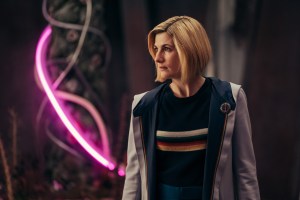
I think the main theme borrows liberally from the original Ron Grainer theme but also takes from a few other places as well like the Murray Gold rearrangements, like the new arrangements that Segun Akinola did for Jodie Whittaker,
The first time I heard that I thought ‘This feels like Delia’ but if she had been let loose in 2018.
 I mythologised a little bit Delia Derbyshire and the Radiophonic Workshop and their approach to everything so I very much wanted to come at it with that kind of attitude. I say that, but I know that Delia Derbyshire hated synthesisers and as much as I would have loved to have tried to do something on tape, I had a deadline. I had a week to turn this around but yes, I very much went, ‘Right, any synths I use I want to have them as analogue as possible, keep them old fashioned, try to keep it as organic in a certain way.’
It’s quite funny actually: the original demo I sent through to BBC Sounds, I would say is a very Doctor Who piece of music. There was an orchestra, there was still the synth but it was much more cinematic than electronic. They came back and said, ‘This is really good, but we’re kind of focusing more on a glitchy electronic kind of sound.’ I did think, ‘Right, that makes sense.’ It does feel a lot like I was getting that out of my system so then I could actually make something that stood on its own!
There were a lot of notes coming through and I’d go, ‘That won’t work’ then put the notes in and think, ‘No… that actually does sound better.’ It’s fair enough, they know what they’re doing!
How much music are you actually composing per episode?
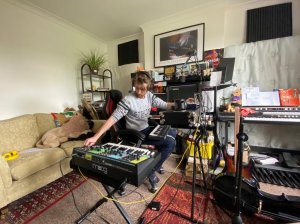 This was an interesting working experience for me because whenever I’ve normally done audio drama or film or something narrative like this, I have access to the finished thing and I can score it by scene. This time round we needed a collection of music that could work in different scenarios because at that point the episodes hadn’t been finished.
In terms of what I was asked to do, I made a main theme and then I made two Doctor themes. There was Doctor Theme (Ominous) and then there was Doctor Theme (Hopeful). That’s what they’re listed as in PRS which I think is very funny.
But then also there were lots of different cut downs. The main theme you’ve got a cut down that’s just the synthesisers, you’ve got a cut down that’s just the piano, you’ve got various different versions, and then you’ve also got things like cliffhanger music.
There’s a shorter version of the theme tune, there’s an even shorter version of the theme tune and then there’s like a sting as well.
I think I ended up sending twenty four mixed down, individual pieces of music and then also I sent all the individual instrument stems as well. That’s just a thing I normally do if I’m working on something like this. If I’m doing a theme song for a podcast I’ll say ‘Here’s all the stems, so if you want incidental music or you just want something underneath, you’ve got everything.’
I’m hearing the episodes when they come out at this point. I heard the first episode before it was broadcast but I’m not scoring each individual episode like I would be if I was working on a TV show. It was just, ‘We’re hiring you to make three pieces of music but then also do up to 20 cut downs, that we may or may not use in the show.’ So it was an odd thing to have to do, to try and anticipate things that might happen.
Interestingly, it’s going back to a 1960s way of working. Effectively you’ve written the Redacted Library… which actually sounds quite pretentious!
 A little bit, yes. It sounds like a Doctor Who episode!
An important thing to say as well is, there is music in the series that I didn’t write. They are using library music in quite a lot of places. A lot of that was in place before I came in, they were just like ‘Production music fits here.’
But this is Doctor Who. It’s got such a rich lineage in sound and music and it has a rich history when it comes to music and its composers and the people who’ve been able to work on it. It’s been an honour to be a tiny part of that.
I’m on the Wiki now. I’ve made it – I’m on the Doctor Who Wiki! It’s wonderful to have my name in very small letters at the bottom of the big long list of people who’ve worked on this show. As with everything, I hope I get to make more. I hope they make more Redacted, I hope they make more audio stuff. It’s like one step closer to working on the TV show.
I went freelance full time this year and I’ve been very lucky in that a big chunk of the commissions that have been coming in have been music commissions. Sometimes you have an idea for how you want something to sound, how a piece of music should work and how it’s going to come together but when you start playing it you realise that the idea’s slightly too big for what you’re able to do. But it has been a wonderful experience to work on this and go, ‘No, I can actually work on projects like this. I’m able to make themes for something like this. I’m able to make a piece of music for something like this that works, that people like, that people like listening to.’ The response to the theme has been just incredible and that’s been a big confidence booster and confirmed I made the right decision to make this my full time job.
Doctor Who Redacted is available on BBC Sounds with new episodes every Sunday.
Click here for our other coverage including reviews and interviews
 Doctor Who News Star Trek News
 Sci-Fi Bulletin: Exploring the Universes of SF, Fantasy, Horror and Spy-fi!