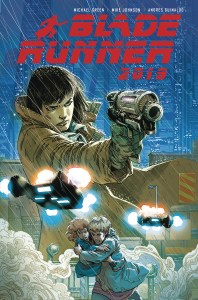
 Mike Johnson and frequent comic book collaborator Michael Green have written Blade Runner 2019, an ongoing continuation of Ridley Scott’s classic movie. With the first four issues released this month in a trade paperback by Titan Comics (read our review here), Nick Joy spoke to Johnson about the challenges of working in such an iconic universe.
Hi Mike, thanks for taking the time to talk to us. I’ve just read the first issue and loved it. There’s a lot more to Ash than meets the Frye and I can’t wait to read on. There’s a lot questions here but feel free to focus on what you have time for.
As someone who has been waiting for more official in-universe Blade Runner stories since the Marvel adaptation in 1982, it’s fair to say that anticipation has been very high for fans. Were you very aware of that pressure when writing this comic?
Definitely, most of all because I am a fan myself. Terror is the flip side of excitement: as thrilled as I am to be working on the franchise, I am scared I’ll screw it up.
What was your first relationship with Blade Runner? At the movies, home rental or TV one holiday?
I was a couple of years too young to see it in the theaters, which I thought was unfair of my parents, because Blade Runner obviously had Han Solo in it and they had allowed me to see Star Wars. Later, I wore out my VHS copy.
 What was your first impression of the movie and how has that changed over the years?
Visual enchantment. Not often can we truly say that something is unlike anything we’ve seen before. Blade Runner is one of those precious things.
How did the opportunity to write Blade Runner come across your desk? Was it something you had to fight for?
My dear friend Michael Green wrote the screenplay for Blade Runner 2049, and Alcon Entertainment asked if he would be interested in expanding on the universe in comics. We had written a few comics previously, and so he asked me to help out.
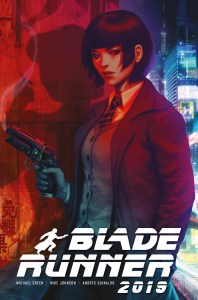 Did Michael’s experience in co-writing Blade Runner 2049 open a lot of doors for this comic book?
It certainly gives everyone involved a certain comfort level when it comes to what is essentially an entirely new corner of the Blade Runner universe. Michael is so fluent in the unique language and tone of the franchise that any fears of taking a wrong turn were allayed.
Did Alcon impose a lot of restrictions on what you could or couldn’t do? How empowering was that relationship?
Alcon have been fantastically open to our ideas, and to taking risks rather than playing it safe. They embraced our new main character, Ash, and gave us all the freedom we could want in building out her corner of this world.
The voiceover narrative was something imposed on Ridley Scott by the studio, and Harrison Ford really doesn’t give it much gusto, meaning it was the first thing to go in the next cut. You’ve retained the narrative – is that because it’s better suited to the page?
Exactly. What works in one medium doesn’t always work in another, but in comics the narration serves two purposes. First, as with captions and thought balloons, it can convey emotion and exposition concisely. Secondly, and more importantly in this case, it invokes the hard-boiled conventions of classic film noir.
 Are you tempted to add more Philip K Dick references to your stories, or do you feel that Blade Runner is so far removed from Do Androids Dream of Electric Sheep? that it’s not necessary?
I was tempted, but Michael was adamant about not doing anything just to wink at the audience. The integrity of our story demanded that we not cheapen it with any attempts at getting cute.
Was there talk of a straight comic book adaptation of 2049?
No, but I’m a big fan of comics adaptations. Speaking of Ridley Scott, the original comics adaptation of Alien is a must-read.
 How does the writing process work with Michael? Do you sit together or do you work on each other’s drafts? Does that method apply whether it’s Blade Runner or Superman/Batman?
We hash out the story together, and then I write a first draft that we kick back and forth, and then he does a final sprinkle of his magic over it. It’s worked so far, so I’m not looking to change it now.
Was there ever an appetite to have Deckard or Rachael in this series, or would that have made things to complicated.
No. As Michael says, those kinds of call-backs are “karaoke”. They’re great songs, but best in their original forms. Rather than returning to what came before, we prioritized the new.
 From the off-world blimp to the Spinner to the orange-brown trench coat with huge collar, you’ve thrown in direct visual references to the original. Was that essential to help sell in the authenticity of this comic book?
Yes. In lieu of “karaoke” with story and characters, we do have familiar visual elements to ground the readers firmly in the world of Blade Runner. The trick is balancing the familiar with the unexpected so that it feels like a fresh story taking place in a beloved setting.
When writing your scripts, how detailed did you have to be about the urban landscapes? Or is every artist so familiar with Blade Runner that no explanation is needed?
We’ve been fairly detailed in our visual descriptions, down to what foreign languages we see on signage, but we do try and leave the majority of visual creation to the artist. Andres knows best, and he has done an incredible job of expanding on the Blade Runner world while capturing what makes it unique.
 Your artist for this series is Andres Guinaldo. Had you worked with him before, and how did this project work in practical terms?
We had not worked with him before. Honestly, we were nervous about who would draw the book, simply because Blade Runner’s visuals are so iconic. But we could not have asked for a better partner than Andres. He makes the writers look good.
I’m a big fan of your Star Trek: Countdown and Khan series. Is it easier to write for that franchise, where you have over 50 years of material to fall bank on, or does Blade Runner’s limited canon give you more freedom to create?
Great question. They both have their challenges because they are so well known and loved. Even though Blade Runner’s canon is smaller, it’s just as formidable given that the movie has had such an impact on pop culture in the years since. I’m just lucky I get to work on both.
 2019 was a long way away back in 1982, and it’s hard to believe that the opening titles ‘Los Angeles, 2019’ will soon be contemporary. For you, what is the ongoing appeal of this brand?
I think it’s a combination of the future noir storytelling and the fearless visual inventiveness. There’s nothing else quite like it.
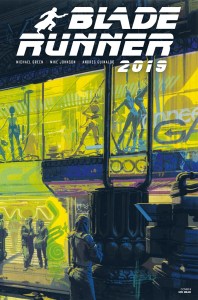
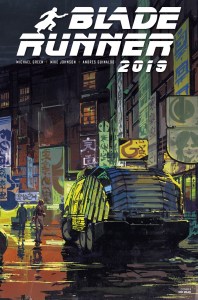
Do you have a favourite cover for Issue 1? I’m leaning towards the Syd Mead one!
I love all of our art-babies equally, but we’re definitely thrilled to see Syd Mead’s incredible concept art on the book.
Thanks for your time!
Thank you!
Thanks to Imogen Harris for assistance in arranging this interview.
Blade Runner 2019: Los Angeles is out now from Titan; order here from Amazon.co.uk




 Sci-Fi Bulletin: Exploring the Universes of SF, Fantasy, Horror and Spy-fi!