 Artist Andres Guinaldo has drawn some of the biggest characters in comic books, from Steve Rogers to The Incredible Hulk to Dr Strange. One of his most high profile assignments is illustrating Titan’s ongoing Blade Runner 2019 series. Nick Joy caught up with him to discuss COVID-19, working in such an iconic universe and the thrill of drawing spinners.
Hi Andres, I hope we find you well? It’s the inevitable question, but how have you kept yourself occupied during the last few crazy months?
With a lot of work. Actually, for a penciller, this situation is not too different from the usual day-to-day work. It’s true that I have missed seeing family and friends and being able to go out to clear my mind every afternoon when I finish the pages of the day. But overall fine. Thanks for asking ☺
The last two issues of Off-World were delayed in their publication. Did this mean that you benefitted from extra time to work on the comic, or was it business as usual?
Yes, I took advantage of the time, indeed. I finished a number in advance and was not rushed by deadlines. The truth is that I have not lacked work in these months. Which I appreciate on the other hand. With all this confinement, it is always better to keep your head busy and your work routines.
 Having established the look and the feel of the comics (and of course the key characters) in the opening four issues, was Off-World an easier gig?
Leaving the usual world of Blade Runner, the city with neon, smoke, crowded streets… has been a new field to experiment and create a different world. The writers have given me a lot of freedom to draw new things, while always maintaining their idea of history, and without betraying the universe already created in the movies.
The fact that Ridley Scott’s original classic movie defined the look of so many subsequent films, was it tricky in creating something new for this project? Or have you been drawing Blade Runner-style sketches all along, so knew exactly how to draw for this universe?
The movies have always shown a very particular future. A mix of modernity and retro fashion, both in clothes, buildings and the same technology. I have not wanted to betray that. I wanted to create structures and settings that respected all that. I don’t think I would have been right if I started exploring other paths. I think the comic must be consistent with itself and with the universe in which the story is embedded. I hope I have achieved that balance, that coherence.
 Was there ever a moment’s hesitation in accepting the job? It’s a high profile project that was bound to come under scrutiny from fans.
I admit that there were doubts very early, during the character creation process. But I immediately understood that it had to do with integration into a new creative group. The editors, screenwriters, and colourist and I haven’t worked together before. You have to find a work dynamic and that is achieved on a daily basis. As soon as that integration happened, everything was much more fluid. Regarding the possible pressure of the project itself due to the mythical and fandom of the film … that always represents, at least for me, more of a challenge than an added pressure. You should forget about all that when facing a job because if you don’t, you run the risk of blocking yourself. It also happens in the world of superheroes that drags a brutal fandom. Also, I’m also a fan of Blade Runner so I had some advantage ☺
Did you experience a certain thrill when first drawing a Spinner?
Right. What happens is that I am not a penciller who seeks realism. I have tried (both with the spinners and with the city in general) to use all the references as inspiration rather than as a sole and absolute guide. If the fans pay attention they will see that the spinners in the comic are not exactly the same as those in the movie. I wanted to capture the spirit more than the exact details. But yeah, sure. I felt that tingle when I first drew it.
 What’s your relation with the writers Michael and Mike? Are their scripts very clear in what they want, or do you get a lot of latitude?
His texts fit exactly what I look for in a script. Clear phrases, short and direct to the point, with exact descriptions of both the action and the feelings of the characters. I always prefer this, because that allows me to have more freedom when creating the panels without betraying their vision. I do not like being too narrowed down with descriptions that are too dense and detailed that do not allow the artist to go one millimetre out of the box. I think we get on well.
What’s your relationship with the original 1982 movie? Did you see it on release, and how did you feel about it?
I’m not that old – ha ha ha ha. I was 7 years old when it was released. I remember seeing it years later on television and it fascinated me. Especially visually although later you start to see the philosophical charge of the film, which made me enjoy it even more. Yes, as I said before I am a fan, and that has made it easier for me to enter this futuristic world. With respect but knowing that she wasn’t going to be too iconoclastic with him.
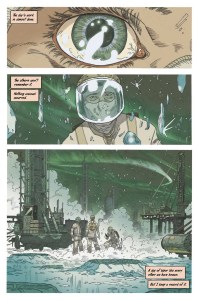 I consider Syd Mead to have been a genius. Have his drawn designs for the original movie influenced your work as much as what appeared on screen?
Of course. I have used Syd Mead’s work for reference without doubts. It was necessary. As you say, the designs are captured in the film almost literally. My intention has always been to be faithful to the movie and it is inevitable that to achieve this I would look at his work. I repeat, not looking for the exact similarity or a copy, but keeping the spirit of his work. He was an exceptional talent.
It’s crazy to think that before this series, the only Blade Runner comic was a Marvel adaptation by Archie Goodwin and Al Williamson in 1982. Have you ever read it? How have comics changed since then?
Yes, I read the comic when I knew it would be part of the project. Being great (Williamson’s work fascinates me) it is true that at that time perhaps the exact translation of the film script to paper was more sought, but with the obligation to do so in very few pages. Which could give the feeling that everything is going too fast. Now we seek to explore that world more without having to be too faithful to each line of dialogue in the film script. Still, it’s a great comic that I think every Blade Runner fan should read.
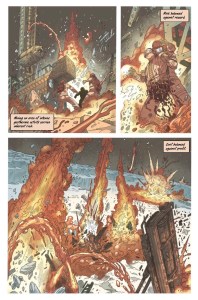 The level of detail in your drawing of the space dock with the transport to Arcadia in the final issue of Off-World is breath-taking. I assume you had to give yourself a lot of extra time to create this?
Thank you. Well, you actually do it in the time you have, he he he. But yes, in pages like this you usually spend more time.
This comic book series is set between the 1982 movie and the 2017 sequel, Blade Runner 2049. Is it helpful or limiting that the future tech of 2049 has already been defined, and that you can apply reverse engineering?
Regarding the issue of technology in both films … it is true that from one to the other there has been an advance. But, in my view, Michael Green (as the screenwriter of Blade Runner 2049) knew how to maintain a certain logic between the two. In other words, there is visible progress but maintaining coherence, a logical evolution that helps me to mark a middle way. We have adjusted something on some page but I think that, in general, I have coincided with its design in the technological advance of this future world.
I can’t wait to see what happens to Ash back on the streets of LA in Home Again, Home Again. I feel we’re in safe hands with you. Thanks for your time.
Thanks to you. I hope I don’t disappoint the Blade Runner fans and I hope they continue to enjoy the comic as they have done so far. Regards.
Blade Runner 2019: Volume 2: Off World is out now from Titan Books; click here to read our review.




 Sci-Fi Bulletin: Exploring the Universes of SF, Fantasy, Horror and Spy-fi!