Firefly: Interview: James Lovegrove
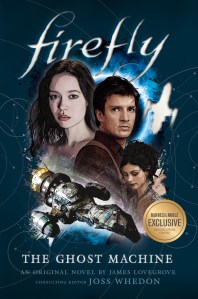
James Lovegrove’s most recent addition to the Firefly canon, The Ghost Machine, was released at the end of June by Titan, telling further adventures set in the universe created by […]



James Lovegrove’s most recent addition to the Firefly canon, The Ghost Machine, was released at the end of June by Titan, telling further adventures set in the universe created by […]
 James Lovegrove’s most recent addition to the Firefly canon, The Ghost Machine, was released at the end of June by Titan, telling further adventures set in the universe created by Joss Whedon. Titan has also recently printed his work in a much older series – The Manifestations of Sherlock Holmes, a collection of short stories featuring the Great Detective in many different guises. During lockdown, Lovegrove chatted with Paul Simpson…
Including the story you wrote from the plot by Nancy Holder, this is your third Firefly novel…
Yes, and I have written and delivered the manuscript for the fourth which I think is out sometime next year? Who knows. I think I’m probably going to call it a day after that and leave it to other people to do. I’ve enjoyed it hugely but I figure I’ve had my go on that; I’ve got quite a short attention span and I like to go and do something else.
What made you want to get involved with Firefly? Was this a licence that you actually wanted to work on?
It is actually. About five years ago my then editor Miranda Jewess and I were just talking about tie-in work and was I interested in doing that, and half as a joke I said if they ever got the licence for Firefly I would definitely do that but I’m not much interested in anything else.
I loved Firefly, I still do. I didn’t actually think anything would happen, then two years later she rang up and lo and behold Titan had got the licence and she asked if I wanted to do it? And I said yes OK. I’d never even thought of doing tie-in work before. I just thought I’d give this a shot. I really enjoyed it and really got into it. I approached it with trepidation because I’d not done anything like it before and also because I wanted to be respectful of the show and the show’s creators and most of all the fans and get it absolutely right for them. I worked hard at it.
 I’ve not been used to working with an existing licensed property as opposed to doing a Sherlock Holmes, something out of copyright. You are beholden to the owners of the licence and they have ultimate say over everything from your initial idea submission, your plot outline, finished manuscript, the whole thing. So far there haven’t been any problems, there have been no objections, but I think another part of that is that the editor for the Firefly books Cat Camacho, is really good at determining what would be allowed and what isn’t, what works, what doesn’t. If you’ve got someone like that keeping you in line, it’s great – you know what the boundaries are and you can work within them.
They can trust you, and in this case trust Titan, to deliver a product they’re happy with – and I think to be honest much though Firefly is loved, it was a show from fifteen or sixteen years ago and therefore it’s not high on their priority.
What about Firefly appealed to you?
Well, it’s funny because I actually hate westerns. I’ve never been a fan of the genre. I say hate – obviously I don’t dislike all of them. I’ve enjoyed some. I enjoyed Spaghetti Westerns and there have been some other great westerns but it’s not a genre I’m really into. But somehow. in this context. the way it was done, they made it work. They managed to merge a decent science fiction premise with the whole western thing and made something interesting and fun out of it.
I think for me, it was fun. It was the fact that there was a sense of humour: there was quite a brutal edge to it but there were great one liners. The main nine characters were all distinct and individual and they merged well together. It seemed like the actors liked each other, that they had a fun time doing it together and they were enjoying turning out this quite elaborate dialogue, notwithstanding the Chinese swearing, with a slightly convoluted vocabulary. They seemed to be having a really good time with it and I think that conveys itself to us as the viewers.
 It did have a slightly theatrical level to it. Was that an issue to recreate when you haven’t got Nathan Fillion, Mark Shepherd or whoever doing it?
Up to a point. I’ve seen it enough that I can sort of hear their voices in my head when I’m writing it and I’ve also got the script book so I can always check through that. Also, having written Sherlock Holmes books there is a slight Victorian diction to them as well. Some of the vocabulary, especially some of the obscure English swear words and things like that which Joss Whedon seems to love, I found quite an easy idiom to get into.
Then it was just a case of coming up with a story idea that not only works as a western story and a science fiction story but allows each of the characters to shine. The slight problem with that is there are seven, well nine characters by the time the books are set,
but they’re all quite distinct. You want to give each one of them their moment to shine and invariably you’re not going to service some of them as well as others.
 The one character I had real trouble with dialogue for was River. Even in the show itself the creators didn’t seem to have a fix on quite what she could do and who she was because she was still discovering that, and they were still discovering that within the show. I think they had grand plans for her that they weren’t able to fulfil. In the episodes we have, she’s this sort of bewildered child-like person with these incredible abilities that have yet to come, and that I did find hard to nail down.
Did you get notes back on that or any other area?
Not a single note. I haven’t had a single note from anyone. I know that it’s gone to the licensor but we haven’t had a single note or objection back so I can only assume that I’ve managed to get close enough that they don’t mind.
It’s a show that fans have latched onto, one that spoke to a lot of people for many different reasons, and of course there are constant rumours of a revival.
You could see Netflix maybe picking it up and I think they would have to do a Firefly The Next Generation. They could do a Picard with it and just have the older characters coming back for one-off cameos, or perhaps some of the younger ones could become part of the main story again. But it’s capturing lightning in a bottle and I think unless Joss Whedon was in charge as well, I don’t think they would be able to get the same kind of vibe going again.
You get your one hit as these things sometimes. With your second and third book, did you have a feeling of “been here done that” or are you approaching each one from such a different angle that you don’t get that problem?
 I think it’s not diminishing returns but certainly you have to bring something new to it each time. Same with Sherlock Holmes: I have to find a new way of doing it each time because otherwise I will get horribly bored and I will just be coasting and just falling back on the craft that I have rather than bringing something a little bit more to it.
So with the new one, Ghost Machine, it’s a wish fulfilment scenario. On the ship, they take on board this device, they don’t actually know what’s in the crate that Badger has asked them to take, but it’s a nefarious thing that sends you into a kind of dream state where you see what is ideally a paradise or timeline for yourself… and that starts to go horribly wrong. That’s not part of the machine’s process, that’s just how it develops.
It was fun for me to do these kind of Marvel “What if?” scenarios. What if Mal and Inara are married and have children and are living happily somewhere? What if Jayne has gone back to his family homestead and his brother is alive and well and he’s with his mother?
It was fun to play around with that idea and then also to sort of slowly, slowly turn the screws on them and make these dreams turn into nightmares. That for me was the fun of the book
The next one Life Signs, I can’t say too much about anything but it deals with Inara quite a lot and again, it allows me to extrapolate quite a major plot point from the TV show that they weren’t able to develop and deal with. I had a couple of ideas of what to do with that idea and the first one, they weren’t big fans of at all but the second one they liked. So we turned it into this book.
But I think in the long term you’re right: unless you can keep coming up with something that keeps your interest sparked, then you’re just doing a pay day and there’s no point. I’d much rather go off and do something completely different.
 Moving from that to Sherlock, the new book, The Manifestations of Sherlock Holmes, is a compilation of short stories some of which have appeared before, and four or five originals?
I think it’s three originals and nine reprints. It’s a quarter of a new book and it’s good.
Obviously you were working for different editors with different parameters on them. When you brought them together, did you spot differences in the way you’d written the stories?
I can see which are the earlier ones. Although I’ve had two really good Holmes editors at Titan, Cath Trechman and Miranda Jewess, Miranda is incredibly proactive and hands on and makes you work very hard, so I have to be much more diligent than necessarily I did with Cath.
 Miranda is great and she loves Holmes so she wants everything to be absolutely canonical as far as you can be. The tone has to be right, there has to be an investigation. Her influence definitely showed in some of them but there’s been a broad range of editors and I think some of the editors are much freer and easier with that I can do and what I can get away with.
For me it’s always about it must be a proper Sherlock Holmes story first and foremost even if it has fantastical elements or Professor Challenger turns up or it’s told from a dog’s point of view. It still had to be a proper Sherlock Holmes mystery; the same with ‘Pure Swank’, the one told by Barker the other private investigator.
Also I can see that some of them I was just relying a little bit too much on it being a supernatural story but at the core of it I always think as long as it works at a Sherlock Holmes story at some level then you can do whatever else you want with it. But I think they all work together.
I think I could have done a complete anthology of some ordinary Sherlock Holmes stories but I think it’s much more fun to push in different directions. Again, it’s that thing we were talking about just earlier of keeping your interest sparked.
Was the order yours?
That was totally mine but Titan did ask me to swap a couple around because there were a couple that were quite similar to each other. I think two of them dealt with inheritances that were being contested and I accidentally put them both together and they work much better if they’re three or four stories apart.
The Cthulhu Casebooks make a brief appearance in The Manifestations: what was the genesis of that trilogy?
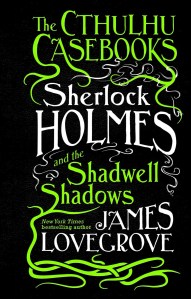 Miranda rang me up a while back and asked if I knew anyone who could do a Holmes/Cthulhu crossover series. Me being incredibly naive went, “Well you know Neil Gaiman did A Study in Emerald and there’s actually a book called Shadows over Baker Street which is a whole anthology of Cthulhu Holmes stories….” What I didn’t appreciate was that she was asking me if I wanted to do it, because I’m not very bright on this kind of thing.
So when that penny finally dropped I said OK, I think I could probably do that then I sat down and thought “How the hell am I going to do this because they are completely divergent properties?” You have the ultra rational Holmes on one hand while the whole Cthulhu mythos is based on irrationality. Also, simply from a chronological point of view, Holmes was more or less retired from the First World War onwards and Lovecraft didn’t really get going until the 1920s so there would be no temporal crossovers really possible. You can’t just throw [Lovecraft’s character] Herbert West in there for instance.
I figured out the way to make it work was the way I did it, to span Holmes’ entire career. The first book would be 1880, the second book 1895 and the third book 1910, so you’ve got there almost the full span of his working life and then treat the books as though they are the true story behind the Conan Doyle ones that appeared.
That to me is what made it interesting: to make it this slipstream Sherlock Holmes that purported to be the true story. Then you could start to play around with it and reconcile Holmes’ rational approach to solving mysteries with the whole madness and supernatural elements of Lovecraft.
 Did you find then that you’ve got two completely different pressures on you, to write a Holmes story that stands up as a Holmes story and a Lovecraft where plot logic goes out the window because you can basically say ‘and then shit happens’.
Yes..
And shit can happen for no reason other than the Old Ones want to do it. How do you square that circle?
It’s not easy I tell you but the priority was always that it’s a Holmes mystery first and foremost. So there had to be deduction, clues, analysis and a proper mystery arc from start to finish. Then the Cthulhu element had to be slotted in around that.
One way I found of doing that was to bring in monsters, because monsters are tangible and they leave traces that can be investigated. For anyone who hasn’t read the books I’m not going to give away too much, but there’s also a kind of meta plot involving Moriarty and the Old Ones and the Outer Gods, all happening off stage that impinges on what’s happening on this planet.
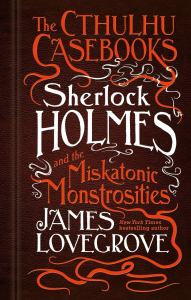
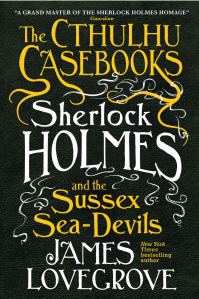 The final thing was, I felt if you’re going to call a series Cthulhu Casebooks you’d better have Cthulhu turn up at some point in the proceedings! So he pops up towards the end. The only other thing I felt I could do, and this I did in Miskatonic Monstrosities, was to have just a piece of pure Lovecraft fiction in the middle, so I did that using the format that Conan Doyle uses in The Valley of Fear and A Study in Scarlet and to a lesser extent in The Sign of the Four, which is to have a backstory, a discrete novella almost, which has relevance to the main story but it’s its own thing as well.
I really loved doing that: it comes in the form of a journal that Holmes and Watson had to read. They’ve got nothing else to do, while they’re in captivity. I decided I’m just going to go for this, it’s going to be set at the Miskatonic University, they’re going to go up the flipping Miskatonic River… it’s just going to be pure Lovecraft from start to finish. That way fans of Lovecraft won’t feel short changed but I think the book is being primarily aimed at Conan Doyle fans. Lovecraft fans can come in and enjoy what they want; it’s true to the Lovecraft ideals but essentially, it’s a Sherlock Holmes story.
 It’s like the many versions of Holmes and the Ripper – some are Holmes, some are Ripper tales.
In the collection, I did a Holmes meets Jekyll and Hyde. I was trying to make that a Holmes story but it ended up being more of a Jekyll and Hyde story. (laughs)
That definitely feels like Holmes guest starring in a Jekyll and Hyde story and all the clever bits with the original names and stuff like that. it’s the sort of smartarse-ry that I associate with your other stuff.
(laughs) Yes. I think you said something similar about my introductions and afterword for the Cthulhu Casebooks as well.
Done hugely tongue in cheek.
It was fun. Just me pretending that because my surname Lovegrove sounds very similar to Lovecraft that somehow we are related through some obscure German ancestry. I have actually had people ask me if that’s true or not and I’ve had to disabuse them of the notion!
You’ve obviously got an ear for not just the way that Holmes and Watson talk and interact but also the world in which they live. What gets you into it?
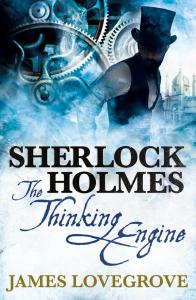 That’s a funny one. I had the Holmes stories read to me by my father when I was about 11 and then read the others myself and I think it’s just embedded. I don’t have any particular historical knowledge, I’m not a big history buff at all. I will find out what I need to know, but for me the world and the idiom are so ingrained that I find it quite easy to get into.
I also have to say that my version of the relationship between Holmes and Watson is based on a couple of things. I have a long time friend who is very much a Holmes and I’m his Watson – I’m always one step behind and he’s quite abrupt and cerebral and sometimes quite caustic as well. So I used that.
I also used Jeremy Brett as my ideal Holmes. In my head I hear Brett saying the dialogue and I liked Edward Hardwicke’s Watson particularly so I try and use his voice as well to a certain extent. They to me are the epitome of the screen Holmes and Watson.
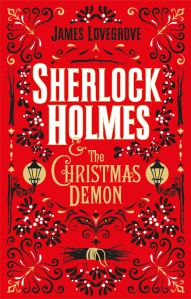 I also remember a friend of mine, the children’s fiction critic Nicholas Tucker, saying to me that he regards them as brothers – an older brother and a younger brother – and that Holmes is one step ahead, very impatient, considers his younger sibling to be a bit of a dunderhead but at the same time there is a deep bond of affection between them that nothing can break. And for me, that is the essential thing: you can’t have one without the other.
That’s why Watson has to narrate but he has to be there as well. He has to be present, almost the whole way so that he can be there, not just as a sounding board for Holmes and not just as a whipping boy but as an integral part of the adventures. I think a lot of people miss that and a lot of people miss the fact that Watson is a very accomplished man. He’s a war soldier, trained doctor, an army surgeon. He is not short of courage and intelligence; he’s just not in the same league as Holmes. And he knows it, and they are both fine with that and they respect each other.
 Which is also why, of course the Mycroft/Sherlock relationship becomes interesting because if you consider Holmes and Watson as brothers, they are the brothers that Mycroft and Sherlock clearly weren’t.
That’s nicely put. Absolutely, they are much closer than Mycroft and Sherlock ever could be. I think Mycroft and Sherlock are too alike to get on with each other for any length of time. At the same time they have a brotherly love for each other but they probably can’t be in each other’s company for more than half an hour.
Which is the way that Steven Moffat and Mark Gatiss did Mycroft and Sherlock in the TV series
Yes, that’s true. You could see that they couldn’t stand to be with each other for very long but nonetheless, one was looking out for the other all the time.
I like to think in the Conan Doyle stories that Mycroft is keeping an eye on Sherlock, all the time. Just making sure he doesn’t go too far or possibly oiling the wheels for him in the corridors of power. If anyone thinks that Holmes is getting out of hand or too autocratic, Mycroft would just have a quiet word in someone’s ear and that whole matter would be smoothed over.
The Manifestations of Sherlock Holmes is out now from Titan; click here to order from Amazon.co.uk
Firefly: The Ghost Machine is out now from Titan; click here to order from Amazon.co.uk
 Doctor Who News Star Trek News
 Sci-Fi Bulletin: Exploring the Universes of SF, Fantasy, Horror and Spy-fi!