Review: The Electric State
By Simon Stalenhag What’s getting lost in the wake of the catastrophically bad response to The Electric State is that it’s an adaptation. It’s not, from what people are saying, […]



By Simon Stalenhag What’s getting lost in the wake of the catastrophically bad response to The Electric State is that it’s an adaptation. It’s not, from what people are saying, […]
 By Simon Stalenhag
What’s getting lost in the wake of the catastrophically bad response to The Electric State is that it’s an adaptation. It’s not, from what people are saying, a remotely good adaptation but if anything that means the original text deserves even more attention. Alasdair Stuart read it over the weekend and was not disappointed.
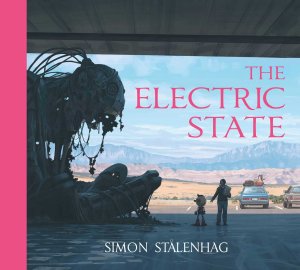
Simon Stalenhag’s original novella, presented in a wide format to showcase his stunning art, follows Michelle, a teenage orphan. We meet her on the run, in every sense, alongside Skip, a humanoid robot. America is collapsing around them and as the slow descent continues they’re also pursued by a federal agent. One who knows more about Skip, and Michelle’s brother, than he’s letting on.
Stalenhag’s art is staggering. There’s really no other word for it. He combines a 1980s aesthetic with the sort of tranquil desolation of Wim Wenders movies and filters all of them through a gritty, complex, Cronenbergian lens of technology. Michelle and Skip flee through a landscape defined by ruined and broken warships and drones. They’re haunted by their past and haunted more by the legions of Americans lost to the Neocaster, a VR helmet that turns its wearer into a near zombie. One of my favourite images is of the latest car the kids have stolen, stopped in front of a bodged together robot and a horde of Neocaster wearers in the fog. It’s beautiful and alien, familiar and nightmarish. It’s one of dozens of images that haunt the shattered landscape Michelle flees across, and you as you trace her footsteps. The world ending in a million individual ways, an apocalypse of adverts showing to a wasteland of broken assault vehicles and fragmented people.
Stalenhag’s pictures, and words, are focused on what a world breaking looks like, and how much the small things matter when it does. The slow unfolding of the Fed’s search, and Michelle’s horrific past combines with a subtle change to sequential art which finishes the book with three moments of enormous emotional weight. They may not be surprising to some readers but all of them hit hard and are given enormous power by their sincerity and the combination of words and art. Stalenhag is as good a writer as an artist and the two disciplines meld and complement and clash in a way that mirrors the relationship with technology the story explores. Concepts as big as the robots lurking in the mist, and just as fragile and personal, are left on the page, on the shore of something new and hopefully better. Just like the world, the characters and the reader.
Verdict: The Electric State is beautiful, and horrific. It’s also unmissable. I’m so sad the movie made the choices it made but the book isn’t going anywhere and it deserves your attention. 10/10
Alasdair Stuart
 Doctor Who News Star Trek News
 Sci-Fi Bulletin: Exploring the Universes of SF, Fantasy, Horror and Spy-fi!