Interview: Sammy H.K. Smith
Sammy H.K. Smith’s novel Anna is out this week from Rebellion – an often harrowing tale of a near-future and a woman fleeing a coercive controller. Smith chatted at length […]



Sammy H.K. Smith’s novel Anna is out this week from Rebellion – an often harrowing tale of a near-future and a woman fleeing a coercive controller. Smith chatted at length […]
 Sammy H.K. Smith’s novel Anna is out this week from Rebellion – an often harrowing tale of a near-future and a woman fleeing a coercive controller. Smith chatted at length with Paul Simpson about the book’s genesis and the pitfalls in writing about such topics.
Thank you for a very interesting read. I don’t know that I’d say it was ‘enjoyable’, I think it’s a harrowing book in many ways, but it was one that grabbed me from the start. What was the genesis of the idea? The character of Anna or was it the situation in which she’s in?
First off, thank you. I think your reaction is exactly the sort of reaction that I want people to have because I want them to think about this book. It’s not what a lot of people have thought it is when they read [the description] which is always quite interesting.
It sounds like such a cliché but I remember waking up one night and having an awful nightmare. It was that claustrophobic feeling of being controlled. My work is in domestic abuse – I’m a detective and I’ve worked there for fifteen years. It is an area I have a lot of passion for. I love what I do and the results that I’ve managed to get over my time.
I started to plot out this idea of bringing in some of my experience into a story. Initially I wanted it to be quite light hearted, a bit of the gung-ho revenge female empowerment but working purely on the ‘You’ve wronged me, so I’m going to get you back’ sort of feeling.
The stuff that I write always ends up with a bit of a cynical slant on it; people have always joked that I can’t write a love story. I always make it a little bit depressing. It’s not intentional, I just find that I can connect better with my characters if I’m putting a little bit more realism to them.
As I started writing I realised that this wasn’t the sort of story that was light hearted. I started to feel quite uncomfortable with myself for even thinking of making a bit of a ‘fun’ story, a bit of a ‘fun’ journey over something that’s quite harrowing.
Rape is horrific. It’s probably, aside from murder, the worst crime you can commit against a person. So I did start to draw, not on any individual cases that I’ve worked on but on the behaviours of how I felt a victim, or as they like to be known ‘a survivor’, might behave.
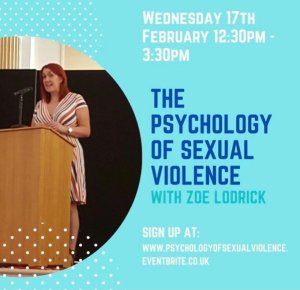 There’s a really interesting psychologist called Zoe Lodrick who works [in this area]. She calls it the Five Fs: Fight, Flight, Friend, Foe, Freeze – and then she’s added Flop recently which is the sixth. She tells us about the amygdala side of the brain and how these reactions are all imprinted on us and explains how different survivors might behave in those situations. I drew on seminars that I’ve been to with her to look at the motivations for Anna.
Will, Peter, Daniel – whatever you want to call him, whatever he feels like calling himself right now – he is a little more generic but he’s the embodiment of that serial perpetrator that we meet. The narcissist who will infiltrate a relationship. We call him ‘Mr Nice’ and ‘Mr Wrong’ and he’ll look like God’s gift to women on the outside world but actually is a controlling bastard. He was a little more generic but Anna, I felt, doing it from her point of view, I could hopefully get into the heads of the readers and see what it is that a survivor goes through.
What elements could you add because of the fantasy setting that you wouldn’t have been able to do if you’d been realistic?
Quite a few people have asked me ‘Why haven’t you set this in contemporary Britain or America?’ and my first answer to that was because I work with it day in and day out, I just wanted that little release. Sci-fi, fantasy, dystopia, speculative, it gives you that break from the norm and because I work it 40+ hours a week, I don’t want to write it as well!
I understand that completely.
I did find that being able to set it in a dystopia, which isn’t too far away from what could potentially happen, it just gave me that creative juice to keep going. I think we could do it in contemporary Britain certainly, and with COVID and with lockdown and people becoming very insular, there isn’t a potential to monitor these perpetrators the way that friends and family usually have. We call it ‘Cocoon watch’ where friends and families will often look after their victim and be able to see these behaviours, but with Covid it’s gone through the roof.
The dystopia allowed me the lack of communication that we have nowadays, with social media, internet, phones –just cut that line off. Love it or loathe it, the internet and social media and being able to have that instant connection with someone is great for victims because it means once the perpetrator’s gone to work, they are then able to call the police, talk to their friends, research websites so on and so forth. But by taking away the communication aspect and making people truly alone, it let the world develop a little bit.
I don’t go into huge detail of the dystopia world. Rebellion asked me to cut a lot of it out because they wanted it to be quite generic. They didn’t want locations mentioned, history, so that it would appeal to readers throughout the world. Funnily enough it’s been one of my biggest criticisms on my ARC. ‘I don’t know where this is set’ and my argument to that in myself, when I’ve been talking to my husband and grumbling is “Anna is the world”. Everything else is nice to have – I’ll give you the basics and I’ll paint some bits and bobs for you, and you fill in the details – but she’s the focus.
I liked being able to set it in the dystopia just for that creativity and to cut her off from other people to make it a little more intense and claustrophobic in the way that I wrote her.
Obviously with your own work, you’re coming into contact with the real evil of human nature; did you find writing this that it was hard to communicate that in a way that the reader is going to believe how banal it can sometimes be?
 Yes, I did. I actually wrote Anna back in 2012 and I had it shelved for years, in the metaphorical drawer because I didn’t know what to do with it. Even in the last ten years society, media, personal interest and understanding of domestic abuse and abuse in general – sexual, domestic, coercive control – has absolutely improved. We’ve still got a long way to go but 2015 was when the Coercive Control and Behaviour Act came out. Before then, any of that sort of behaviour wasn’t a criminal offence, so whilst I was covering it I don’t think a lot of people understood what potentially goes on behind closed doors. We see it on television and we see it on dramas and they’re always dramatized and fictionalised so people go ’Oh that can’t be real, that doesn’t happen’ but it really really does.
So after writing it I put it to one side, left it and it was only when I started seeing that society’s response to domestic abuse was improving that I thought that now was the time to get it out.
I looked over it, and I didn’t actually cut anything. I just added a few characters and gender switched a few people. I suppose in a very bizarre, ego way, I wanted to remain quite authentic to what I’d written.
I always thought I’d be set up and ready for people’s reactions to Anna but I’m not, at all. I knew it was going to be polarising. I knew people would either get it, understand where it’s coming from and appreciate it or people absolutely wouldn’t. I think they thought that they were getting a YA dystopian love story – one of my reviews was, ‘Where’s the love?’
There is but it’s a perverted love. My understanding of him, when I was reading it, was that in his mind he loves her and he cannot understand why she left. It’s not The Hunger Games…
No, he’s a narcissist. He’s a psychopathic narcissist and we do get them, there are actual domestic abuse narcissists. Again I come back to Zoe Lodrick, because she’s an amazing psychologist: something like 65% of D.A perpetrators are either diagnosed or undiagnosed narcissists. It’s not just men by the way; there are quite a few female perpetrators as well.
Daniel is a narcissist and you’re quite right, it is his perverted love. It’s not love in the traditional sense that we have, because there’s no respect there from him to her. He can’t understand why she’s left and it falls into that control aspect. He wants to control her and the idea of her leaving him willingly is just something he can’t compute. He can’t get that into his head and there was a line that I added later in the draft, which I quite liked: ‘He couldn’t bear the thought of her dead or, even worse, with someone else’. The idea of his property willingly leaving him for somebody else is worse than her dying. These perpetrators would rather kill their partners than let them go.
That goes right back like the Egyptian pharaohs and societies where the king died…
And so did all of their slaves and subjects, absolutely yes.
 So there is a perverted love and there’s a very honest love between her and Alan, the little boy. He’s somebody who has lost everything. He has no parents and was found alone and she’s coming into the theme of motherhood. So I wanted to give those two a very special relationship.
He’s a child who has seen violence – and I never make it explicit what it is he’s seen because I think, again, we can just draw out own conclusions as to what he would have seen in this world; whatever it is, it’s not going to be nice when he’s been found wandering alone. I wanted to show that people can start to heal and you can take things from one another. There’s something very similar about Alan and Kate that they were able to draw to each other. That relationship of love I enjoyed writing as well
I did want a little bit of hope with Rich, the vicar. Initially I didn’t have that, I just had that as a very platonic relationship and it was only in a later draft where I’d gone through it that I was thinking, ‘She actually needs something’. We need something as readers to hold onto: she’s got her baby, and that’s fantastic, but actually we need to see her confidence with the male species start to build back up again. So that’s what I started: the very founding foundations of something there, but I didn’t want to take it too far because, to me, it has to be believable. In a nine or twelve month timescale a victim who’s been through what she has, isn’t exactly going to rebuild a relationship. You do see it, but on the whole they don’t jump into bed or form very close relationships that close with people that quickly, when they’ve been through that level of abuse.
One of the things that struck me right from the start was that you felt that you knew the characters outside the book, that they had had a life even before we get into the whole flashback section. We know that what happened to us as teenagers and our twenties affects how we are now.
Absolutely, yes.
I think that you had built all of the characters, so that if you told a story about them set ten years earlier we’d still recognise them, albeit in a slightly less mature form.
I think you’ve hit the nail on the head there and that is something that I worked on. Not with every character but with some of them I did base them on people that I know and have interacted with, good and bad.
I think every writer does that and those that say they don’t, I think they’re lying, to be fair.
It’s subconscious if it’s not conscious…
Absolutely and Anna was an embodiment. A lot of my personal stuff is in there and some of the victims that I’ve worked with – not the circumstances but their mindset because we do stay in contact. Some of them, even five or six years later, I’ll get a phone call once or twice a year, which is lovely at work. It really makes you feel better when you’ve had a real crap week, believe me, and you see how they’ve progressed and grown up and dealt with things. Yes, they never forget but they learn to heal and live with it and that was something that I really wanted to stress as well.
Like I said before, I am quite a cynical person at times, so a lot of my characters do carry that suspicion around with them but I didn’t want to be all doom and gloom either. That’s something that I really want to stress: it is a horrible situation to be in but I don’t want anyone to read it and just feel really depressed and miserable that they’re never going to heal from it. Some do, some don’t, I won’t lie, but those that do come out – I think anyone who can extract themselves with or without help from a relationship like that is a hero, in my mind. They are absolute superheroes to be able to function back in society having been through those sort of relationships.
I know it’s a miserable book but I think it’s a very important book in some ways to get out there.
I don’t know that I’d agree it’s ‘miserable‘. It reminds of Little Marvin, talking about the Prime Video series, Them. He said, ‘It’s not a horror show, it’s a show about terror’. So is this book: it’s peeling away a layer that we don’t always see but putting it within a generic trope of the dystopia, and doing what science fiction is supposed to, which is to take today and present it in a way that makes you think about today differently.
Yes, that’s a really good way of describing it because this was one of the issues that publishers had with the book. I’m unagented: no agents wanted to touch Anna, they said they didn’t know what to do with it. I didn’t know where to pitch this because it’s almost like a speculative literary dystopian dark fiction novel which hits so many different boxes but ‘Who is my core audience?’ was the question..
But surely the core audience is a big series been running on Hulu for the last five years, The Handmaid’s Tale….
Which is bloody brilliant.
‘The Handmaid’s Tale meets The Road with a sprinkling of Sleeping With The Enemy’ is the way that I wanted to pitch it. People have downvoted it on NetGalley because they found it unsettling. Which I don’t take as a criticism to be honest with you: they may not have been able to finish it or didn’t like it, but unsettling is what I wanted to go for.
When I first started to write Anna, I was guilty of making sexual violence a trope. You see it so often in fantasy and science fiction – but if it’s going to be there, let it be part of the story to move it along, a plot point, inciting incident whatever you want to call it. Don’t just add it for the sake of some grim dark spice, as some authors like to.
 I did a piece for Cat Rambo on her blog because I realised I’d started to fall into that trap when I first started to write it and I stopped, thought, No I can change this around and then wrote what we finally released. I’m not somebody who necessarily believes in this generic cancel culture but I think everything needs to have a purpose and a plot and you need to think about what you’re putting out there – because once it is in print, in one form or another, it’s going to be there for a very very long time and you’re going to have to be accountable for what you put out. Go at it with an honest intent or purpose; put it in there just for shits and giggles and you’re going to have to answer those tough questions that come along in the future.
What I’m writing at the moment is in the same dystopian world but it’s completely standalone and independent. We’re going from another point of view from a different character who’s dealing with disabilities, bit of human trafficking, sexual offences again and we have a couple of characters who cross over. Ollie the pimp makes an appearance in this one and we get a brief appearance by Will Daniel. But they’re not the main characters at all, we’re working on a different aspect for that one.
Anna is out now from Rebellion
 Doctor Who News Star Trek News
 Sci-Fi Bulletin: Exploring the Universes of SF, Fantasy, Horror and Spy-fi!