Interview: Courttia Newland
Courttia Newland’s new novel A River Called Time is out now from Canongate, an epic tale of alternate history and speculation. The writer who contributed screenplays to Steve McQueen’s recent […]



Courttia Newland’s new novel A River Called Time is out now from Canongate, an epic tale of alternate history and speculation. The writer who contributed screenplays to Steve McQueen’s recent […]
 Courttia Newland’s new novel A River Called Time is out now from Canongate, an epic tale of alternate history and speculation. The writer who contributed screenplays to Steve McQueen’s recent series of films Small Axe chatted with Paul Simpson about the writing process – and how the book reflects the changing times over the past two decades…
I enjoyed A River Called Time, but I’m not sure that a review from a White perspective can do the book justice.
Yes, there’ve been a couple of reviews where I think they completely missed… everything basically, and were trying to read it like you would read another book. I just think you can’t read it like you would read a traditional sci fi book, you just can’t.
I loved the Financial Times review, that was great.
She got it, she got everything that I was trying to do, whereas there was another review came out the next day, and I just think, “If you’re not willing to engage with what it is I’m trying to do then there’s no point reviewing the book.” Some of my students might say, “Oh, I’m not usually into sci fi” and I would say, “I don’t want to hear that, what I want to hear is that you’re engaging with what the writer is trying to do. That’s it.”
 I’ve proofread a book of Afrofuturism which was fascinating and left me wanting to find out more.
Yes, it amazes me actually. It’s great to hear you say all this stuff but sometimes the lack of imagination is quite startling from science fiction aficionados. Just hold on: aren’t we supposed to be dreaming up new worlds and all this stuff?
Yes and the gatekeepers are the worst.
It’s sci-fi. We’ve got a whole universe to play with and we’re saying, “OK, let’s keep it narrow.” It’s like just doing Star Wars sequels, we can’t be that narrow. Let’s widen it out, let’s use the whole world and universe as we know it and let’s just explore things.
That’s what the book was about. It was an exploration rather than a negation of anything. It wasn’t trying to say that these types of science fiction aren’t valid and I think it’s interesting.
Cosmogramma – the short story collection out later this year – that’s more trying to engage with the form and its traditions but with A River Called Time, the novel, you want to do something big, right? If you’re going to step into the arena, you want to do something that hasn’t been done before rather than regurgitate the same old tropes.
 Oh yes, if we keep the Star Wars metaphor, it’s The Last Jedi not The Force Awakens.
Right, exactly but also it’s The Mandalorian… I’d go even further, I’d say it’s Dave Filoni and not anyone else.
I have a Dave Filoni attitude to writing this book. How can we make it fun? How can we explore things that have not been explored before, but also being respectful of what came before?
I’m not trying to say this is invalid, I’m trying to say my experiences and my way of looking at things is as valid as yours basically and that’s what I’m arguing for. It’s not just shared by myself either, I know there are loads of people who I engage with on a regular basis who feel this way too and would like to see these too and that’s why I did it in the end.
Only you can tell the story through your eyes.
Yes.
 And with a book it’s different. Obviously if we were talking about Small Axe or we were talking about theatre, you’ve got far more input from others whereas with a book it’s not the same collaborative process.
Where did the idea, the astral projections side come from?
The astral projection came from the fact that I was having what I felt were these experiences myself. So, shortly after writing my first novel I felt I had an out of body experience.
I was living on my own, I had just left my Mum’s house. I was living in rented accommodation full of men, it had a dystopian feel, I was living on North Pole Road! It was really cold and wintry and one night I felt I had an out of body experience, it was really surreal.
First thing I thought was, “What the fuck was that?” (Laughs) And I feel like it was real because when I was looking down at my body, the room looked a certain way with the light coming in through the window. I was on the high street and that light was beautiful – and when I woke up it looked exactly the same. The room looked like how it did when I was dreaming, so I thought, “Wow, what was that? I’ve heard of these things, it must have been an out of body experience.”
 The second inclination that came straightaway was, “I would love to write about that (laughs).That would be an amazing thing to write about.”
So the first thing was just shock and fear and then the second thing was “Wow, imagine if you could do a story about that” and that was it. That’s usually it for me: what if I wrote about that? And then you wait and wait.
Years later I had the separate idea of “What if I wrote a science fiction story about an indoor city? An inner city and an outer city,” and I wrote the whole synopsis for that down. I wish I could find it, it’s been gone for years. I wrote it as a one-page synopsis then I looked at it and thought, “You just basically wrote The Truman Show (laughs) that’s just a rip off of a film you saw recently and that’s it.”
Years later I must have looked at it and thought, “Ah, if I do that and I put that with the astral projection”… then I started to build and then the world just started to formulate.
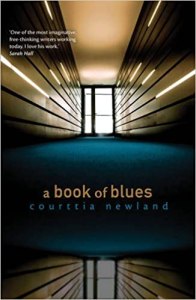
That was 1997 that I had that experience and first wanted to write about it. That took until 2002 when I got an Arts Council grant. I thought, “OK, what if I do this story?” I wrote it up as a proposal through the Arts Council. I wrote an outline for the whole novel, all the parts that you have in the novel and then I got to work on part 1. I started in 2002 and finished part 1 by 2004.
 And the rest of it was…?
The rest of it I wrote in 2019.
So once Canongate had said they loved it…
Yes, I was waiting. I’d run out of Arts Council money and couldn’t get any more. At the time when I got to the end of part 1 I was looking at it like, “This is going to be huge, this is a massive undertaking and I’ve bitten off a little bit more than I can chew”, in terms of I didn’t have the money to finish it.
I’d written a vampire graphic novel set in Victorian Bristol, for part of the Arts Council grant. So I’d done two projects and that was in the same kind of state – nine pages of graphic novel and a whole outline but I hadn’t finished it – and I thought, “I’ve got these two projects now and I need more money.” I needed someone to buy into this now for me to be able to continue and I didn’t find that. I tried until 2006 to get a deal for A River Called Time, but it didn’t happen so I thought, “I have to move on now, I need to start working on other novels” and that’s what I did.
Did you have the temptation to go back to it? Sometimes when something is that big a passion project, much as your head is going, “I need to earn the money”, the heart is going, “I’ve got to write this… I need to get this out”. So were you returning to it in that period?
 Every year.
Once a year I would go back to part 1 and do a full rewrite in terms of just a pass – I would go through it and edit it, I would tidy it up. I wouldn’t really touch the story, apart from chapter 3 as you now have it in the book, where Markriss goes to see Nesta and he goes to see Misty and he does some investigation that wasn’t in the original novel. I rewrote that and put it in, then later down the line I took it out. When I submitted part 1 to Hannah [his editor at Canongate] that chapter wasn’t in it, and she said, “There’s a big gap between chapter 2 in the park and chapter 3 where he goes to the Ark” and I said, “Yes, that’s because I took a chapter out”. I put it in, took it out, put in back in but I just kept going at it.
I wrote a paragraph or so that was a complete rewrite of the book where I changed the storyline entirely but it was the same world and I thought maybe that would do it. It was going to be from Markriss’ daughter’s point of view and she was telling the story of what her dad had done. I wrote this out and just looked at it and I thought, “No, I still like the old version.” So for the next 18 years, I kept returning to it.
My friend Jade, who’d been around me around the time I first had the idea for the book, would send me an email every year and she’d say “I think it’s time for A River Called Time”!
So how much does what I’ve got here alter from your original concept?
 It doesn’t. Part 1 is the part 1 I wrote in 2002 to 2004, it’s pretty much the same. I’ve done edits and changes but that’s it, that’s what I wrote. Part 2 is exactly what I envisioned, it’s what I wrote in my outline that I gave to Canongate.
Part 3, the relationship setup was different. My wife said to me, “It doesn’t feel right to me, it feels a little bit misogynist” what I had envisaged in the first place. It just felt wrong for the times. I felt like we’d moved on and had these discussions and I needed to learn from that. So my wife said, “What if these two people were in a relationship?” and I thought, “That’s brilliant and actually does what I want it to do better” so I did that.
Part 4 is exactly the way I imagined it and all the astral projection stuff was meant to be like that.
Part 4 needs to basically be the same; if you’re starting from the same part 1 you’ve got to get to the same part 4…
I always had the epilogue too, I always knew that was going to happen. I’m not sure I wrote that in the original outline but I always said I was going to end where we end. That’s rare for me; I very rarely end where I’m supposed to end but I did.
I think when something’s been working in your subconscious for that length of time even if you don’t realise it, the answers are there aren’t they?
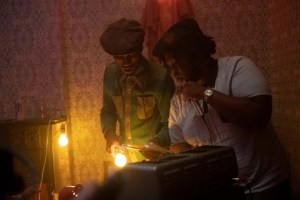
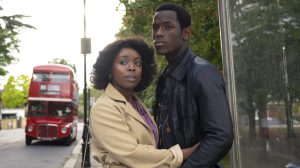
 That’s what happened. August till December 2019, I wrote the whole of the rest. I had just finished Lovers Rock and Red, White and Blue [the screenplays for Small Axe]. I was half a year late on delivery and they’d given me a little bit more time but Canongate said to me, ‘Look, please January has to be the final cut-off point’ so I started in August and I finished in December, just before Christmas and handed it in.
I’d been so scared. Ever since I finished part 1 in 2004 I’d been scared of moving on because I felt I’d done alright and I didn’t want to mess it up with part 2.
Part 2 was the hardest bit, that was going to be really difficult, but it just poured out of me. Everything worked, in the sense I was doing what I felt I could do, and I could see everything. I could see the whole world and the characters, I was having fun – so it was really great.
It’s that feeling when you’re almost transcribing something, rather than creating it isn’t it?
It’s exactly that feeling. It was literally pouring out of me. I was really tired because I was doing the Small Axe stuff. Basically my wife said to me, “Listen, get up at six in the morning, do three hours of A River Called Time then do the rest and I’ll deal with the kids and then in the afternoon we swap.” She writes too, so in the afternoon we would swap. I did that for that period of time, was really knackered but it worked, it was what I needed.
 You’ve probably seen the Douglas Adams stories about how he’d do anything, 37 baths every day, anything to get away from actually sitting in the chair and writing.
That can be me sometimes. I think I take a lot of time thinking about it and then once I hit that pocket where I’ve been getting up at 6 in the morning for a week or so then it just becomes a habit and it’s automatic.
I’m generally good when I’ve got a project, I’m not good before I start the project. I almost don’t want to commit and then when I’m committed I’m in.
Obviously so much has happened in the last 12 months let alone the last 12 years in the world. The concepts and characters you had in 1997/2002 – how much did you need to alter them or was it purely for the sections where it’s directly relevant to our experience rather than it being analogous?
 What I realised was, I had written this novel with an idea of what it was supposed to be and what I wanted to do, and like I said, I suffered years of rejection with the novel, which is normal – but the reasons why I was being rejected were slightly different.
What I’ve found was that time has, in a sense, caught up to me so what I was doing before, there was no language for it. Well, there was a language for it but it wasn’t common knowledge that that was the language for it.
I realised I’d written a decolonised novel and there was a language for it now – and it was in common parlance. People were talking about decolonising spaces and I thought, “Yes that’s exactly what I was trying to do with that novel, I was trying to decolonise science fiction for myself and for my readers.” Not necessarily saying this is the way for everyone to do but for me, it was an experiment in, “Can you do this? And what would it look like? And how would it work?”
 So in keeping with that, part 2 was pretty much the same, part 3 I had a really amazing idea I felt, which was this stuff was happening in real time. So when I was writing it, all this stuff was happening with part 3, I did it as it happened. I wrote it as it was going on. I didn’t know what the results were going to be for that section, I had no idea, but I knew what I wanted in my mental outline.
I thought, “Well, if it goes the way I want it to go in real life, the way I don’t want it to go in the book, I’m going to have to pretend that it didn’t happen.” Inevitably – and I think I knew in my heart of hearts which way it was going to go – it did match. What happened in real life is what would happen in the book and so I found the means to make what I was saying in parts 1 and 2 more acute in part 3 and it was all there around me anyway. Everything was happening anyway.
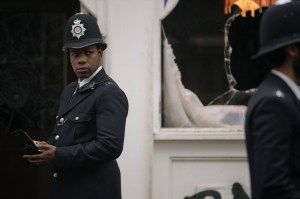
A lot of people ask me about Small Axe. They say, “You obviously made Small Axe before what happened last year – don’t you think it’s fortuitous?” And I’m like, “It’s not fortuitous, it’s because everything is going around circularly. The things we were talking about back then are still happening and they haven’t been fixed, so it’s going to seem like it’s relevant and we did something amazing, when it’s just that things haven’t been changed.” That’s the problem.
If the zeitgeist does not change then your and my grandkids are going to be sitting here having a similar conversation.
Yes, and isn’t it sad that I can write something in 2002 and it be painfully relevant in 2021? Isn’t that sad that the things I’m talking about are still happening? In fact they’ve become even more acute. I don’t see that as a boon for me, I see that as a worse problem.
I was very intrigued by the reaction Small Axe got in the States. It seems to have had a more positive reaction there than here for films about British life.
 It has, yes.
There’s an element of discovery for them out there, and I think, I’ve been waiting for that day because even in the early days when I was a published author and going to the States, that element of discovery and exploration that they seem to want, I was coming up against that.
People would be asking me all the time, “What’s it like in London? How do you guys do this? Where do you come from originally? In the sense of where are your parents from?” They wanted to find out more about us and I always thought if we could get this work to them we could have a dialogue and a conversation which would be really interesting, instead of it being this one-way monopoly on the conversation where everything about Black experience comes from America.
They don’t believe that – well, some people do but on the whole, the smart intelligent people, they don’t believe that. They want to know but they’re not being given the tools they need to be able to have this discourse, so many African American reviewers said to me, “Thank you for making that stuff, I’m so happy that you made it.”
I think that hopefully that’s what will happen with A River Called Time, but I think for a long time, for many reasons that discussion has been stunted and disallowed.
I genuinely think that in the next four years we’ll see the next American Civil War, I hate saying it but…
My friend in New York said the same thing to me the other day: “I don’t see how we’re going to get out of a civil war”. It’s really sad to see that. And the thing is that people in America have been saying this for years, before Trump. “This is at the heart of our society, this is what’s going on.” If you look at the writers, they’ve been shining a light on it and even talking about playwrights like August Wilson, he’s been tracking a century of African American experiences saying “This is what’s being done to us, this is how we’re responding to it. I think you’re right, I just feel it’s really sad that it’s gone this far.
A River Called Time is out now from Canongate Books; click here to order from Amazon.co.uk
Author photo © Sharon Wallace
Small Axe can be seen on BBC iPlayer
 Doctor Who News Star Trek News
 Sci-Fi Bulletin: Exploring the Universes of SF, Fantasy, Horror and Spy-fi!