 Daryl Gregory’s new novel Spoonbenders has just been published by Quercus and has already been optioned by Paramount TV. His novel We Are All Completely Fine won the World Fantasy Award and the Shirley Jackson award, and was a finalist for the Nebula, Sturgeon, and Locus awards, and is in development at Syfy. His novel Afterparty was a National Public Radio and Kirkus Best Fiction book of the year. In this piece, he gives a peek behind the curtain at the writing process…
You approach a house in the woods. The door swings open. Inside, a strange shape moves in the light of the fireplace. A creature howls. A woman laughs. Then a horned figure comes to the doorway and you realize the creature and the woman are one. She beckons you forward.
In fiction, this is called the hook, but that’s a bit of a misnomer because it makes it sound as if the reader has no choice. Really it’s an offer. The door’s open, the author’s hand is outstretched, and the reader has to decide: am I in, or am I out?
If readers take the deal, if they turn that page, they become partners with the author – at least for a while. That trust has to be earned over and over again, perhaps on every page. If this is true, the author says, then wouldn’t it follow that that is true, too? If you were in this situation, wouldn’t you do the same?
When I teach fiction writing, I tell students that writers of the weird and the fantastic have an especially tough job of earning trust, but the tools are the same for all fiction.
One technique is to front-load the far-fetched. Whatever happens early in the story is premise, an inarguable fact of the fictional world. The reader knows from the beginning – or even from the blurb on the back of the book – that the story contains monsters, or spaceships, or, say, a family with psychic powers. The same event which would be hard to believe if introduced late in the story will be accepted in the beginning as the price of admission.
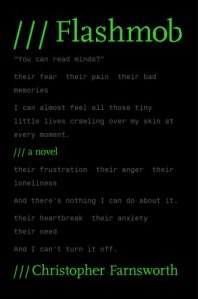 Take the opening of Christopher Farnsworth’s new SF thriller, Flashmob. The first sentence is this: “It’s not easy to find a nice, quiet spot to torture someone in L.A.” You know immediately what kind of book you’re in for. In the next five hundred words, we learn that John Smith, Farnsworth’s protagonist, is tied up at the bottom of an empty pool, next to the client he’s been hired to protect, while Russian gangsters unpack an electric drill. We also learn that Smith is a telepath who is scanning the gangsters for their weaknesses. I ask you, dear reader: Are you in, or are you out? I stayed in. I wanted to know how Smith was going to get out of this.
The second technique is to ground the fantastic with sensory detail. No matter how weird a world is, it is its specific sights, sounds, and smells that persuade readers of its reality. Kij Johnson’s recent novella, The Dream-Quest of Vellitt Boe, is set in a Lovecraftian universe full of mad gods and monsters. Vellitt Boe, a professor at Ulthar Women’s College, goes searching for her student who’s eloped with a man from another dimension: Earth. But Johnson makes her bizarre world as real and concrete as any place you’ve visited. Here’s Boe walking out of her city as she begins her quest:
This was the old part of town: half-timbered buildings with overhanging second stories and peaked roofs, the occasional shrine or public building of heavy granite or blocks of labradorite. The air smelled of ancient mold, but also of herbs, of rue and basil and catmint, for every window had a hanging basket bright with greenery.
Johnson quietly mixes the unusual – public shrines, crystal labradorite as a building material – with mundane sights and smells.
The most important technique, however, is to emphasize drama. Readers will follow a story anywhere if they know what a character wants and why they want it, and then can see them act on those desires. It doesn’t matter if those goals are unusual – say, to throw a magic ring a volcano, or steal that ring back from a nasty hobbit – as long as we understand the stakes. It’s not even necessary to make characters “likeable.” Gollum’s treachery engages us because we’ve seen how much his precious means to him.
Beginning writers are often coy with motivations. They believe a shadowy stranger, acting in mysterious ways, is somehow more intriguing that a character working toward clear goals. But mystery takes readers only so far, and that coyness can be annoying – or worse, boring.
So, writers: give us those wizards and warp drives. We want them all! But also give us a living world full of persuasive detail, and characters struggling to achieve goals we understand. Persuade us to trust you, and we’ll follow you all the way to Mount Doom.
Spoonbenders by Daryl Gregory is out August 24 published by Quercus. Click here to order from Amazon.co.uk





 Sci-Fi Bulletin: Exploring the Universes of SF, Fantasy, Horror and Spy-fi!