Feature: This is What Happens When a Horror Author Writes Science Fiction
Weston Ochse is a former intelligence officer. A writer of more than 26 books in multiple genres, his military supernatural series SEAL Team 666 has been optioned to be a […]



Weston Ochse is a former intelligence officer. A writer of more than 26 books in multiple genres, his military supernatural series SEAL Team 666 has been optioned to be a […]
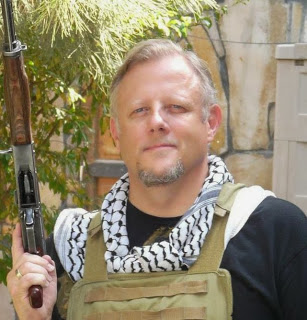
 Weston Ochse is a former intelligence officer. A writer of more than 26 books in multiple genres, his military supernatural series SEAL Team 666 has been optioned to be a movie starring Dwayne Johnson. His military sci fi series, which starts with Grunt Life, has been praised for its PTSD-positive depiction of soldiers at peace and at war, with the final volume, Grunt Hero, just published by Solaris. Here the award-winning writer discusses the real monsters in horror…
My science fiction publisher told me that my last three military sci fi novels were the bleakest books they’ve ever published and that’s a good thing.
Let me explain.
 I’ve been a fan of science fiction for as long as I can remember. I broke my teeth on Heinlein and Bradbury, groking Glory Road, Stranger in a Strange Land, The Illustrated Man and The Martian Chronicles. I smashed through the fourth wall and skipped down Destiny’s Road, visited the mysteries of Rama, ate the spice, wore Steakley’s Armor, Neuromanced the internet, farcasted with Hemingway, studied at Foundation, gamed with Ender, spent a Midnight at the Well of Souls, anthropoligized on Gethen and Lagash, slid through The Door Into Summer, been as condemned as Gully Foyle, space-walked with Hal, and warred forever with Mandella. So based on all of that you’d think that when I decided to become a writer that I’d write science fiction, right? So then how the hell did I become a horror novelist?
I think part of the reason is that I’ve never felt that horror was solely a genre. To me, horror has always been a feeling. I didn’t read a horror novel until I was twelve and that was The Stand; and if you think about it, The Stand really isn’t a horror novel at all. It’s dark fantasy at its best. The first true horror novel I read was The Shining. Now that was a horror novel. The theme of being haunted runs through the plot in so many ways it creates an etch-a-sketch of the horrible, weaving its darkness into the protagonists until they don’t even know themselves.
 Horror is everywhere.
Horror lives in Through the Looking Glass.
There are elements of Lord of the Rings that have horror.
The Passage is more horror novel than science fiction.
Solaris is as creepy as any horror novel can be.
The Aliens movie is a horror movie even though it’s set way in the future.
So why not write about horror?
 Fast forward twenty years and I wrote my first book—a horror novel about astral projection and the lengths to which man will go to make other men miserable. And then more and more and more horror. I became an auteur at manipulating readers, knowing that I could create characters that they’d come to adore, only to do things to them that couldn’t be undone. I enjoyed creating horrible situations for terrific characters and then turning up the heat. The SEAL Team 666 series was widely successful and reviewed by everyone from USA Today to The Atlantic, even getting the attention of Hollywood heavyweight, Dwayne “The Rock” Johnson. It was then that Solaris contacted me and asked if I wouldn’t mind writing some military science fiction for them.
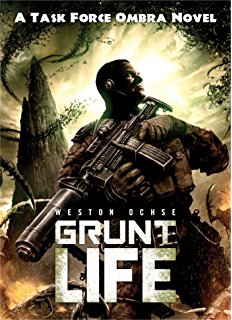
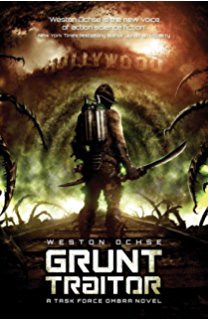
I was supremely delighted to turn in Grunt Life. Upon reading it, the editor came back and said it was fantastic, but it was undoubtedly the bleakest novel that they would ever publish. And it remained so, until I turned in the second book in the series, Grunt Traitor, which was then the bleakest novel they would ever publish. But that was a good thing, right? Bleak is good, right?
Let’s unpack that.
 Grunt Life was a novel about alien invasion and PTSD. Those two were linked because the soldiers with PTSD who inhabited the book had a change of brain chemistry that better allowed them to fight the aliens who were invading. The problem was that if you have an all-star cast of characters who have PTSD then they’re going to be some pretty messed up people with metric tons of emotional baggage. Hence, bleak.
I recently received a message from a fan who was listening to the audio version of the book. A veteran himself, he had to stop listening to part of it because it was quickly becoming a trigger. The part in question took place when the soldiers were getting indoctrinated into Task Force OMBRA. Part of the indoctrination forced them to come to terms with their PTSD origin story, telling the others in the unit what it was that had been so terrible that scarred them for life. The various technicolor-graphic stories about dead friends and children rang too true for this fan.
The truth is that war is hell, if you’ll pardon the cliché. When you write about it—I mean when you really write about it well—readers should come away a little bit sickened by it. After all, we are human. So here I am a horror author writing science fiction. I’m not including ghosts, hauntings, demons, devils, or a possessed 1958 Plymouth Fury. I’m writing about the real monsters—us humans and what we do to ourselves. For as bad as the aliens are and as terrible as they are to us, the bleakness that inhabits these books is the greasy stain of an embattled soul.
This is what happens when a horror author writes science fiction.
And it’s a good thing.
Grunt Hero is out now from Solaris
 Doctor Who News Star Trek News
 Sci-Fi Bulletin: Exploring the Universes of SF, Fantasy, Horror and Spy-fi!