 Tim Major is a freelance editor and co-editor of the British Fantasy Society’s fiction journal, Horizons. His first novel, You Don’t Belong Here (Snowbooks, 2016), is a curious mix of time-travel SF and psychological horror. He has also released two novellas: Blighters (Abaddon, 2016) and Carus & Mitch (Omnium Gatherum, 2015) – the latter was shortlisted for a This Is Horror Award. His short stories have appeared in Interzone, Not One of Us and numerous anthologies. Blighters forms part of the Invaders from Beyond omnibus out from Abaddon this month, and in this piece, he discusses the route to publication – and some useful tips for selling your ideas.
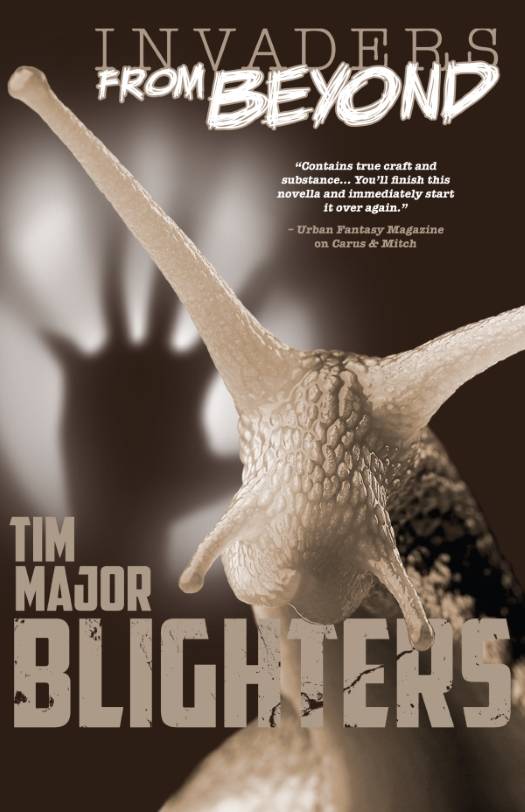
My novella, Blighters, was published as an ebook last year and appears in the Invaders From Beyond print omnibus, published by Abaddon this month. This all came about due to a chance meeting with Abaddon commissioning editor David Thomas Moore at FantasyCon in 2015 – in the hotel bar – which turned into an impromptu ‘elevator pitch’ session. David was beginning a new series of linked novellas about unusual alien invasions; I had a longish short story about alien slugs; could it be extended to 30,000 words? For you, David Thomas Moore of Abaddon Books, yes, it could.
I’d never been in a position to pitch a story before, face to face. (In fact, it was my first FantasyCon and my first real opportunity to meet anybody related to UK genre fiction.) The fact that the novella was accepted suggests I did a reasonable job of pitching – though even now I can conjure up David’s sceptical expression, which may or may not have melted as I stumbled through my synopsis. It went something like this:
Giant alien slugs have landed in various locations around the world. Everybody’s after them. There’s a girl, Becky, who discovers one in rural Cumbria. Oh, those slugs? They exude some kind of forcefield that gives anybody nearby a sensation of total wellbeing. Oh, and Becky? She’s not all that interested in Blighters, she just wants some kind of distraction from her poverty and aimlessness. It’s all sort of about society, deep down.
I should have prepared an elevator pitch. We all should, we writers, for any of our projects. But writers hate writing synopses, hate boiling their immense, imaginative plots and worlds into lifeless bullet points, hate elevator pitches most of all.
I think we’re wrong to avoid them. Synopses are a wonderful plotting tool; nowadays I tend to produce one at the early stages of writing a novel. Then I read it out loud to my wife and watch her carefully for signs of disinterest, while trying to stifle my compulsion to insist that it will all make perfect sense once I’ve written the full novel. If a plot falls apart as a result of summarising it, there’s a problem.
An elevator pitch is even more brutal. With so little time to describe your story, the chance of it being dismissed by your spouse, or your trapped commissioning editor, is high. I once read some good advice about writing synopses, and it applies doubly to elevator pitches: after each sentence, imagine somebody saying, ‘So what?’ Giant alien slugs have landed in various locations around the world. So what? Everybody’s after them. So what? I’m immensely grateful to David that he didn’t adopt this approach, mind you.
Of course, I’d already had my chance to order my thoughts and summarise Blighters, safe at my desk when I completed the initial story and began to think about submitting it. One of my cover letters included this description:
It’s a contemporary mystery story with SF elements. Slug-like alien creatures have landed around the world and produce an intensely calming effect on anybody nearby. This phenomenon has been widely reported and isn’t feared, due to its ubiquity on social media. A disaffected young woman from the north of England discovers a hidden Blighter and must decide whether to help it, or to exploit its calming effect to cope with her tragic family history.
So is that better than my face-to-face pitch? Maybe. Maybe not much.
 Recently I saw a TED Talk, filmed in 2009, in which marketing consultant Simon Sinek suggests that great political speakers and successful commercial companies promote their ideas by beginning with why they do what they do, then how they achieve it, then what they do. He argues that Apple is successful because it follows this ‘Why’, ‘How’, ‘What’ order in marketing messages. Typically, its advertisements begin with a statement along the lines of, ‘In everything we do, we believe in challenging the status quo’, then ‘We do this by making our product beautifully designed and simple to use’, then, for example, ‘We make great phones’. It’s a fair point. If Apple began by outlining the product, its marketing would be bogged down in descriptions of features – whereas, in general, we assume that each new product will be robust because we’re already on board with the company’s ethos.
I think there’s an analogue with plot synopses. Rather than get bogged down in the ‘What’ – the specifics, the worldbuilding, the nouns – we ought to start with the ‘Why’. Blighters explores the way that earthshattering events quickly become old news, thanks to the internet, and it’s about the temptation of narcotics to distract yourself from problems in your life. Then the ‘How’: the story features one of the most extreme world events imaginable, an alien invasion, and it substitutes an inexplicable phenomenon, a calming forcefield, for the narcotics. Finally, the ‘What’: it’s about giant alien slugs who appear entirely benign, but whose arrival causes envy and inequality around the world.
This approach may or may not make for a more compelling elevator pitch, but I think what I’m edging towards is a realisation that this ordering of ‘Why’, ‘How’, ‘What’ may actually be particularly useful during the process of writing. Like many writers, I tend to discover the theme of a novel only in the edit; while rereading, threads tend to pull together and I’m able to see a shape and an intention – that is, I hone in on the ‘Why’. The initial idea for Blighters came about when my mum described the horror of witnessing sleepy, placid wasps dropping from an overhead Xpelair fan in her bathroom, whereas the main themes of the story emerged only in the second draft. In future, I’ll try to wrestle with the issue of why I’m writing a particular novel – what it is about a concept that instinctively appeals to me – before I get started.
And then, who knows, maybe I’ll also develop more confidence when describing the end results to a commissioning editor.
You can read Blighters in the Invaders From Beyond omnibus, available from 30 November. It’s about giant alien slugs that exude a forcefield of intense—
Argh. Look, I’m doing it again.
Find out more about Tim at cosycatastrophes.wordpress.com





 Sci-Fi Bulletin: Exploring the Universes of SF, Fantasy, Horror and Spy-fi!