Feature: Meet the Imp
Eric Brown’s new novel Binary System is out now from Solaris Books, and features a self-aware intelligent AI. Here he explains the many different purposes that such a system serves […]



Eric Brown’s new novel Binary System is out now from Solaris Books, and features a self-aware intelligent AI. Here he explains the many different purposes that such a system serves […]
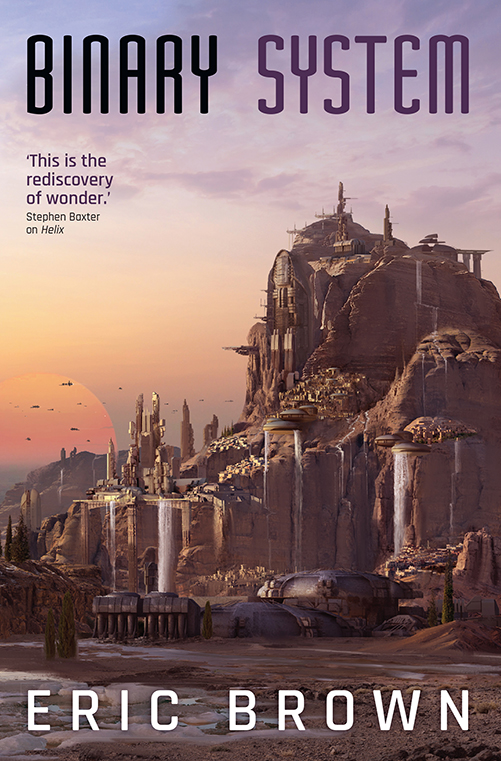 Eric Brown’s new novel Binary System is out now from Solaris Books, and features a self-aware intelligent AI. Here he explains the many different purposes that such a system serves in the novel…
It’s only a matter of time, of course, before we’re all using cranial implants – hardware and software plugged into our brains to help us access information. Instead of looking up info in books or online, it’ll be instantly available to use at the speed of thought. There’s a chance that these implants will be intelligent, to varying degrees, and that raises a whole host of interesting questions. What will happen to our identity, our senses of self? Just how autonomous will we be, with these imps riding around in our brains? How autonomous will they be? We’d run the risk, of course, of being taken over, infected with malware and viruses… The idea of implants to aid our lot could turn from dream to nightmare, creating a legion of programmed zombies – the wet-dream of multinational conglomerates, nefarious states, and religious or ideological cults.
When I wrote my latest novel, Binary System, set a couple of hundred years into the future, I had my central character, Delia Kemp, implanted with a self-aware, intelligent AI. She calls it Imp. (When I wrote the book, it never occurred to me that it might be a mischievous imp, riding on her shoulder). In this high-tech future, where star-travel via wormholes was commonplace, every spacer was rigged with an intelligent cranial implant – a means of instantaneous communication and a readily accessible font of information. Her Imp is a personality unto itself – in fact a very real character in the book – which she talks to as if it’s another person, even a friend.
Now, why did I implant Delia? Why did I think it’d be fun to have this ever-present voice in her head? To answer the many questions I posed in the opening paragraph of this piece?
Well, no.
The novel opens with the line: The Pride of Amsterdam was transiting the Lunar wormhole when the explosion ripped through the starship’s fusion core.
What follows is a headlong action-adventure as Delia finds herself stranded on the inhospitable world of Valinda. The planet has an elliptical orbit around a binary system, resulting in a long period of winter followed by a short, blistering hot summer. Valinda is populated by the Skelt, a race of hostile aliens who will stop at nothing to obtain Delia’s scientific knowledge. She escapes from the Skelt with the assistance of a friendly chimpanzee-like alien and a giant spider-crab, then travels south through a phantasmagorical landscape as the long winter comes to an end and the short, punishing summer approaches. Pursued by the Skelt, she and her companions make a death-defying dash across the planet’s equator to meet up with fellow survivors from the starship, and a final journey to the valley of Mahkanda – where salvation just might be awaiting.
And, of course, she could have done none of this without the assistance of her implant, Imp.
It occurred to me that she had to have help on the journey. For although Delia was a tough cookie, a resourceful medical doctor with lots of xeno-logical experience and survival-training, she couldn’t do it all alone – she needed a companion, a Dr Watson or Man Friday.
Imp served a number of purely technical, novelistic functions. First of all, and unsubtly, it would allow me to impart information about the planet, its geography, meteorology, and even its history, that would not be known to Delia. It would serve as a sounding-board, for want of a better word, for Delia as she underwent the trials and tribulations of capture by hostile aliens: it would assuage her loneliness at times, encourage her to think positively, and also help her out of scrapes with suggestions based on its observation of situations.
And, perhaps most importantly for me, her Imp would act as a translation device between Delia and the various alien races on Valinda – a Babel Fish, if you like.
In the course of her adventures, Delia meets Mahn, a Fahran, a primate alien with blue fur and huge eyes, and Var the Vo, a gigantic spider-crab creature: both assist her on her journey across the face of the planet. The evil Skelt, locust-like aliens, chase and occasionally capture her… It was vital that she be able to communicate with these various aliens, and thanks to the instantaneous translation facility of her Imp, she is able to do so. The Imp’s rendering of alien language into English also helped me overcome a technical problem. Its translating of alien speech into vernacular that Delia (and the reader) would understand, would I hope circumvent that age-old criticism of SF writers writing about aliens: that their alien creations are too anthropomorphic. It’s a conundrum that we SF scribblers face again and again: how to render aliens alien without their being too alien, and therefore incomprehensible to the reader? I wanted the aliens in Binary System to be different, and yet recognisable and sympathetic, with characteristics that would render them comprehensible. I found that using the Imp’s translations I could, I hope, achieve this… Though whether I’ve succeeded or not is hard to tell: one criticism of the novel has been that the aliens are just too human… Hey-ho.
 As I was writing Binary System, it came to me that implanting Imp in Delia’s head was raising a lot of interesting questions – questions of individual autonomy and identity, and others, posed in the opening paragraph.
However, Binary System was a fast-paced action-adventure novel, not a hard SF disquisition extrapolating from current trends in AI technology.
Perhaps that’s the subject for another novel.
 Doctor Who News Star Trek News
 Sci-Fi Bulletin: Exploring the Universes of SF, Fantasy, Horror and Spy-fi!