Feature: History: What has it ever done for us?
Patrick Edwards’ new book, Echo Cycle, is out this week from Titan. Described as Gladiator meets 1984, it’s set in the near-future and at the height of the Roman Empire. […]



Patrick Edwards’ new book, Echo Cycle, is out this week from Titan. Described as Gladiator meets 1984, it’s set in the near-future and at the height of the Roman Empire. […]
 Patrick Edwards’ new book, Echo Cycle, is out this week from Titan. Described as Gladiator meets 1984, it’s set in the near-future and at the height of the Roman Empire. Edwards has a fascination with both future and past, and in this short piece, he discusses the knotty problem of historical ficion…
Historical fiction takes the piss. Arty-farty writers come in and ride all over the carefully-documented, painstakingly researched evidence without regard to empiricism, looking to make a quick buck by embellishing the truth.
Historians are such dried up imagination sumps. They suck the joy out of the stories of the past, determined to consign it to boxes in archive buildings where even the dust will forget it.
These (exaggerated, c’mon) points of view collide on a regular basis with no shortage of snarkiness and highbrow mud-slinging (Starkey vs Gregory is my personal favourite). So who has the greater claim to telling the past to a mass audience, academe or literature?
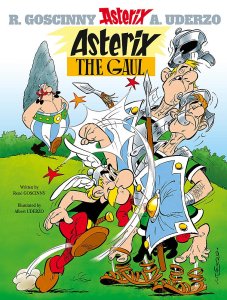 I’ve loved classical history since I was knee-high to a thingy, and it wasn’t because someone beat me around the chops with Thucydides (had that been my first introduction to the riches of the ancient world I’d have likely ended up in HR). I’ve visited ancient sites in Italy and Greece and my second book, Echo Cycle, was set in 69 CE Rome. My gateway drug to all this? Asterix the Gaul. Plucky stereotypes ripped on performance-enhancing drugs (sorry, ‘magic potion’) bash all sorts of corpulent legionaries senseless, but Asterix doesn’t content himself with a small village in Gaul. In 20+ volumes he, Dogmatix and Obelix travel as far as Egypt and, on more than one occasion, to Rome itself. This jokey, thoroughly French bit of kids entertainment opened my eyes to town planning, armour, gladiatorial games, trade in the Mediterranean. Whenever, in later years, I was confronted with the drier texts (I’m looking at you, Cicero) I could get through it because my grounding in the subject was steeped in fun and colour. The ancient world was a riot of variety and it was fiction that tattooed that impression on me.
 That said, we need the dusty archives and we need those who pursue more than one side of the story. For centuries the emperor Nero was perceived as a tinpot despot who played the lyre as his city burned – only through (relatively) recent research has it been shown that he was in fact extremely popular in the early part of his reign and quite the reformer. That’s not sexy though, and it’s not as much fun as a chubby madman with delusions of godhood. That perception of him, by extension, cheapens every inhabitant of Rome at the time, robbing them of the agency they most surely had. It takes a grown-up will to look past the loudest voices and form a complete picture and, in doing so, rehabilitate a society. Imagine for a moment that the times we live in were only defined by the loudest, brashest voices and that’s how we were perceived for posterity; how many of us would be happy for future generations to assume we all marched along to the divisive rhetoric of the bombasts who have wriggled their way into power? Detachment from narrative is what it takes to look past the more obvious noise and to feel the countercurrents of an age, and thereby understand it.
 So which is it to be? Well, the answer is of course: Mary Beard. A twinkle in the eye; a wry sense of humour; an appreciation of fun, drama, hyperbole. But beneath it all a flint-hard devotion to the whole truth, no matter how grimy and pedestrian.
Echo Cycle is out now from Titan Books; click here to order from Amazon.co.uk
 Doctor Who News Star Trek News
 Sci-Fi Bulletin: Exploring the Universes of SF, Fantasy, Horror and Spy-fi!