Feature: Fun with Future Tech
Jay Posey is a narrative designer, author, and screenwriter by trade. He started working in the video game industry in 1998, and has been writing professionally for over a decade. […]



Jay Posey is a narrative designer, author, and screenwriter by trade. He started working in the video game industry in 1998, and has been writing professionally for over a decade. […]
 Jay Posey is a narrative designer, author, and screenwriter by trade. He started working in the video game industry in 1998, and has been writing professionally for over a decade. Currently employed as Senior Narrative Designer at Red Storm Entertainment, he’s spent around eight years writing and designing for Tom Clancy’s award-winning Ghost Recon and Rainbow Six franchises. His new novel SUNGRAZER is out today from Angry Robot, and here he talks about one of the best aspects of being a science fiction writer…
For me, one of the most fun and interesting parts about writing science fiction is getting to imagine and develop future technology. It’s like being an inventor without having to worry about financing, safe test environments, or government regulation.
As great as all that freedom is, though, making up future tech does have its challenges and potential pitfalls. Characters finding themselves stuck in some trouble you hadn’t anticipated? No problem! You can just invent some cool gadget on the spot to help them escape …
… and, having forgotten all about your one-off invention, you might end up creating plots holes or irritation in your readers, usually with some variation of “Well, why didn’t they just use that before when …”, or “Why don’t they just use that gadget again now?”
Or, you can put so much effort and research into figuring out how something might actually work that you are then compelled to write a forty page description of your tech with diagrams and explanations into its inner workings that absolutely no one cares about but you.
And, of course, to really make technology work in a story, it has to be well-integrated into the world and most importantly, handled properly by the characters.
Knowing how much trouble I can get myself in, whenever I’m developing a new bit of tech for a book or series, here are are a couple of things I try to keep in mind to help keep my worst tendencies in check.
 That fancy new tech isn’t fancy to the people who use it (unless it’s new to them too).
If you’ve got a smartphone, you probably appreciate the convenience it affords, and if you ever stop to think about it, you might be genuinely awed by all the computing power you’ve got in your pocket. But a lot of us get irritated when our favorite cat videos are loading slowly over the Wi-Fi we’re using on the airplane while we travel across the country, without ever thinking about how magical that entire scenario is.
If something is new to the characters, some recovered alien artifact or new breakthrough for example, then it certainly makes sense that they would approach it with wonder or fascination. Or, in some cases, it might be important for readers to understand how a particular gadget works so that they understand the rules and can experience the appropriate levels of tension and drama when that technology comes into play in the story.
But for the most part, if future tech is a part of future people’s daily lives, they probably ought to be somewhat oblivious to how cool it is.
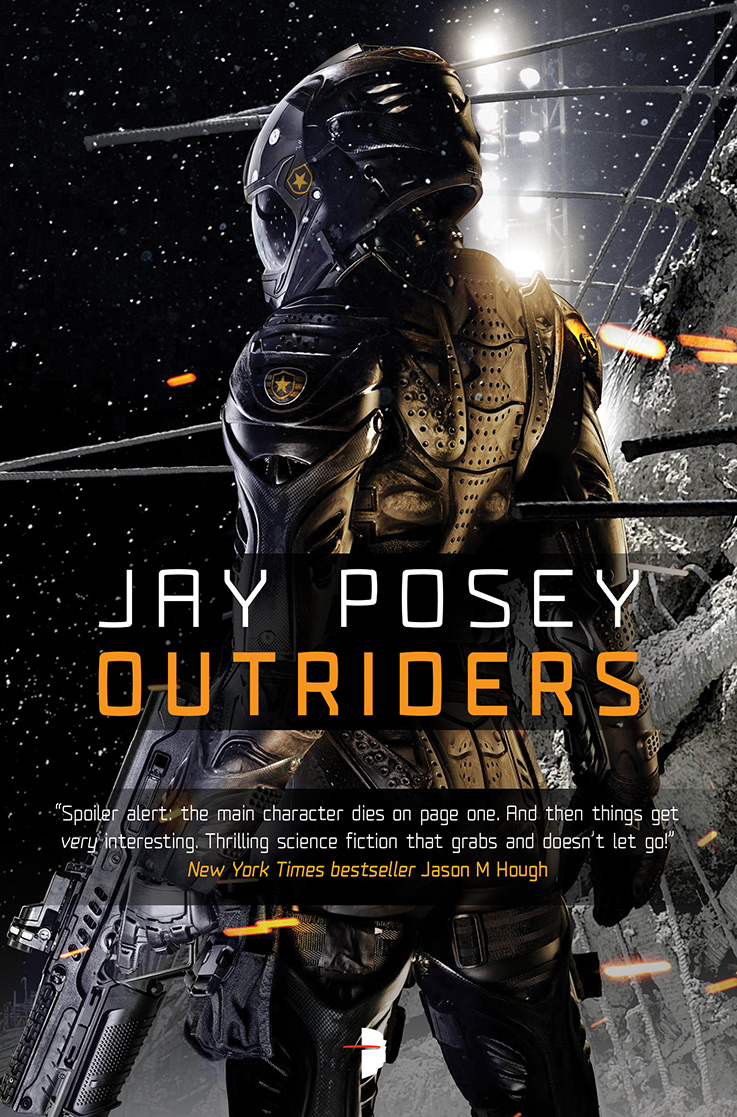
In my Outriders series, for example, the Outriders are a small, elite team of soldiers with their consciousnesses on back up. If any of them are killed in action, their consciousness can be reintegrated with a replica to effectively bring them back from the dead. They call it the Process. And it works most of the time.
When the main character, Lincoln Suh, first joins the team, he is briefed on the Process so that he knows what he’s getting into (relevant to the character) and also so certain rules are established about how it works (relevant to the reader). But I tried to strike a balance in giving only the minimum information required by the story, without delving into all the research and science behind the concepts involved.
And while the Process is treated with some degree of awe and respect in the books, hardly anyone in the Outriders universe thinks anything of the power armor they use, or the spaceships they fly around in, or the instantaneous communication they enjoy across vast distances. Those things are just part of daily life for the Outriders, and they treat it as such.
Characters probably don’t how it all works either.
Very few of us could explain in depth and detail how all of the technology that goes into our smartphones works. And I doubt any of us would want to listen to anyone who could for very long.
We most certainly wouldn’t want to have to build one on our own.
The same probably holds true for the people using all of that fancy future tech in your story. Unless they’re a specialist in the relevant fields (and the story necessitates it), a character probably isn’t going to casually drop the mathematical principles and inner workings of your quantum communications array into dinner conversation.
Technological change brings social change.
 Massive technological change can’t help but disrupt social function and structure. Whenever you create a new bit of technology, it’s worth taking some time to think through how thoroughly your tech would impact society, beyond the immediately obvious.
One of the most common jobs in the US right now? Driver. So what happens when cars and trucks drive themselves? Where do those jobs go? What do people who drive for a living do instead? What new jobs will be created?
Beyond employment, what happens when all those people who drive themselves to work every day no longer have to pay attention to the road? How do they use that time? What new goods or services might arise for the bored commuter, when they can customize the space they ride in (unlike subways)?
What happens to vehicle ownership? If a service like Lyft or Uber can have a self-driving car wherever you want it, as soon as you want it, for however long you want it, is there any reason to own a car for yourself?
Will traffic jams still exist when vehicles are driving themselves?
You can fall down a deep rabbit hole of questions like that when you think just about self-driving cars… and, depending on how you define “self-driving”, that’s a technology that’s just a few years out. It only gets tougher and more complicated the farther into the future you go.
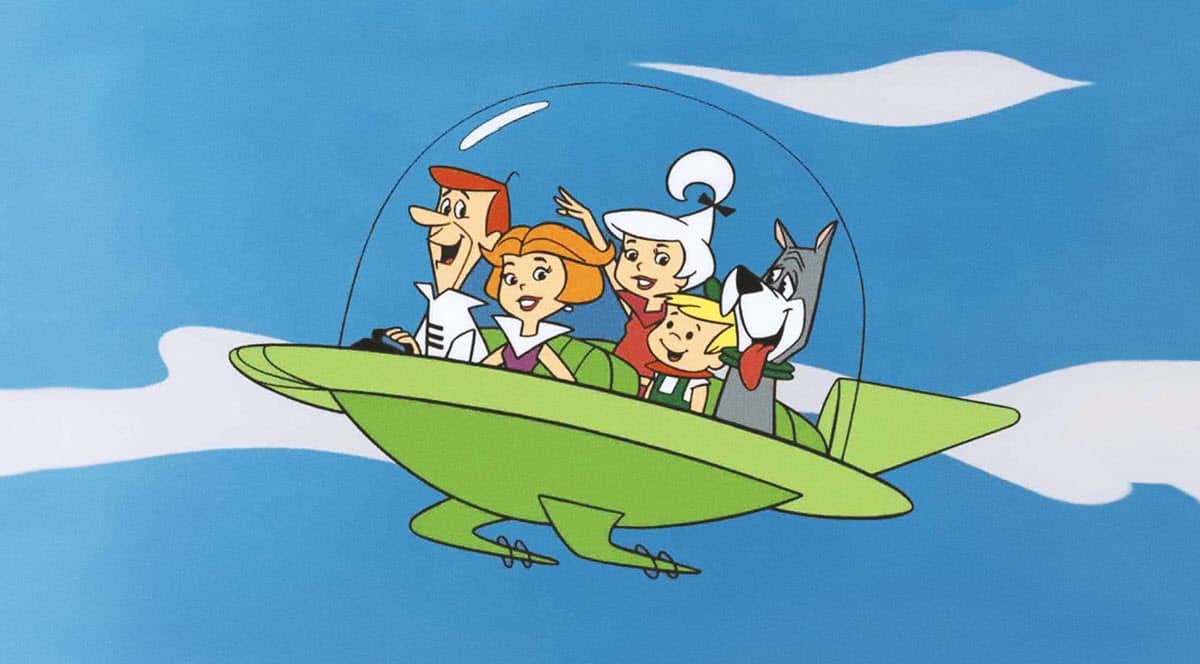 This is an area where it’s almost guaranteed that an author is going to miss certain implications. In The Jetsons, for example, people enjoy flying cars and cities built above the clouds, but for some reason still have to commute to an office for work.
Of course, science-fiction often isn’t trying to be predictive, nor is it necessarily attempting to accurately portray all aspects of life in the future. Even if someone were able to pull off the task of detailing life a hundred years in the future, it’s likely that the change would be so radical and overwhelming for modern readers that it would be impossible to comprehend.
So, like most things in writing, it’s about understanding the needs of the story and deciding where to spend your effort. Depending on how central to the narrative your piece of future tech is and how it fits into the themes or messages you’re exploring, it may or may not be worth the trouble of designing social rules around it. But whether you choose to incorporate it or not, giving a little thought to the social impact of your tech can help ensure you’re making a conscious, deliberate decision in how it is treated.
Nothing works, everything sucks (even in the future).
Jocko Willink is a retired Navy SEAL who commanded Task Force Bruiser in Ramadi, Iraq during some of the most brutal fighting of that war. On a recent podcast, he mentioned one way he and his teammates dealt with the inevitable complaints about equipment breaking down:
“Yeah, nothing works, everything sucks, deal with it.”
Though most of us have never had the batteries in our night-vision goggles die right after we’ve just kicked the door open on an enemy-held position, we’ve probably all had a time when a piece of tech failed on us right when we were counting on it the most. The oven dies the night before Thanksgiving. The car won’t start on our way to the airport. We lose cell signal right in the middle of that critical phone interview.
 Thinking about how your future tech not only works but also how it breaks down can help make it feel more authentic and connected to our own life experiences. One of the things I love about the Millennium Falcon, for example, is how lived-in it looks, and how often Han and Chewie are having to deal with its quirks and malfunctions. That moment in A New Hope when the ship is under attack, and Han answers Leia, “Don’t worry, she’ll hold together”, then a second later, says to his ship, “Hear me baby? Hold together.” rang true to life, and helped ground the entire world.
As I mentioned before in the Outriders series, the Process works most of the time. And, as we come to learn more about it throughout the series, we get to see how it’s not the perfect solution its creators claim it to be. Of course it’s going to break at the worst possible time, because that’s life. The uncertainty adds some level of drama to the story, but it also helps connect the incredible technology to our own experiences and expectations.
So those are just a handful of thoughts I try to keep in mind whenever I’m creating some new technology for a story, and maybe someone out there will find them handy too.
SUNGRAZER is out now from Angry Robot Books
 Doctor Who News Star Trek News
 Sci-Fi Bulletin: Exploring the Universes of SF, Fantasy, Horror and Spy-fi!