Review: Philip K. Dick on Film
By Gregg Rickman Arrow Books, out now A brief overview of the film and TV adaptations of influential sci-fi writer Philip K. Dick’s novels and short stories. In his […]



By Gregg Rickman Arrow Books, out now A brief overview of the film and TV adaptations of influential sci-fi writer Philip K. Dick’s novels and short stories. In his […]
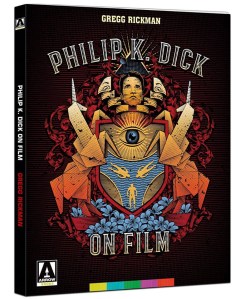 By Gregg Rickman
Arrow Books, out now
A brief overview of the film and TV adaptations of influential sci-fi writer Philip K. Dick’s novels and short stories.
In his introduction to this book, author Gregg Rickman acknowledges it’s a short book that is at least as interested in the man himself as the movies. It’s not a ‘making of’ tome, a biography or critical study of Dick, but rather a study of how PKD perceived media. That’s a wise move, as the ‘making of’ aspects have already been covered in detail in Paul M Sammon’s Future Noir and Brian J. Robb’s Counterfeit Worlds.
Rickman clearly knows his subject, having interviewed him during the last year of his life, and provides a number of interesting nuggets for even the most avid ‘Phildickian’ (did you know that in the original Total Recall movie they spelt the author’s first name with two Ls?) and some insightful observations around how his name transformed from little-known sci-fi author to an ‘above the title’ brand. There’s also reference to Dick’s Valis event, a visionary experience in 1974 when he allegedly received a huge sum of information from an unknown source.
The author also (unwisely?) repeats George Orwell’s description of a book reviewer being a person who spends their life ‘…pouring his immortal spirit down the drain, half a pint at a time.’ And with that in mind I guess it’s my time to pour some Johnnie Walker Black Label down the sink rather than into Deckard’s tumbler. I have no issue with the length of the book – I consumed it easily in two sittings – but its structure is such that it’s not as easy as it might be to find what you’re looking for. In the absence of an index and few signposts in the chapter headings you do have to read the whole thing to reach a particular movie. Admittedly there are chapters devoted to Blade Runner and its sequel, but chapters on postmodernism or ‘women and empathy’ give little away about what films will be covered. In summary, there’s a lot of good information about all the movies and shows, but it’s spread across all chapters, flitting between them.
Probably the most unusual choice is a style one – the inclusion of 33 full colour full-page cover reproductions of PKD’s novels and stories. It’s a nice touch, but they feel randomly spread across the book, and might sit better as an appendix. Moreover, in a book of 176 pages, this represents 20% of the page count, and yet there’s no reproduction of any stills or posters from the films or shows, which would have been more relevant.
Back to the text, I learned about Your Name Here, a 2008 movie starring Bill Pullman as William J. Frick, a thinly-disguised look at the life of Dick, and also about French film Barjo, based on his Confessions of a Crap Artist. I also discovered that he watched The Invaders, The Outer Limits, Star Trek and Star Wars (he could relate to the Force) as well as being influenced by The Man Who Fell To Earth. I also did not know that Impostor was adapted twice for TV before becoming the Gary Sinise movie.
Verdict: A concise, unique take on the Philip K. Dick movie phenomenon written by a passionate expert. Sitting on the right side of academia, it’s accessible enough to the casual film reader, but loses points for its absence of movie posters and stills and its sometimes choppy jumps between films across chapters. 7/10
Nick Joy
 Doctor Who News Star Trek News
 Sci-Fi Bulletin: Exploring the Universes of SF, Fantasy, Horror and Spy-fi!