Review: Flying Fists
by John Beckett Telos, out now The definitive guide to Western Martial Arts films of the 1970’s Opening with a somewhat self-indulgent but chatty introduction explaining the author’s love […]



by John Beckett Telos, out now The definitive guide to Western Martial Arts films of the 1970’s Opening with a somewhat self-indulgent but chatty introduction explaining the author’s love […]
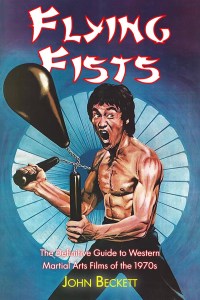 by John Beckett
Telos, out now
The definitive guide to Western Martial Arts films of the 1970’s
Opening with a somewhat self-indulgent but chatty introduction explaining the author’s love of the genre, and how he came to plan writing first a guide to non-Asian martial arts films in the 1990s, then the 1980s, before figuring out it’d be best to start with the 1970s, this is perhaps misleadingly titled. Not in the sense of the subject matter, but in the ambition to be – and actually this is not a negative opinion on the matter – the “Definitive Guide.”
This is misleading in the sense that the book isn’t actually really a guide. Yes, it covers many – not all of the – films in the stated genre, and contains a nice level of trivia and information about most of those, but it doesn’t really fit a typical guide format. Rather, what this reads as is a very entertaining and frequently informative memoir or commentary on a decade of non-Asian martial arts films.
Which means, while not fitting the “definitive guide” label, it’s a wonderfully accessible chronological tour through a decade of a fairly niche genre, written quite conversationally by an author who clearly knows and loves his subject, both in terms of Asian action and Italian genre films in particular. This format means that rather than being able to look up information in convenient sections (some films are given a trivia section, others not) all the information, opinions, and so forth, are mixed into each spoilerific plot summary.
Though mainly about the 1970s, the opening chapter covers the development of this genre – including TV series – prior to Enter The Dragon in 1973. This is a nice whistle-stop tour, though it would have been nicer if 1970, 71, and 72 had each got a proper chapter. This opening tour covers films and TV, briefly touching on the likes of The Avengers and The Man From UNCLE while rather oddly not mentioning the latter show’s Karate Killers compilation, or the properly karate-themed Avengers episodes.
Once into the main chapters, each covering various films in a given year, followed by a section of “honourable mention” entries, and then an “also released.” Strangely, some of the “honourable mention” entries are longer than some of the main entries. That gives a slight air of the main entries being the ones that Beckett spent most effort or money tracking down, rather than necessarily the most notable or enjoyable. Not that a work on a genre has to restrict itself to good examples, and if you’re a fan, here you’ll find a good mix of chat about old favourites, recommendations for little-known gems to track down, and awful flicks to avoid.
There are also some chapters in between, such as one about Bolo Yeung, one about Italian Easterns, and so on, which themselves would make excellent choices to be expanded into books on those subjects themselves, and it’d be a great pleasure if Beckett followed up with those.
There are some typos and minor errors, most immediately starting with the apostrophal abuse in the subtitle, but also, for example, at one point crediting Angela Mao-Yin as Angelo. These are pretty few and far between, though.
There is some lack of consistency in Chinese naming conventions, especially in the second quarter of the book. Where anglophone names read given name then family/surname, Chinese names go family/surname then given name, so it’s understandable that for over a century Westerners have switched them round. In this book, this happens sometimes and not others – Lam Ching-Ying is referenced as Ching-Ying Lam, and Ching Shih as Shih Ching, but then famed Shaw Brothers director Chang Cheh is referred to both as Chang Cheh and Cheh Chang… It’s even more confusing when Asian actors with blended English and Chinese names come into it, with poor old Peter Chan-Lung referenced as Peter Lung Chan.
The format is very much a means for Beckett to chat to the readers through the page, and many of the entries feel like a short DVD commentary or convention panel expositions, which is a pleasurable read, avoiding any danger of dry academia. Most criticisms really would be down to personal taste over whether this or that film deserves to qualify or not, and every reader is going to have a different opinion. It is a little uneven with regards to some of the “also in that year” films getting longer entries than some of the main entries. In this sense, and with the rather chatty format of commenting through a plot summary, this is not really a “definitive guide.”
It is a great beginning to what hopefully will be a companionable series – Companion To Western Martial Arts Films Of The 1970s would be a spot-on subtitle – with those promised 80s and 90s volumes to come. Beckett might be warned, though, that by the time he gets to the 1990s this format of volume will need more 990 pages… 9/10
David A. McIntee
.
 Doctor Who News Star Trek News
 Sci-Fi Bulletin: Exploring the Universes of SF, Fantasy, Horror and Spy-fi!