Interview: Rio Youers
Rio Youers’ latest novel The Forgotten Girl was published in the UK by Titan this week, and is another gripping supernatural thriller (read our review here). To mark publication, Youers […]



Rio Youers’ latest novel The Forgotten Girl was published in the UK by Titan this week, and is another gripping supernatural thriller (read our review here). To mark publication, Youers […]
 Rio Youers’ latest novel The Forgotten Girl was published in the UK by Titan this week, and is another gripping supernatural thriller (read our review here). To mark publication, Youers answered a few questions from Paul Simpson…
What was the first time you felt you knew you had to be a writer or is it something that’s just been part of you as long as you can remember?
I’ve been writing stories for as long as I’ve been able to form sentences, so I guess it’s always been inside me. A part of my DNA. I used to steal exercise books from school, take them home, and fill them with wild tales. Pages upon pages of pencilled scribble (and occasionally some very bad illustrations), and I did that up until I got my first typewriter at the age of sixteen. This thing was a beast. A heavy, electric contraption that, when I plugged it in, would tick and hum like a refrigerator, and striking any key produced a loud and satisfying clunk. My bedroom was littered with those little sheets of Tippex paper, completely covered on one side with odd letters and half words; I became quite accomplished at getting the maximum mileage out of them.
That’s around the time I knew I wanted to make money writing stories, and (hopefully) do it as a full-time job. I submitted my first short story for publication in 1987. I was sixteen years old. It was called “The Dog” and it was not good. It produced one of the quickest rejections I’ve ever had. But the idea of having a story published, in a real magazine, was incredibly intoxicating—consuming, even. The rejection fuelled me, and it’s a fuel I’ve been running on ever since.
 What drives you as a writer? Is it telling the stories, creating the characters or the world in which they live, for instance?
It’s all of those things. The entire process… taking an idea—a flicker in the deep well of your mind—and making something out of it, hopefully something important, and good, and enriching. To create concepts and characters that are believable, and that can entertain and inspire others, is a certain kind of magic.
Moreover, as I mentioned in my previous answer, writing stories is in my DNA. This is what keeps my skeleton upright, as much as my heartbeat and the blood that runs through me. Without writing, I think I would crumble.
Which writers have inspired you?
There are too many. I’m inspired, always, by great storytelling, great fiction, and great writing. Graham Greene is one of my favourite writers; whenever I read one of his novels I am inspired—challenged—to write something amazing. Whether or not I manage this is a matter of opinion, but the inspiration is always there. I could say the same about Gillian Flynn, Dennis Lehane, and Emma Cline: pure storytellers who make me want to be the best I can be.
I’m also inspired by storytellers in other mediums—in movies, TV, comics, and music. There’s a richness of story out there, an abundance of beauty and creativity, and I only wish I had the time to absorb it all.
 Do you plot everything out before you start writing, or are you more “seat of the pants” when writing the first draft? Did that change transitioning from shorter stories to full length novels?
Seat of the pants, all the way, for novels and short fiction. I mean, I usually have an idea of what I think is going to happen, or what I’d like to have happen, but it doesn’t always work out that way. I rarely know how I’m going to get to the key scenes lined up in my mind, or how to make them viable. I just trust that everything will fall into place. Often this requires some reworking of pieces, and I might sketch out a few things, but the process is invariably an act of absolute faith.
Of course, signing with a major publisher requires providing them with an outline (they like to know what they’re spending their money on). I don’t put any pressure on myself to stick to this outline. I let the story breathe and take me where it wants to go. There’s usually enough crossover at the end for the publisher to feel I’ve given them what I promised.
That said, I understand the appeal—the security—of writing to a strict, meticulous outline, to knowing that your book has a beginning, a middle, and an end, and how you’re going to fill in all of the spaces you need to. But that, to me (and all writers are different), feels too much like working inside a tight box, clipping your own wings, and telling stories (again, to me) is a liberating, freeing act. I want to see how far I can fly. There’s very little engineering. It’s a blind journey into the unknown, and it’s exhilarating.
What was the spark that triggered the new novel – a particular incident, or a character?
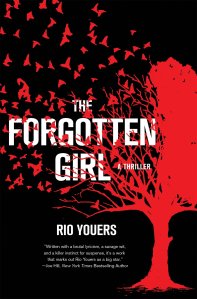 The Forgotten Girl is about an incredibly powerful young woman, Sally Starling, who has the ability to steal memories. We learn early on that she has deleted key parts of her boyfriend’s memory, to protect him from her perilous life, and from the dangerous men who will stop at nothing to find her. The story explores multiple themes—love, family, the unquenchable desire for power—but its underlying theme is memory, and how it defines us.
The writing of the novel was triggered by two things. Actually, three. Firstly, I had developed a pitch (it was for the X-Files comic, actually) where Mulder and Scully investigate a town plagued with early-onset Alzheimer’s, and discover a young girl in a nearby foster home who can steal memories. The comic didn’t happen, but that memory-stealing girl stayed firmly in my mind. Secondly, I’d previously had an idea for a novel about a vampire that fed on memories instead of blood, but shelved it for numerous reasons—not least because I felt the world didn’t need another vampire story, however different the concept. Thirdly, Jaime Levine, then at Thomas Dunne Books, was building her client list and asked me to pitch her a few ideas (she’d read my work and wanted to get something going with me). I was incredibly keen to work with Jaime, so I drew on the two previous ideas, reworked them, introduced a host of new concepts, and The Forgotten Girl was born.
The novel was originally published in North America by St. Martin’s Press, and I’m absolutely thrilled to have Titan Books bring it to the UK.
John Connolly notes that he always ensures that there’s a “real world” explanation for all the supernatural event that Charlie Parker gets involved with; do you try for the same thing, or do you (and therefore to an extent your characters) embrace that side of it?
My priority is to make sure the story is engaging, that the characters are well presented, and that everything is as believable as it can possibly be. This latter is not always easy, particularly when you’re dealing with supernatural elements, but I insist on giving them credibility whenever, and however, I can.
So yeah, I think it’s a little of both. Some subjects are difficult to embrace, but with a foundation of strong story and character, and some well-handled research (science has an explanation for everything), it’s possible to lend credence to the unreal. But the story comes first, and if that means the reader has to disengage from what’s possible for a little while, then so be it.
 What did you find most challenging about writing – and what’s the most rewarding aspect?
The beginning (of a novel or short story) is always a challenge. Being at the bottom of the mountain, and knowing you have all that climbing ahead of you… I mean, it’s exciting, because adventure awaits (and being a seat-of-the-pants writer, I rarely know what those adventures will be), but it can often feel overwhelming.
The most rewarding aspect, for me, is when I nail a particularly difficult scene. I invariably go into such scenes wondering if I have the skillset to pull them off, and when I do… it’s the best feeling. It doesn’t always happen. I rely heavily on my beta readers to tell me if I’ve done a good job, or not. But occasionally I’ll go back through a challenging scene and feel that I knocked it out of the park. I love that.
And getting feedback from readers, of course. These mountains we climb… it’s a lot of work, hundreds and hundreds of hours, so when a reader responds positively to what I’ve given them, that’s a wonderful, beautiful thing. And it never grows old. I still get reader feedback on Westlake Soul, and it always fills me with joy. (That was a tough, tough mountain to climb.)
 And finally, what did you learn from writing The Forgotten Girl that you’ve carried forward into your next book?
I learn something new from every book, every story. The Forgotten Girl was no exception. This was the first book I had sold before writing it, which is both incredibly comforting and utterly terrifying. So I learned to trust myself, to work to a strict deadline, and to know that I am part of a team that is committed to putting out an exceptional product. Whether we managed it or not is up to the individual reader, but we certainly tried.
The Forgotten Girl is out now from Titan Books. Click here to order from Amazon.co.uk
 Doctor Who News Star Trek News
 Sci-Fi Bulletin: Exploring the Universes of SF, Fantasy, Horror and Spy-fi!