Interview: Simon Stålenhag: Tales from the Loop
Simon Stålenhag is the creator of Tales from the Loop – a collection of intriguing artwork that combines everyday items and landscapes in Sweden with science fiction artefacts. The book […]



Simon Stålenhag is the creator of Tales from the Loop – a collection of intriguing artwork that combines everyday items and landscapes in Sweden with science fiction artefacts. The book […]
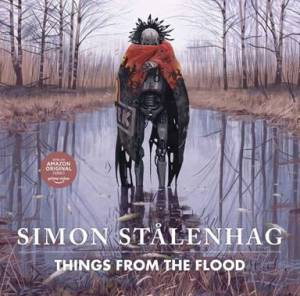
 Simon Stålenhag is the creator of Tales from the Loop – a collection of intriguing artwork that combines everyday items and landscapes in Sweden with science fiction artefacts. The book accompanies the art with a detailed backstory regarding The Loop and its effect on the people living above it. The Loop has now come to the small screen, courtesy of Amazon Prime, and to mark the publication of the book in English and the launch of the TV show, Paul Simpson spoke with the artist…
The paintings in Tales from the Loop are very distinctive. Did you have a Eureka moment when you amalgamated the elements in this way? Or was it happenstance?
It sort of happened. I remember doing the first twisted version of a Swedish landscape, when I was 17, in 2001. I’ve always had a fascination for Swedish landscape, and the everyday mundane stuff on it like road signs, cars, whatever. That’s been with me since I was a teenager, or even a kid. I was ten years old, or even younger, when I started to do watercolours – I wanted to paint a bird in our backyard. I was already trying to capture those everyday experiences with art.
That part has been with me since the beginning but then the actual science fiction stuff started later when I started working with the concept artists in the videogame industry and I learned the craft of designing robots and creatures. When you do that it becomes a muscle memory – like when you learn a new chord, you use it in all your songs. I started to do that when I was 25 or so, when I was working as a concept artist – I wanted to combine that with the Swedish landscape, so I did that in my spare time on weekends.
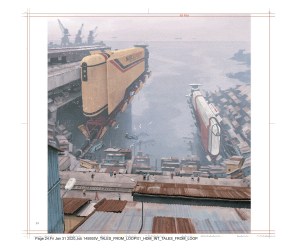
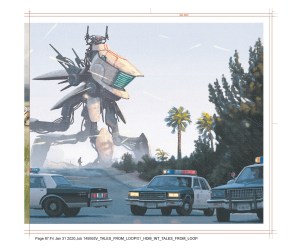
There was this moment when I felt like it was working – I think it was a dinosaur standing in an orchard. I felt aesthetically very pleased with it. I felt I should do 20 of these, and that was what became Tales from the Loop – and that picture is in the book.
 There’s a quite detailed backstory laid out in the book; did you have that in mind in embryo form when you were preparing the art, or have you had to retcon all of it?
It was happening at the same time. Maybe I had done 10 of the 60 pictures in the book when I started writing. I always knew it was going to be some sort of government agency thing.
I was inspired by a picture that had the Swedish telephone agency logo. The government agency that ran all the telecommunications in Sweden had this very iconic logo. I wanted to do a utilities vehicle that had that logo on it, but I knew I was going to do my own government agency with its own logo that looks similar to it.
I hadn’t figured out the exact idea of what they were doing – was it particle physics? Something that would leave these artefacts around. I guess that’s why I chose high energy particle physics – you don’t really understand it so you can do anything! There’s very few people who will actually say that those things are not compatible with high energy particle physics research. You can do anything – you can even do dinosaurs because you can do time warps!
 I love the little things like the two brothers swapping bodies, and the ripple effect – it felt as if you were wondering how weird could you get with it.
I was also inspired by a Swedish role playing game that came out in the 1980s that I played as a kid. Starting in the 90s, we became used to using English words for tech stuff, so there’s a lot of it now, but when they wrote games in the 1980s they used the Swedish language for everything. They had names for every little artefact that you could find in the science fiction world, and that had a certain tone. I wanted to write a Swedish science fiction prose that didn’t use any English loan words that you see all the time today.
I remember the technical prose about these things, and the names you would call these things – I came up with words for things without knowing actually what they did but they felt like a typical Swedish gizmo! That was almost a poetic thing – I want to write these words and it’ll have a meaning to people who read Swedish without me even explaining them. That was part of the inspiration for the writing.
Did you prepare the English version?
It was translated by a Swede who is very knowledgeable in the genre and is active in the Swedish community, but he’s also lived and worked in the US. To me it was more important to have somebody who was really familiar with the references and the world in Tales from the Loop. In later books he did the first translation and, for Electric State, we had Americans who read his translation and came up with suggestions. It’s very close to his translation.
 It retains that Swedish feel and doesn’t feel homogenised in any way…
That’s good.
Was there a temptation when the book was being translated and brought to a new audience to tweak any of it, or have you kept it so it’s as near to the original text as it can be if you’re reading in a different language?
I’m not sure. It was a long time ago we did the translation – five or six years ago – but I don’t remember us doing anything. All Western European countries are very similar in the post-war era – that’s where the Loop comes from.
There’s references to pop songs and we kept those – it would be weird to change those because it’s set in Sweden. For me, if you don’t understand the reference, it adds some sort of flavour, like the logo – you know it has meaning. There are a lot of Swedish references that Swedes don’t get! It gives the feeling that it’s specific, and that’s worth something too.
 For Electric State, set in America, how different was that for you to create?
It was more academic in terms of research. I still do the same process but putting the book together and writing I had to make sure I didn’t make any stupid mistakes. Those things I know intuitively in Sweden – what kind of stores were around in 95 or whatever – but this is set in Northern California.
At the time I was working on it, I had already gained a lot of followers on Twitter so I could ask the ones who were brought up in Northern California, where would you go to rent a movie or whatever. I could do pretty good research and people sent me their own private photos of places – “this is the drugstore we used to go do, but it went bankrupt in the early 2000s” – so I could use these specific things without having experienced them myself.
I only used them for background details, not for the narrative itself because that would have felt weird as I didn’t know these details personally. They were part of the background visual setting. For the writing I went back to my own memories, how it felt to be a teenager in those situations – it’s not autobiographical but it includes stuff that isn’t culturally dependent.
 Have you been tempted to do anything in English?
I thought about it for Electric State – there’s no word for strip mall in Sweden, we don’t have those things, so I felt like the translation was going to be the first language in a way. I wrote it in Swedish because it’s my first language but I came up for suggestions for the translations. That was just for a few select words and concepts but the bulk of the prose has to come from an emotional place and for me Swedish is the only language, it’s the one I learned growing up.
It’s your heart language, not your head language.
Exactly.
I was told years ago that you know you’re truly bilingual when you dream in the other language. When you’re writing in another language you’re describing emotions rather than feeling them.
Yes – and you can always translate it. It’s interesting – you get two versions. I like the Swedish version and I also like the English version – they have different qualities.
I can actually understand the English text rather than all the others my work is translated into, so it’s nice to have two versions. I quite like that translation process.
 What was your reaction when you saw the TV show?
It happened in stages. I saw the script, then I saw it without special effects, then with special effects, and I was designing some stuff that was in it.
It was a feeling of ever-increasing weirdness – it looked like a TV show that I would watch but based on my own book. It wasn’t an instant shock because it’s been something that’s going on for the last six years for me.
Six years ago was the first time we talked about this; over the years maybe once a year there’s been something happening – the first draft written, then going into pre-production. I’ve been [kept] informed, and asked to feedback on certain things.
I did some design stuff on minor things. Everything is in the book; they’ve been very faithful to the book, it’s only been when there’s been key things – there’s a prosthetic arm that one of the characters has. Nathaniel Halpern the showrunner asked me to design the arm, as well as another plot device that was very important.
The last thing I did, which was quite unexpected, was the opening titles. I’m not a motion graphic designer at all but they had not found any concept that they liked so Nathaniel asked me if I had an idea. I did a simple animation and that looks pretty similar to the one that’s in the show.
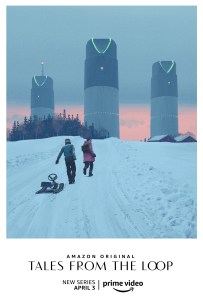 It’s very distinctive, which is what the show needs. You don’t want people feeling safe at the beginning. What are you currently working on?
I’ve just finished my fourth art book and it’s being edited and translated.
The art is something I suspect I shall be sitting and looking at and enjoying and making up my own stories.
It’s meant to be that way – it’s an art book, so it’s something that works very well without the text I think.
Tales from the Loop is now out from Simon & Schuster; click here to order from Amazon.co.uk
Tales from the Loop – the TV show – is now available on Amazon Prime
Thanks to Jamie Criswell for help in arranging this interview
 Doctor Who News Star Trek News
 Sci-Fi Bulletin: Exploring the Universes of SF, Fantasy, Horror and Spy-fi!