Interview: Sam Hawke (City of Lies)
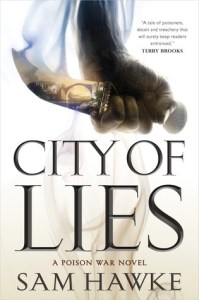
Sam Hawke’s first novel, the epic fantasy City of Lies, is published this week in the UK by Bantam. Hawke is a lawyer by training, but has now moved over […]



Sam Hawke’s first novel, the epic fantasy City of Lies, is published this week in the UK by Bantam. Hawke is a lawyer by training, but has now moved over […]
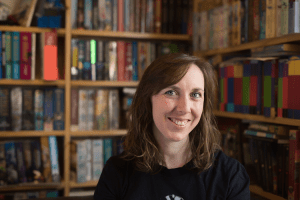
 Sam Hawke’s first novel, the epic fantasy City of Lies, is published this week in the UK by Bantam. Hawke is a lawyer by training, but has now moved over into the literary world. Throughout the process of seeking agents and writing her novel she’s been balancing parenthood to two children. Australia based, Sam enjoys SFF whether on the big or small screen and is also a black belt in jujitsu as well as having trained in karate, judo, kobudo, tai chi, BJJ, boxing and krav maga – and among all that found time to answer some questions from Paul Simpson…
What drives you as a writer? (Is it telling the stories, creating the characters or the world in which they live, for instance?)
Oh, what drives me changes from day to day. Deadlines nipping at my heels certainly play a part. The desire to tell stories about worlds and people that I want to spend time with, maybe? To make myself feel things? I’m not precisely sure. I think perhaps I’m just wired to want to tell novel-sized stories. I know I spent hours wandering around my garden in primary school narrating my games in novel-style like I was reading a Famous Five story aloud, so something in my brain clearly liked the format pretty early on, and I never grew out of it. (To be clear, I don’t narrate myself in everyday life anymore, though my son does so clearly I’ve passed on the genetic curse).
What was the initial inspiration for City of Lies?
I had the idea that I wanted to write something about a poison taster, which was partly inspired by thinking about terrible jobs in history and partly by reading about supertasters – probably because I’m a bit obsessed with food – and combining the two. With that job as a beginning, my main trio of characters sort of stepped out of the shadows, asking me to make a story around them. I had a strong sense of who they were, what was important to them and what they meant to each other.
Everything came from that core position – all the worldbuilding was essentially about determining what kind of society might have had such a ‘proofing’ role and how those three characters got where they are. Then, of course, I set about poking them in all the places that it would hurt the most.
Fantasy has always been my favourite genre but I’m also extremely fond of crime and of old spy thrillers and a good suffocating, tense, closed-room mystery, so City of Lies was my hat tip to a bunch of different things that I like reading.
Was City of Lies your original title for it?
It was originally called Proof, which I thought was a nice punchy word that called to mind both the profession that was the subject of the story, and also implied a kind of crime/mystery bent, as well. Yeah, I’m bad at titles. I think I suggested about 1,400 different ones to my editor before we finally settled on City of Lies.
 The first line has justly received praise – was that one of those lines that came naturally?
Absolutely. It was the first sentence of the book that I typed out and it never changed once. (It might be the only sentence in the entire book that has that honour…)
Did you plot the entire story arc out for the Poison War series before you started writing, or did you allow yourself the option of going down side alleys with the story when you were writing it – which might change later books?
Haha, I wish! That would have made writing the sequel a lot easier. No, the original draft of the book was entirely a standalone, so it was only in later versions that I was actively working to develop some threads that would feed into the next story. I had only the vaguest broad stroke ideas for the continuing story when I finished City of Lies.
In terms of the worldbuilding, some writers know every detail before they put “pen to paper” (the price of milk, the economic fluctuations that the arrival of a giant would bring!), others work it out as they proceed with the writing – which works for you?
Oh, boy, yeah, definitely the latter. I’m both too lazy and too distractible for the former. I basically chase the story around and frantically try to slap up a framework around it as I go. If I tried to plan all the worldbuilding stuff in advance I’d go down a zillion interesting looking rabbit holes to develop a detailed infrastructure for the dairy industry and then all I’d have would be milk and no story. I can’t be trusted with anything that gives me the chance to procrastinate.
 Are there aspects from your background as a lawyer that you’ve found either particularly helpful, or unhelpful, when writing fiction?
Only that I’m very used to sitting down for long periods of time, staring at a gleaming box and making tiny movements with my fingers. The butt-in-chair part of writing exists in both jobs. Though that’s a curse as well because it does mean I spend far too many hours a day at a computer. My hands will probably fall apart before I’m 60. I probably should have been a zookeeper after all.
What did you find most challenging about writing the book?
First drafts are the worst for me. I love editing but I find it quite hard to switch off the critical part of my brain and just get the story down without agonising over every paragraph and moving words around.
And, counterpoint to that, what was the most rewarding aspect?
Ha – is there any other answer than ‘finishing it’?
City of Lies is published on August 23rd by Bantam. Thanks to Hayley Barnes for her help facilitating this interview.
Author photograph (c) Kris Arnold Photography, used with permission
 Doctor Who News Star Trek News
 Sci-Fi Bulletin: Exploring the Universes of SF, Fantasy, Horror and Spy-fi!