Interview: Marie Brennan
Marie Brennan is a former academic with a background in archaeology, anthropology, and folklore, which she now puts to rather cockeyed use in writing fantasy. She is the critically acclaimed […]



Marie Brennan is a former academic with a background in archaeology, anthropology, and folklore, which she now puts to rather cockeyed use in writing fantasy. She is the critically acclaimed […]
 Marie Brennan is a former academic with a background in archaeology, anthropology, and folklore, which she now puts to rather cockeyed use in writing fantasy. She is the critically acclaimed author of the Lady Trent series, as well as the Doppelganger and Onyx Court novels, six novellas and more than thirty short stories. She won two Isaac Asimov Award for Undergraduate Excellence in Science Fiction and Fantasy Writing Grand Prizes. Her latest novel, Turning Darkness into Light, is set in the same world as the Lady Trent series, and is out now from Titan and to mark publication she answered some questions from Paul Simpson…
What was the inspiration for Turning Darkness into Light?
 Oddly, the inspiration was not what I ended up writing!
Several people had asked me whether I was thinking about writing anything else in Lady Trent’s world. But on one specific occasion, while I was giving my standard spiel about how I’d love to write a kind of “non-fiction” companion book if a publisher was interested, I got ambushed by a fiction concept: a sweeping historical novel, framed as having been written by somebody in Lady Trent’s own country, about the downfall of ancient Draconean civilization. After a while, though, I realized that writing about the collapse of a civilization would be depressing – so it morphed into something more mythological – and then it took a giant sideways step to what I actually wrote, which is the story of Lady Trent’s granddaughter translating a mythological epic, intercutting between the epic itself and what’s going on around it, with lots of hijinks and politics and complications.
 Was it a story that you felt had to be told in a different time period or could the core elements have worked elsewhen?
Certainly with what’s been established about the world so far, it needed to be told in this time period, because the Draconean language wasn’t deciphered until fairly recently in their history – before that, they wouldn’t be able to read the epic at all! And later on the field would be more established, with less room for groundbreaking discoveries. The general vibe of the setting at this point is the 1920s, and that part wasn’t necessary to the story, but I liked it as an update to the more Victorian era Lady Trent was writing about.
Had you always intended to write standalone tales alongside the main books, or was it circumstance?
I didn’t initially plan to do more than the five volumes of the Memoirs, no – though I have written some short fiction. “From the Editorial Page of the Falchester Weekly Review” takes place between Voyage of the Basilisk and In the Labyrinth of Drakes, and doesn’t require knowledge of the series; I wrote that while on book tour for Voyage. Also, Uncanny Magazine just published “On the Impurity of Dragon-kind,” which I wrote as a riff on a Tumblr discussion about dragons and Judaism.
 What was the biggest challenge about writing this story?
The structure. Oh my god, the structure.
The Memoirs of Lady Trent are, as the name suggests, written as memoirs – an in-world kind of document. “From the Editorial Page” is dueling letters to the editor, and “On the Impurity,” which I wrote after Turning Darkness Into Light, is written as a dvar Torah, a sermon about a particular bit of scripture. The mythological part of this novel was obviously going to be a translation of the original text… but what about the rest? I could theoretically have written it as an ordinary novel, but that would have broken the pattern for these stories.
As I was pondering this, what wandered into my head was a newspaper article: STUPENDOUS FIND IN AKHIA! followed by a letter between two of the characters. And at that point I was off and rolling, not with a single type of document, but a carefully-assembled mosaic of articles, letters, diary entries, police reports, and more. That took quite a bit of wrangling all on its own – but I also had to pay attention to how rapidly my characters would be able to translate the epic, and pace the rest of the story around their progress through that. Plus it took me until I was nearly done with the first draft to notice that what I was writing was, in many ways, a mystery novel. Which isn’t something I’d ever tried to do before, and it might have been easier if I’d realized it a little bit sooner…
 Dragons have become very much part of the landscape once again – what makes your take on them different to someone who doesn’t know the books?
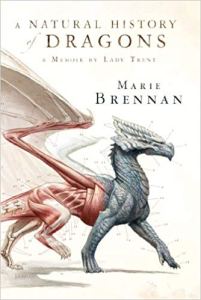
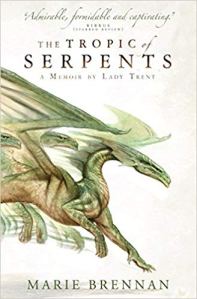
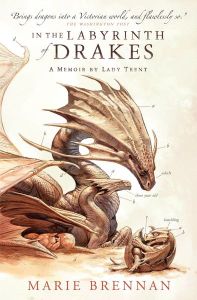
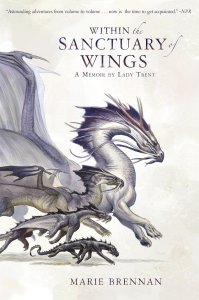
The dragons in this world aren’t magical, sentient creatures like Smaug. They’re natural animals, albeit ones whose evolution works a bit differently from the other animals around them – which occupies some of the plot of the Memoirs. I wanted Lady Trent’s work to be field biology, not anthropology (which is my own background).
It’s being promoted as a good introduction to the world of the Draconeans – but have you included “Easter” (or dragon) eggs for those familiar with the series?
Lady Trent herself is kind of this inescapable presence in the background. I kept her mostly offstage, except for one flashback scene, one letter, and one appearance at the end, because I didn’t want her to overshadow the story… but at the same time, part of the story is how her granddaughter lives in that shadow, and measures everything she does by what her famous Grandmama has done. I think that’s something a lot of readers will be able to empathize with, even if they hadn’t read the Memoirs. (If you had an elder sibling go through the same school system as you, then you know exactly what it’s like to always be thought of as so-and-so’s relative.)
What did you learn from writing this that you’ll take forward into your next writing projects?
 That it helps to notice you’re writing a mystery novel before you’re three-quarters of the way through the draft…
And also certain things about characterization. Writing from multiple points of view isn’t a new thing for me; many of my novels before the Memoirs feature at least dual protagonists, and sometimes several other minor viewpoints. When you do that in third-person narrative, though, there’s a degree of standardization imposed by the techniques of third-person perspective. But the nature of this book means it mostly consists of first-person texts – diary entries, letters, and the like. Which meant that when I switched from Audrey to Cora or Kudshayn, I had to really embed myself in the characterization: what would they choose to record? What kind of documents would they even be creating? Those weren’t questions I was accustomed to asking, let alone answering, and I think it added a lot of depth to how I envisioned their personalities. If I can keep that while working in a more conventional format, I think it will be very beneficial.
“On the Impurity of Dragon-kind” is now free to read on Uncanny’s website: https://uncannymagazine.com/article/on-the-impurity-of-dragon-kind/
Turning Darkness into Light is out now from Titan Books

 Doctor Who News Star Trek News
 Sci-Fi Bulletin: Exploring the Universes of SF, Fantasy, Horror and Spy-fi!