Interview: Frank Hinks (Tales of Ramion)
Frank Hinks’ Tales of Ramion is a fast-paced contemporary fantasy series for younger readers, illustrated by the author, out now from Perronet Press. By day, Hinks is a Chancery QC […]



Frank Hinks’ Tales of Ramion is a fast-paced contemporary fantasy series for younger readers, illustrated by the author, out now from Perronet Press. By day, Hinks is a Chancery QC […]
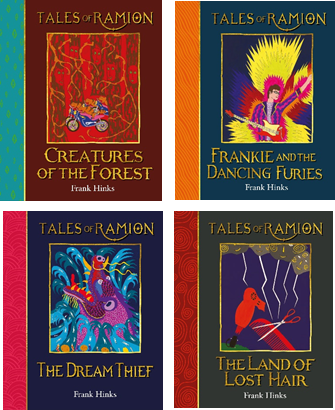 Frank Hinks’ Tales of Ramion is a fast-paced contemporary fantasy series for younger readers, illustrated by the author, out now from Perronet Press. By day, Hinks is a Chancery QC but away from the heady world of the law, he indulges in his storytelling – and to accompany the release of the books, he answered some questions from Paul Simpson…
What’s the first story you can remember hearing as a child?
I learnt the art of storytelling at the age of two or three sitting on my grandfather’s knee. He would take a real family incident and turn it into something fantastic. The first story I remember (and my grandfather’s party piece for me as a very young child) was the dark night when his father drove a horse and cart into the pond at Blackheath. He never explained how it was that his father (an experienced horseman) came to make such a dreadful mistake. I now fear that it may have been an early example of drink driving. Sitting on my grandfather’s knee we would be riding along, riding along, with me getting more and more excited in anticipation of the moment when the cart would hit the pond and I would be spun upside down through the air and with a great splash into the water.
Later stories were more sophisticated, starting with a real family incident, (such as a fight with bull rushes between local boys and my grandfather when he was evacuated to a Sussex village in the First World War) but suddenly taking off into realms of fantasy (as seed from the bull rushes enveloped the entire village). I was left sighing, “Why do adventures like that not happen these days? Why has life had become so boring?”
 What was the first story you wrote yourself – and how old were you?
There were probably previous stories, but I did a series of illustrated stories at the age of around 8. None has survived complete. The stories starred flying horses, and magic wishing wells. I sometimes think that I have not changed much at all.
The paintings are very distinctive in style – how did that develop?
As a child I always wanted to be a writer and a barrister (when watching Perry Mason on the TV I told my Great Aunt Dora that that was what I was going to be when I grew up). I was good at art: one school report said that I had a style all of my own and at age 10 I had a picture of Viking long-ships in an exhibition in Bromley Library. But I never had the slightest thought that art might form an important part (or indeed any part) of my life. At Bromley Grammar I became obsessed with getting A grades and a scholarship to Oxford and (with a total lack of self-knowledge as to what I needed to lead a fulfilled life) gave up art completely.
After getting a Double First at Oxford my creative side fought back briefly and I painted a few pictures and wrote some poetry. But I swiftly abandoned art again until after I wrote the first 12 Ramion stories in 1991 at the age of 40/41. The stories needed illustrations. My wife (an abstract painter and art lecturer) was not going to do them. I thought I could manage a few pin men. She treated me like one of her students, ripping apart (metaphorically) everything I produced. I committed every error known to woman: false attachment etc. But as with my legal studies and practice at the Bar I was focused and persevered. I was not allowed any amateurish shading. Lines had to be clean cut. The concept behind each drawing was critically important. For around four years I just did black and white ink pen drawings illustrating seven stories which were produced on a small scale in aid of charity. I then turned in 1995 to colour. My wife suggested that I paint in gouache (opaque water colour) with flat plains of colour. To paint flat plains of colour in gouache is technically not easy (the paint has to be mixed to precisely the right consistency), but in the end I satisfied her and achieved my current style.
The stories have one foot firmly set in the “real” world – did this develop from the way that your son reacted to the stories?
As stated above this style of story-telling was learnt from my grandfather at the age of two or three. It enables the stories to be grounded in reality (albeit a surreal and absurd reality), distinguishing them from fairy tales.
 What’s the biggest challenge for you in creating them (both in terms of the stories and the illustrations)?
On the whole the stories came easily (although the idea for The Dream Thief knocked around my brain for around 15 years before it came to be written). They arose out of years of bed-time storytelling for Julius (the most demanding of children) who wanted a different original story every night. But he would help me saying, “Dad tonight I want a story about the witch Griselda (who had purple hair like his artist mother) and the rabbit Scrooey-Looey (a glove-puppet bought by my wife from a magic shop in Charing Cross Road) and it starts like this….” He would then give me one sentence and I would have to take over with no idea where the story was going (save that in the end the witch was never allowed to eat the children). Of course, the stories told at bed-time were not good enough without much changing (the idea of Ramion came to me in a flash whilst walking down Oxford Street returning from an antiques market) but most of the characters and many of the situations had already evolved thanks to Julius (who remains a source of inspiration at the age of 34).
To begin with creating the illustrations was very hard. Each page of text needed a full-page illustration. Some of the surreal text was hard to illustrate. I had to think very hard before I could produce any illustration. I had to learn to think in a very concrete way about the images I described when writing. However, I think that this lack of easy facility was one of the factors which helped me ultimately to produce a distinctive style. Now I know how to go about producing the 35 illustrations needed for a new story: I have a clear process starting with an original tiny pencil drawing. The illustrations still take many many hours of work, but it is much easier than at the beginning.
What element of these are you proudest of?
In relation to the writing I am proud of being able to combine adventure and humour in an original way that can be enjoyed by children and adults (or at least some adults). In relation to the illustrations I am simply proud. I started with such low expectations that I find it extraordinary that I could have produced the best of the illustrations to a story such as The Dream Thief.
Do you think your legal training assisted with developing the narratives, in terms of looking at things for errors and gaps in logic?
I think that my training as a barrister principally helped me in being focussed and directed: using my spare time to best effect. It may at times have helped me to see errors and gaps in logic, but the best moments in the stories are when they defy logic and suddenly move to a different plane, such as when the roof of the cavern beneath the Dream Thief’s castle explodes, dreams return to those from whom they have been stolen, the dream unicorn comes alive, and draws the greyness from the Land of Dreams. These moments do not come from the lawyer in me.
Click here to order The Dream Thief from Amazon.co.uk and check out the other stops on the blog tour:

 Doctor Who News Star Trek News
 Sci-Fi Bulletin: Exploring the Universes of SF, Fantasy, Horror and Spy-fi!