Interview: Christopher Paolini
Christopher Paolini began writing the Inheritance Cycle aged 15, and at the start of this year returned to the series with The Fork, the Witch and the Worm – a […]



Christopher Paolini began writing the Inheritance Cycle aged 15, and at the start of this year returned to the series with The Fork, the Witch and the Worm – a […]
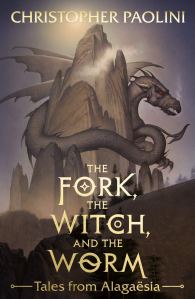 Christopher Paolini began writing the Inheritance Cycle aged 15, and at the start of this year returned to the series with The Fork, the Witch and the Worm – a collection of tales set in the same world. He answered some email questions from Paul Simpson…
What was the key inspiration for The Fork, the Witch and the Worm – a particular image or a character? – or did you just feel that there were more tales to be told in this world that you had to get out of your head?
Like many readers of the Inheritance Cycle, I’ve continued to think about the world and the characters ever since the last book, Inheritance, came out. After all, I worked on the series from 1998 until 2011. It was a huge chunk of my life. Even when writing other novels, there’s a part of me that’s always wondering, “Hey what is this character up to?” or “Hmm, what would happen if someone in Alagaësia did this?”
That said, The Fork, the Witch, and the Worm, was an unplanned-for book. A bit over two years ago I saw a rather bad movie, and discussing the failings of the plot with my sister led me to write “The Worm of Kulkaras.” I was pleased with “Worm,” but by itself, it was too short to publish. So it sat on my computer, alone and abandoned, until the summer of 2018.
At that point, I got an urge to write a story about Murtagh. The inspiration came from a tweet I’d made to a fan who was curious about Murtagh’s current activities. I made a rather offhand comment about him wielding a magic fork… and for whatever reason, the image wouldn’t leave my mind. Thus “A Fork in the Road” was born.
I sent both that and “Worm” off to my publisher. Meanwhile, my sister, Angela, proposed writing a vignette from the point of view of the character Angela the herbalist (whom I based off her). And hey, presto! Before I knew it, we had an actual book-sized object.
 Which came first – the Eragon thread or the other parts?
The other parts. But in many ways, the framing material with Eragon is the most important, as it provides the backbone for the whole book. When I put down the first few sentences with Eragon, I actually got chills down my spine. It was both moving and somewhat surreal to be writing about him after so long.
You’ve incorporated work by your sister – did you act as her editor or did she work on her material separately?
Angela invented and wrote her section herself. I was delighted to see how well she envisioned the character. I suggested a few tweaks – just as she often does with my own writing – and then it went through the usual final review with my editor.
You’ve mentioned in interviews before that you and she have created a shared universe – are we going to see a lot more material jointly written?
Definitely! I’m finishing up a massive science fiction book in that universe, and she is working on pieces for that world as well.
Are there elements you encountered while writing The Fork, the Witch and the Worm from the previous books in the series that made you go, “I wish I’d done that differently”…?
No, not at all. I told the story I wanted to in the Inheritance Cycle. The few things I do wish I could change are mostly pacing issues, not worldbuilding issues. For example, were I to write Eldest now, I would include another chapter from Nasuada’s point of view when the Varden are traveling to Surda.
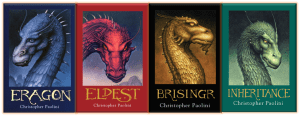 How did it feel going back to “book 1” again after such a long time? Are there things that you’d love to be able to tell your younger self not to stress about?
I’d always imagined returning to Alagaësia with a full-sized novel. However, doing it this way made for a wonderful experience. Getting to dip into the heads of some of the characters from the Inheritance Cycle – as well as a few new ones – was a real treat for me. Writing about Eragon and Saphira after so many years was like returning home after a long journey.
If I could give my younger self any advice, it would be to take a breath and relax a bit. Work hard, yes, but stressing about things you can’t control isn’t helpful.
What was the biggest challenge for you on this book in particular?
Finding a way to tie together three different stories (four if one counts the framing material with Eragon) into a cohesive whole. It was a new experience for me, and I rather enjoyed it. Also, this was the first time my sister and I have officially collaborated on an Alagaësia-related project. It was a learning experience for both of us!
And finally, is there a character or particular scene that you know that you could only have written now that you wouldn’t have felt comfortable doing when you started?
All of them! Our greatest weakness when young is a lack of experience. There’s no way I could have written these stories ten or more years ago. I just didn’t have the needed perspective. With time comes context, and context allows us to see more than we could before.
The Fork, the Witch and the Worm is out now from Penguin Random House Children’s Books. Thanks to Shona Abhyankar for help arranging this interview.
 Doctor Who News Star Trek News
 Sci-Fi Bulletin: Exploring the Universes of SF, Fantasy, Horror and Spy-fi!