Interview: Beth Cartwright
Beth Cartwright’s debut novel Feathertide is released today by Del Rey – a magical tale of a young girl’s journey to the City of Murmurs. A week before publication, Paul […]



Beth Cartwright’s debut novel Feathertide is released today by Del Rey – a magical tale of a young girl’s journey to the City of Murmurs. A week before publication, Paul […]
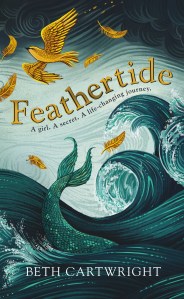 Beth Cartwright’s debut novel Feathertide is released today by Del Rey – a magical tale of a young girl’s journey to the City of Murmurs. A week before publication, Paul Simpson chatted with the author about the book’s own 10-year journey to the bookshelves…
What was the inspiration for the story in the first place? Was it a character or a specific incident?
That’s a difficult one; the only answer is I don’t know. Well, for me probably I always start with a place, so the City of Murmurs came first.
I am a bit weird and quirky so it’s not like a normal place. There’s a bit of magic in it and I think that comes from my childhood. I had a very outdoors childhood: I was in the woods, I was in the streams, I was having treasure hunts, I was trying to find the Magic Faraway Tree.
The city to me is actually a character in the book. How much did it alter as you actually had to do the nitty gritty of the writing?
 For me it’s a reimagined Venice; you might recognise parts of it. It’s not completely Venice but it’s taken from there. For me, two people don’t go to the same place and see the same things. I’d like to think that that side of Venice does exist somewhere – maybe you’ll go down that alley and you will find Sybel and you will find a mermaid somewhere in the lagoon.
It’s that idea of the impossible made possible, and that again is the childhood thing: you go into the forest, maybe you’re going to find a magic tree that takes you to a land in the sky, maybe you’re going to find a little creature like a fairy in a bush or something. So, it’s the idea that maybe that kind of Venice does exist for somebody and somebody might be lucky enough to find it.
I take it you’ve spent time in Venice.
I’ve been twice, just long weekends, quite far apart, like several years apart. The book I wrote over ten years, not in one go – I wasn’t sitting at a desk. Life gets in the way, doesn’t it? I abandoned it for years and came back to it. So I grew as I wrote it.
But the city didn’t really change, it was always just there.
 Waiting to be discovered.
Yes.
When you say no two people go to the same place, it’s also you at age at nineteen and you at age twenty-five or whatever are going to see things completely differently as you would at age forty, age fifty, age sixty…
Yes. You become more cynical, don’t you? (laughs)
Where would you get that idea from? (laughs)
I do.
I think that some of the gloss wears off. You don’t want to be cynical about your childhood places but you see some of the reality behind them.
You mentioned you started the book and abandoned it; what made you put it down? Was it just life getting in the way or did you reach a point with the story where you didn’t quite know where to go?
I’m not very disciplined, that’s probably the main thing. Life gets in the way, you get a full time job. You doubt yourself.
I’m a worrier. I never thought it would happen so it was like, “I’ll do a bit and, oh I’ll leave it now”. I thought I was just doing it for me anyway. It was a dream that it would ever be published and ever be on a bookshelf. So this is very strange.
You have all this self doubt which delays everything and it’s a distraction and then you find somebody that actually believes and that kind of spurs you on a little bit. Then other people get involved and they believe too and then you start to think, “Well maybe this is going to happen”, so that’s the motivation but it took me a long time to get it ready to submit.
It’s a much more character driven book than an action plot. We are learning about the characters from page 1 to page 420. Those characters and their progression – how much did they alter during your writing process?
It was a very different book in the beginning. It wasn’t even set in Venice – it was set in the Red Sea. I don’t know why, I’ve never been there but it was always water. It was always going to be water probably because of the mermaids.
The Red Sea has got that whole floating property and the very weird visuals you get with that.
 I like weird visuals!
It quickly changed from the Red Sea. It’s so subconscious the way that I write. I can’t write in snatched moments. Some people can get up, they can write for an hour and then go off to work. I could never do that. I need hours without distraction because it’s like a trance. You just disappear – you’re in the room but you’re not, your mind’s gone.
Lockdown for me, I didn’t feel locked down because I’ve been writing. I’ve been very far away, I’ve been everywhere.
It’s hard to say how I developed Maréa because I just disappeared into that world. I think my agent, Ariella Feiner, was very editorial, so it was quite collaborative towards the end. She really helped me learn that certain things had to happen in a certain way structurally and shape it more into a book.
What was the biggest challenge for you on the editorial side of it?
 The beginning of it; we grappled with that. It was probably too long in the beginning, and it’s still quite long, but I just felt that we needed to see her in her home environment. There are a lot of ideas that aren’t obvious: at the start she’s in a small port town, so it’s the idea that the port is a place of safety but it’s also a place where things are hardest. They don’t move and it’s a bit like her life there: she’s safe because she’s hidden but she’ll never grow, she’ll never escape, she’ll never live a life that she should live.
The progression is an emotional and mental one but also physical because she leaves that port and she goes to the City of Murmurs, which is a place of canals and lagoons, and then eventually out to the sea. It mirrors the physical and the emotional.
The beginning was difficult but we couldn’t quite work out why other than it was probably a bit long.
Was there anything that you lost that you would have loved people to have experienced with her?
Do you know what? She was absolutely right, she’s been spot on with everything.
It’s very irritating when editors do that, isn’t it?
 (laughs) No she’s amazing, she’s just got the right idea but that’s probably experience, of which I have none.
It was actually the agent that got it where it needed to be and then the editor, Katie Seaman, came and she just added more magic. She wanted more on the City of Murmurs so I did have to go back and put more in about it.
The one change my agent made which I do kind of regret a bit is Sybil’s got dogs but originally she had pigs… but she said ‘No, that’s just too weird now’. (laughs) I had to get rid of them and change them but I still imagine them as pigs, they’re pigs in my mid.
If George Clooney can have a pig anyone can have a pig! How do you pronounce Maréa? Is it Maria or Mar-ay-ya?
It’s Mar-ay-ya. It means “tide” in Italian.
Did you have a very clear picture of her in your mind? When you were writing scenes, were you looking at her in the scenes as you were writing them or were you looking through her eyes?
Probably more through her eyes. That’s an interesting question, I’ve never been asked that, but now that I think about it, more through her eyes. The only thing that’s very clear to me is the colour of her hair; it was always that colour because it matches the feathers.
 What do you think her strengths and weaknesses are?
I think she’s quite a brave character, far braver than I’d be. She sets off to an unknown world having known very little of her own. She’s got that fierceness inside her, she’s got that independence, she’s got the confidence, but I think she’s very innocent, she’s very naive, she doesn’t always get it right.
Who does?
Well yes. I was going to say because she’s young but actually that’s got nothing to do with it, we all get it wrong, don’t we? She’s very loving but perhaps a bit too impulsive in that area and she makes mistakes. So she’s flawed but, like you say, aren’t we all?
You’ve spent a lot of time in her head; what do you think of her as a character? If you were to meet someone like her in our world, would you get on with them?
I don’t know. I don’t think we’d have very much in common but I think I’d probably want to maybe give her some advice and set her on the right track. I’d admire her bravery but I think she’s got a lot to learn.
You mentioned you were writing during lockdown; is this a sequel with the same character?
 No. I’m working on book two. It’s similar in that it’s magical but this one’s a bit darker, a bit more mysterious. It’s similar but different.
Strangely it’s [based on] Italy again – there was a picture I saw in a magazine about twenty years ago and I went there about three years ago. It’s an island in the middle of an Italian lake, very small. I finally went but t I didn’t gather information there. I didn’t think about the book. That came later because I never thought there’d be a book 1 never mind a book 2.
Is it up near Como? Near Bellagio?
Yes, it’s Lake Orta. If you Google Lake Orta it’s usually that image that comes up. It’s got a little wooden jetty and then ahead of you, you can see the island.
If we talk for book 2 at least we know where the image for that one started from!
Yes, it’s a bit clearer than book 1. I don’t know where that was. Strangely book 1 took over ten years, book 2’s taken less than a year.
What’s been the biggest challenge for you of the whole writing process?
Finding the time, being disciplined enough to do it, having enough belief to keep going. The writing is challenging but also the publishing process. I had no idea what to expect. I’m not a member of any creative writing groups, I don’t know any writers. I have no experience. I live far away from London, where it all seems to happen. In fact I’ve only been to London probably twice or three times in my whole life. So, it’s very strange.
Then of course reviewer, (laughs) because I never thought about having a review. It was just a book for me then finally it got picked up and I was told it was going to be published and put on a shelf in a bookshop; I thought my mum would go and buy it and she’d have a copy and I’d have a copy and everything would be great.
But, then of course you’ve got lots of people that have opinions and want to express them and of course they’re entitled to that. It’s all people talking about you and I just wasn’t prepared for that… and it’s not even out so I don’t know what‘s going to happen when it is. I’ll just go and hide I think. (laughs) It’s hard, you do your best; people like it or they don’t and it’s the same with every book, every product.
 I’m brand new to this. Nobody I know has read the book. My mum hasn’t read it, nobody’s read it. In fact, it was a secret for a very long time because of self doubt. I didn’t want to say to people, “Look I’m writing a book” and have them look at you and think “oh right, well that’s not going to work is it?” and then it doesn’t work and you fail. So I kept it very secret, very private.
When I got my pitch from the editor, my agent said she was going to phone me and I was like, oh OK. I thought I was trying to sell the book to her, so I’d written down some things I was going to say because I’m not very good at self promotion, which is also a battle.
But my agent was like, “No, you don’t understand – she wants you to go with her. She’s trying to sell herself.” It was really weird that it was the other way around. That was a really lovely chat and then she sent me through the pitch, and it’s the most beautiful thing. I’m looking at it now – it’s on the wall, it’s framed because she wrote this amazing letter and every time that you have that self doubt, that’s something to look at and remind yourself that the dream came true.
Feathertide is out now from Del Rey; click here to order from Amazon.co.uk
Thanks to Alice Spencer for her help in arranging this interview
Author photo by David John
 Doctor Who News Star Trek News
 Sci-Fi Bulletin: Exploring the Universes of SF, Fantasy, Horror and Spy-fi!