Feature: Why don’t they just shoot the monster?
Alex Knight is an author of Fantasy and LitRPG books. His fantasy thriller The Far Wild is out now as an Audible Original, and in this short piece he looks […]



Alex Knight is an author of Fantasy and LitRPG books. His fantasy thriller The Far Wild is out now as an Audible Original, and in this short piece he looks […]
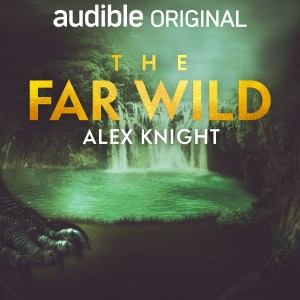 Alex Knight is an author of Fantasy and LitRPG books. His fantasy thriller The Far Wild is out now as an Audible Original, and in this short piece he looks at our fascination with monsters…
As long as humankind has been telling stories, we’ve told tales of monsters. Monsters eating people. Monsters chasing people. Monsters being defeated by people.
But these days, the monsters aren’t always looking so monstrous. Be it books or movies, the monster tales of the modern era have encountered something of a complication: the need to even the odds.
And not in favor of the monsters’ prey, but the monsters themselves.
In prehistoric times, size meant a lot. Be it mammoths competing for mates, or Neanderthals trying not to get eaten by a cave bear, the bigger animal usually prevailed.
But then us pesky humans had to come along and start using tools. Spears equalized things a bit. Bows did a better job. And then we found this little explosive black powder and realized ‘hey, exploding this stuff in a particular direction is pretty useful.’
 Suddenly, writing monster stories got a bit more complex. A cave bear isn’t really that scary when any random character can use a gun powerful enough to blow the engine block out of a car.
It’s for this reason that every monster story set in modern, or near-modern times, has to give an answer to the same question: “why don’t they just shoot the monster?”
I’ve always low key wondered this, but it was a brought to the forefront of my attention when writing my newly released fantasy thriller, The Far Wild. Thinking deeper on this question led me to watching monster movies in a new way.
Monster stories tackle this problem in a variety of ways. Some monsters are bulletproof for any number of reasons. Others can’t be harmed by physical means. Or sometimes, the monsters can be injured by bullets, but the writers just straight up don’t let the characters have guns.
Take a favorite of mine, Michael Crichton’s Jurassic Park. (If you haven’t read it, the book is wonderful and well worth it. But for simplicity’s sake here, I’ll stick to the Spielberg movie.)
The premise of being trapped in a malfunctioning park while dinosaurs run wild is a fun one. (And by fun, of course, I mean mostly terrifying with a side dish of exciting.) It’d be a lot less so, though, if everyone just had assault rifles to mow the dinos down.
Should a park full of multi-ton animals, some of which are apex predators, be equipped with its own personal army? Probably. But it isn’t, and because of that, we get an infinitely more interesting movie.
Instead of little Timmy going full Rambo on the raptors in the kitchen scene, he and Lex must crawl and hide, sneak and run, and ultimately outwit the raptors. Tricking one with the power of reflection, and another by luring it into the walk-in freezer, makes for much more interesting plot, and a more suspenseful scene.
And all the while, as an audience, we grow to like the characters more because they prove they’re clever, brave, and adaptable.
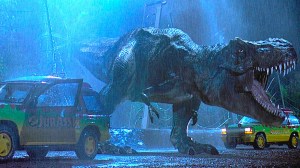 Another perfect scene to demonstrate this is when the tyrannosaur breaks free of its paddock. Could guns have solved that whole scene? Well, maybe. But then we’d miss out on the drawn out, heart-stopping minutes of tension as the tyrannosaur casually traumatizes the trapped characters.
We’d also miss out on Dr. Grant putting his knowledge to use to lure the tyrannosaur away with a flare — or, trying to until Dr. Malcolm botches the idea. Even though it doesn’t work, the characters being forced to get creative makes them, and the story, more interesting.
So in monster stories, why don’t we just shoot the monster?
Well, the simple answer is, it’s boring. The longer answer is when you force characters to rely on ingenuity and creativity, the whole story benefits.
Unless you’re making an action movie, in which case, more guns and explosions are probably a good thing.
The Far Wild is available as an Audible Original now
 Doctor Who News Star Trek News
 Sci-Fi Bulletin: Exploring the Universes of SF, Fantasy, Horror and Spy-fi!