Feature: Reaching the Middle
The Brass God, the third novel in K.M. McKinley’s The Gates of the World book series is out shortly. Magic and technology combine in this epic fantasy, where lost science, […]



The Brass God, the third novel in K.M. McKinley’s The Gates of the World book series is out shortly. Magic and technology combine in this epic fantasy, where lost science, […]
 The Brass God, the third novel in K.M. McKinley’s The Gates of the World book series is out shortly. Magic and technology combine in this epic fantasy, where lost science, giant tides and jealous gods shape the fate of two worlds, and the actions of six siblings may save a universe, or damn it. In this piece, the author discusses the importance of the middle portion of a story…
The Brass God will shortly be upon the shelves. We are at the middle of the story, and middles are interesting places to be.
All tales grow in the telling, the old aphorism goes. Like most sayings, it is true. It’s true when applied to multiple storytellers embroidering a legend over centuries. It’s true for lone writers of modern novels. It’s especially true of fantasy trilogies.
The Gates of the World was, I swear, going to be a trilogy. I had in mind a place of old gods undergoing a magically fuelled industrial revolution. I had a mystery in mind at the heart of the world. I come from a big family, so I wanted it to be about a big family. I wanted to write about female agency in male-dominated societies, which is a fancy way of saying I wanted strong female characters, but I hate that phrase. Characters should be believable, with good and bad in them, weakness and strength. Characters should be people. This story is about people of all kinds.
Three is the fantasy standard. Three is a magic number. Three books could surely accommodate my intent.
 Ahaha. Nope.
Multiple character stories are lots of stories braided together. Every story needs growing room. Lots of stories need lots of room. The Gates of the World unfurled majestically, like a monstrous fern. So three books became five.
Bearing that in mind, perhaps you’re wondering how I can make any sort of claim that books four and five will not swell further.
We’re in the middle, that’s how, that magical place. A middle is a fulcrum, it is the tip in the seesaw. We walk up to the middle, the seesaw swings down, the downward journey is faster. We have crested the hill. At the middle the way ahead becomes clearer. I planned out the last two books to make sure The Brass God was the middle (it felt like the middle, but you can never be sure). Not in meticulous detail, but enough to know that the spreading stories have ceased diverging. The middle is where convergence begins.
I have written a lot of stories. Sometimes I plan them out exactly. Sometimes I have a rough framework. On a couple of notable occasions I’ve set out with nothing but a first line, a few scenes and a destination in mind.
But no matter how precisely your map, narrative routes always change. I liken writing to grabbing a snake by the tail. It whips about wildly as you work your hands up the length of its body. The further your hands crawl, the weaker it struggles. Once you have a snake by the throat (gently, you don’t want to hurt it), it is helpless.
A series of books is a very long snake. Now I’m at the middle I can see into its eyes. It will soon lose the power to bite me. Its lidless glare tells me with certainty that the Gates of the World will be five books, not six or ten or a million, that’s how I know.
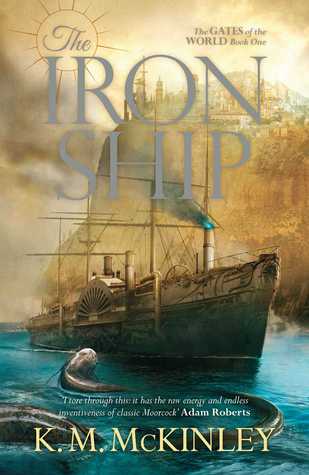
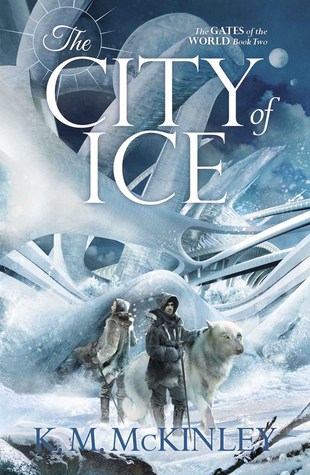 Writing is a process of choices. In the case of the Gates of the World, I decided to focus particular books on particular parts of the story, and that meant characters feature at different times. Some of the arcs, like Aarin’s, for example, are spread evenly across all books. Others required more space. There are six Kressind siblings, and a number of supplementary characters. To take two Kressinds as an example, The City of Ice was very much Garten’s story, whereas Rel who occupied many pages in The Iron Ship was in book two only a little. However, The Brass God returns to Rel and the vast wasteland of the Black Sands. If you want to know what happened to some of your favourite characters from book one, in book three you will find out.
This was a technical choice, a solution, but every solution presents its own problems. I didn’t want to jump around in time. The multiple storylines make it complicated enough already. The events in the story happen chronologically, but a novel is not a chronicle of events. It is an entertainment, and must obey various narrative laws to be entertaining. Matters of pace and tension supersede that of what happens when. That was trickier to pull off than it sounds.
A middle is a place to begin to nudge stories back together, to begin to reveal how seemingly unconnected threads influence each other. At the middle, the streams of narrative have split as far as they’ll go, from there they flow back into a single channel. A few stories become many, become a few, and will ultimately become one.
From many people to one god. Revelations occur at the middle. It is time to pull the sheets from mysteries. You will leave The Brass God with many of your questions answered. Though naturally, there are others answers yet to come.
A story like this is a puzzle as much as anything. In the Gates of the World, the world is the puzzle. At the middle, the solution begins to resolve.
If you write yourself, remember this. There is a beginning and an end. But all stories need a middle.
The Brass God is out on April 5 in the UK from Solaris, and on April 17 in the US.
 Doctor Who News Star Trek News
 Sci-Fi Bulletin: Exploring the Universes of SF, Fantasy, Horror and Spy-fi!