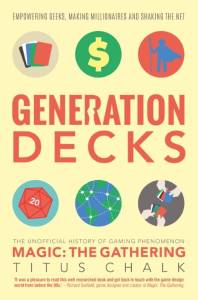
 Titus Chalk, author of Generation Decks: The Unofficial History of Magic: The Gathering shares some of the insights he gleaned whilst writing his first non-fiction book.
When I set out in late 2012 to write the history of the fantasy card game Magic: The Gathering, I really wasn’t quite sure what I was doing. Sure, I had been a journalist for half-a-dozen years, but never tackled anything on the scale of a book before. In fact, it had taken a good two years of the idea gestating in the back of my mind before I dared commit to it. Yes, I had matured as a narrator in that time, newly freelance and discovering my own voice, but it was primarily fear that shocked me into starting, as is so often the case with anything creative. As a friend once observed, artists only do anything once the fear of not doing it outweighs the fear of doing it. In my case, Magic’s fast-approaching twentieth birthday in 2013 focussed my energies. I didn’t want to let the landmark slip by without giving my account of a game I felt had changed not only my life, but the wider world. As I set about my frantic quest, I learned more than a few lessons. Here are some of them, for anyone contemplating their own foray into non-fiction.
Self-publishing can be empowering
By the time I had realised that I had a story I wanted to tell right now, the chances of me finding a traditional publisher seemed non-existent. So, I steeled myself for a challenge: a crack at self-publishing. I must say, the fact that self-publishing was at all possible, felt incredibly empowering and I’m not sure I would have ploughed ahead with the book without it. I was lucky that though out the process, I was able to turn to contacts from my journalism career for help – hiring a graphic designer and sub-editor when required – as well, as asking for informal advice from numerous sources along the way. I’m not sure I would have made it to end of the endeavour without them. Self-publishing, however exciting, is massively difficult and requires such a diverse skill-set, it is not for everyone. Writing a book feels like a marathon. Self-publishing one is more like an ironman triathlon – writing it, producing it and marketing it. It’s not something to be undertaken lightly.
 Non-fiction can be an expensive business
One of the downsides of not finding a publisher to work with at first, was that the costs involved in researching a work of non-fiction added up quickly. I’m lucky to live in Berlin, a notoriously cheap city, otherwise, I’m not sure how I would have been able to finance the book. I worked roughly three weekends a month, did a few bits and bobs of freelance journalism, but spent most of the time from Monday to Friday in the library. It was not an easy balance to achieve. I dug into savings for research trips to the US, to pay my cover designer and sub-editor the going rate for their work – and then I dug even deeper for an expense I hadn’t reckoned with: legal help. One of the big differences between writing non-fiction and fiction, is that you are featuring real people (and in my case a real company). On the advice of a more experienced author, I had my manuscript read by a media lawyer for a cost of around €2000 to make sure I wasn’t going to get sued by anyone for libel. It was an illuminating process and one that helped me release my book with confidence. It also made me sure I was on solid ground when I decided to seek out an agent and traditional publisher later down the line. In all, it was money well spent – but it’s not a cost everyone can bear and I’ve rarely seen it mentioned in advice about self-publishing.
 Get ready for hard work
It should hopefully not come as a surprise to anyone, that writing a book is a lot of hard work. Much of it is extremely fun – for example, if you’re writing on a subject you’re passionate about, even the research can be fun. You get to dig through layers of sediment and unearth priceless treasures like an archaeologist. It’s also a real joy to track down the heroes and villains of your favourite field and to interview them (do it by phone or Skype if you can, the results are nearly always better), especially if they’ve been away from the limelight or were difficult to reach. Be warned though, it takes a lot of time and discipline to organise interviews – and one thing, I didn’t realise was just how long it takes to transcribe them. Sure, I had transcribed numerous interviews in the past. But not as many lengthy interviews as for my book – perhaps 30 or more of them. It is tedious work (and something bigwig authors I’m sure farm out). Worst of all, it takes away from your writing time. It’s best to have no illusions about it – research can be laborious. But when done well it can help you soar on your writing days as the story falls into place on the page in front of you.
 Non-fiction can be incredibly rewarding
Those good days, when you’re steaming ahead towards you goal, feel great – and if you’re as invested in the story you’re telling as I was in Generation Decks, you will be energised by writing non-fiction. In fact, once I had self-published my first crack at the book, I could look at it with enough satisfaction to realise that it stood up as more than just an anniversary story – it was universal enough to have a wider audience. That’s when I began in earnest to search for a home for the book – and to take a further step on my writing journey.
On a personal note, I also benefitted from including memoir in my non-fiction – I needed to say some of the things I included in those sections for my own well-being. And knowing that I could confront certain truths from my past helped me advance as a writer more generally. Digging down into the deeper stuff that we think and feel…that’s really what it’s all about. Airing some of my own laundry has been cathartic and revelatory – and made me want to tackle fiction next. A place to get even closer to the bone.
Generation Decks is out now from Solaris; click here to order from Amazon.co.uk







 Sci-Fi Bulletin: Exploring the Universes of SF, Fantasy, Horror and Spy-fi!